Film Festival Reviews: “Scary Movies XIV” Finds Horror in Bodies, Landscapes, and Ecological Ruin
By Steve Erickson
This strong 2026 lineup ranges from a colonial nightmare in the Kalahari to a Japanese ghost story and Carlos Conceição’s chilling vision of cosmetic obsession amid climate catastrophe.
Scary Movies XIV, Film at Lincoln Center, NYC, August 12 through 20. Full lineup and schedule available at Film at Lincoln Center.
This year’s entries in Lincoln Center’s “Scary Movies” series is a considerable leap up from 2025’s edition. The programmers scoured the globe for five North American premieres, while also reviving Daniel Goldhaber’s Cam, John McNaughton’s Henry: Portrait of a Serial Killer, and Brian Damude’s Sudden Fury. Backrooms and Obsession have confirmed the horror film’s ongoing cultural relevance, even if both left me a little skeptical of their merit. While the films I caught at “Scary Movies XIV” don’t avoid contemporary horror’s pet themes of grief and familial trauma, the best find new ways to express them visually and build on various narrative influences. Although the series is screening in New York, many of its entries will turn up in theaters and on streaming channels down the road.
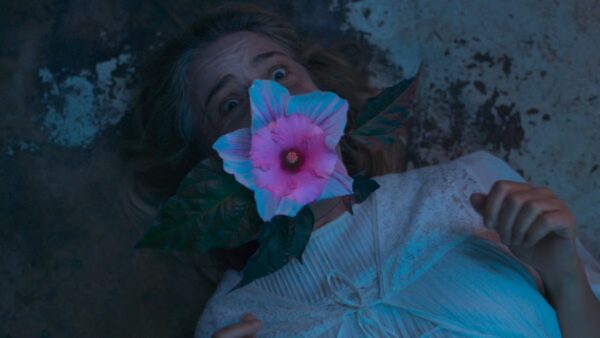
A scene from Raymond St-Jean’s Veins. Photo: Courtesy of “Scary Movies XIV”
The weakest film I saw at “Scary Movies,” Raymond St-Jean’s Veins, gets lost in the narrative’s tangled, menacing forest. When Isabelle (Romane Denis) visits her parents in a rural Quebec town, she realizes something’s gone very wrong. Her mother, Therese (Marie-Thérèse Fortin), acts very oddly, forgetting to tell Isabelle that her father died three days ago. Dr. Toubin (Sylvain Marcel), who moved there recently, holds a mysterious degree of control over the community. The film flashes back two months earlier to reveal the doctor and his wife conducting experiments with plants growing in a nearby forest.
Veins supplies a few gruesome body-horror images, especially for those of us who fear syringes, but the pain of aging is held at a comfortable distance. The plot’s interest in its characters’ lives before Dr. Toubin’s arrival is perfunctory. (Isabelle’s lesbianism serves as nothing but a device to create tension between her and her family.) The proceedings turn toward the predictable once we discover what Dr. Toubin is up to. The screenplay’s three-part structure ends up keeping suspense and mystery at bay. There’s a degree of thematic ambition here, but no urgency whatsoever is generated.
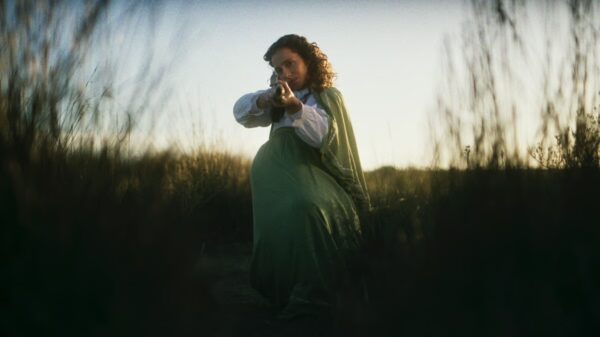
A scene from Meekaaeel Adam’s The Trek. Photo: courtesy of “Scary Movies XIV”
The Trek teleports the Western to 19th-century Africa. Director Meekaaeel Adam worked double duty as its cinematographer. His eloquently empty landscape images imply a subtle threat; the location looks as isolated as it could possibly be. In 1846, a British man, Henry (Rob van Vuuren), and an Afrikaans family—Karel (Morné Visser), his pregnant wife Jakoba (Trix Vivier), and their daughter Carolina (Leah Lindeque)— travel across the Kalahari to begin farming on stolen land. After their horses run away, scared by an accidental rifle shot, they are forced to rely on Atshumao (Maurice Carpede), a Khoen guide whose presence Henry can barely tolerate. As the journey becomes more perilous, they risk dying from starvation and thirst.
The Trek is set in a concrete physical space. Even its most claustrophobic scenes were shot in real locations rather than faked on a set or with CGI. This immersion in reality makes the film all the more unsettling. The European men assume that their view of the world must be smarter and more accurate than Atshumao’s. Although Henry’s villainy is rather overdone, Karel’s complicity in the inevitable violence also emerges. As in The Blair Witch Project, the earth itself turns hostile and confusing. The Trek is infused with a pantheist spirituality that allows the land to speak and even resist colonialism: a ravine becomes a weapon.
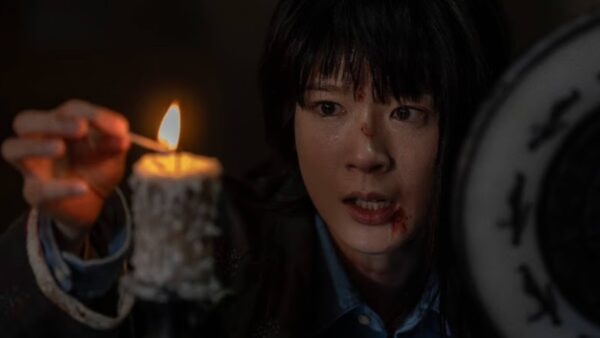
A scene from David Boyle’s Never After Dark. Courtesy of Magnolia Pictures
In Never After Dark, Airi (Moeka Hoshi), a medium hired to investigate a haunted hotel, lives between worlds. (While director David Boyle is American, he made the film in Japan.) She carries on conversations with her late sister, whose ghost she glimpse as a reflection in mirrors. Although she sees her job as aiding troubled spirits in moving on to the afterlife, Airi is haunted by her paranormal abilities. She confesses that she didn’t choose to be a medium. Mirrors and candles are used to establish a passageway into another dimension, and these interactions with paranormal entities come with real. At one point, Airi emerges back at the hotel — bruised.
Never After Dark spends much of its runtime establishing its atmosphere, but that effort lets it break its own rules. Ghosts aren’t safely confined to an alternate universe, and Airi’s subjectivity is highly suspect. Patrick Ouziel’s blue-tinged cinematography conceals the film’s secrets without becomes a staid setup for your standard jump scares. For once, a horror film’s twists are fully earned — this is a successful shake up the formulaic ghost story.
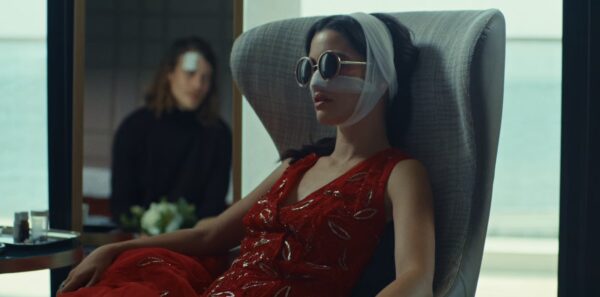
A scene from Carlos Conceição’s Bodyhackers. Photo: Courtesy of “Scary Movies XIV”
Angolan-Portuguese director Carlos Conceição’s Bodyhackers wouldn’t exist without the influence of David Cronenberg, but it transcends mere homage. Set among a populace fully aware of catastrophic climate change, the film dreams up a perverse cult that fetishizes plastic surgery. Dr. Pollard (Elina Löwensohn) is the guru behind a busy clinic. Haunted by his father’s death, activist Denver Blake (McCaul Lombardi) is in the midst of investigating the cosmetic industry when he meets Renée (Joana Ribeiro). She is going through an endless series of operations to finally achieve her idea of perfect beauty.
As in the writings of J.G. Ballard—the subject of a monograph written by the director—and Cronenberg’s Crash, Bodyhackers’ sci-fi patina comes from a perverse rethinking of neurotic psychology. Its characters are dedicated to shutting out the outside world. They can still have an emotional life, but they speak and act as if they’re stuck in a tranquilized daze. Lombardi and Ribeiro’s performances are muted, while Dr. Pollard speaks in cryptic aphorisms, guiding them toward a future they don’t fully understand. Conceição’s first film in English, Bodyhackers establishes a thoroughly convincing mood of panicked disconnection propelled by our bodies’ transformation into commodities and by a looming sense of ecological doom.
Steve Erickson writes about film and music for Gay City News, Slant Magazine, the Nashville Scene, Trouser Press, and other outlets. He also produces electronic music under the tag callinamagician. His latest album, Bells and Whistles, was released in January 2024, and is available to stream here. He presents a biweekly freeform radio show, Radio Not Radio, featuring an eclectic selection of music from around the world.
Tagged: "Bodyhackers", "Cam", "Never After Dark", "The Trek", "Veins", Carlos Conceição, David Boyle, Meekaaeel Adam