
Book Review: Johannes Brahms’s Unwedded Love
By Christina Nellas Acosta
John Worthen’s biography explores the composer’s lifelong devotion to Clara Schumann and its role in shaping his music.
Johannes Brahms by John Worthen. Reaktion Books, 208 pages, $22 (paper).
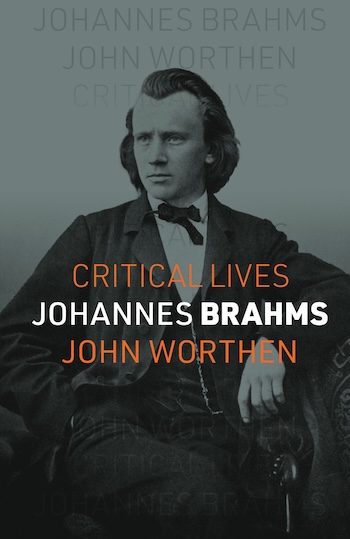 If John Worthen’s latest biographic study had been written as fiction the novelist’s arc from start to finish would draw a sweeping love story, the love of the ever-striving composer Johannes Brahms for the widow and pianist Clara Schumann.
Brahms was the tender age of twenty in 1853 when he presented himself as an aspiring composer, introduced by his friend and violin prodigy Joseph Joachim’s card, to the famous musical couple Robert and Clara Schumann at their Düsseldorf home. Clara was the feted piano virtuoso, strictly trained by her father, pedagogue Friedrich Wieck, who famously tried to forbid their marriage. Heralded by Robert, the established composer, in his now-famous article “Neue Bahnen” (New Paths), Neue Zeitschrift für Musik (1853), and recommended to Schumann’s own publishers, Brahms was on his way to being acknowledged as the new young composer with a “symphonic spirit.” It took another twenty years for his first symphony to appear, however, as many composers at that time were intimidated by the shadow of the great symphonist Beethoven.
Then fate stepped in. Only months after this important introduction, Robert had a mental breakdown, attempted suicide by leaping into the Rhine, and was subsequently and voluntarily hospitalized at an asylum in Endenich, until his death two and a half years later. Brahms rushed to Clara’s side after Schumann’s suicide attempt and, by 1854, was situated in the Schumann household assisting her and her family of seven children. This devastating loss became the life-changing event that attached Brahms to Clara until the end of their lives. He was with her at the asylum on the day Schumann died. Thirteen years older than Brahms, she eventually toured as a celebrated pianist, an absolute necessity for earning her living, though it also meant separation from her children. Brahms remained in Düsseldorf, doing what he could to comfort Clara Schumann and care for the family, so his composing stalled. In 1857, at Clara’s recommendation, he accepted a post in Detmold, where for three-month terms over the next three years he was finally well paid, teaching and conducting the choirs of the ruling Prince of Lippe. There he learned to conduct and to write for voices, skills that helped launch his prolific choral and song output, while he also began his First Piano Concerto.
Worthen gives Brahms’s early years more attention than his later life, arguing that the late period is already well documented. He also revises some contemporary accounts of Brahms’s social temperament, relying instead on later scholars such as Michael Musgrave. Scholarship on Brahms has been abundant since his death, beginning with Florence May’s biography, published less than a decade after 1897; May, one of his piano students, presents him as a teacher who was both exacting and encouraging. Worthen also draws extensively on Johannes Brahms: Life and Letters (Oxford UP, 1997), edited, selected, and translated by Styra Avins, which preserves Brahms’s own voice despite the loss of many letters agreed to by Johannes and Clara for destruction.
Almost at once, Clara Schumann became for the young Brahms both colleague and mentor, opening to him the Schumann library and supplying books, music, and manuscripts. Over the course of his life, he sent her at least eighty-eight of his 122 opus numbers, often inviting her criticism and counsel; she, in turn, championed his work and gave ten of his compositions their first performance. The two spent summers together in the mountains, usually with her children and friends and, at first, his sister in tow, to fend off gossip about an intimacy that was already stirring tongues. Summer became Brahms’s great season of composition, winter the time for revision, spring for travel, all of it lived under the terms of the “vagabond life” he never converted into a settled home. Like Mahler and Beethoven, he found musical stimulus in long walks; Clara, meanwhile, endured grueling months of touring to support herself, yet never ceased urging others to play Brahms, which she regarded as her artistic duty.
Worthen coins the phrase “unwedded marriage” to refer to Brahms’s commitment to love without marriage, the touchstone of his solitary life. A particular Romantic sensibility, Sehnsucht, is marked by the aching intensity of yearning for another, a loneliness that can seem almost glorious, at least to some. This poetic theme comprises nearly the entire repertoire of German art song, a genre that Brahms wrote throughout his life. Just before Clara died, he finished his Four Serious Songs, which, after forty hours of train travel, he brought with him to Clara’s funeral; he insisted on singing the first of these songs to friends in his broken voice at the piano. These are the compositions she would never hear — they are what Worthen calls “his last declaration to Clara.”
Contributing a new biography to the Brahms bibliographic store, Worthen recasts the renowned nineteenth-century composer from the “emotionally distant” stereotype into a man, artist, and genius who, early in life, took up the path to the Schumanns and could never veer from it. He explores the complex psychological makeup of an ambitious composer whose oeuvre spans all music genres, except opera. Brahms’s self-imposed loneliness, self-embraced melancholy, and idiosyncratic choice to be a wanderer were deliberately chosen, he argues, sometimes for the sake of creating music. That said, Brahms was always emotionally bound to Clara — woman, wife, mother, widow, pianist, and composer — a devotee of the ideal female and the “ever unwedding love that is all the same a lifetime’s commitment.” Refreshingly, this illuminating study does not treat Brahms’s pensiveness as a pose, but as a condition he sometimes embraced for inspiring art, that he endured for the sake of “the only woman he ever really loved.”
Christina Nellas Acosta is managing editor of the University of California Press journal 19th-Century Music and a freelance editor for Oxford University Press. She has written book reviews for Open Letters Review, the Historical Novels Review, and the Jane Austen Society of North America Newsletter.