
Book Review: Chronicling a Life of Devotion and Disquiet
By Joan Frank
Michael Klein’s new essay collection weaves brushes with artistic giants into candid meditations on addiction, desire, and survival.
Happiness Ruined Everything: Essays by Michael Klein. Galileo Press, 211 pages, trade paper, $23.
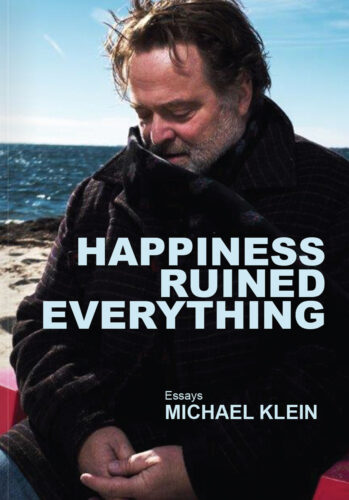 Michael Klein will side-swipe your complacency. An award-winning poet, teacher, and author of two autobiographies, Klein, 71, is also gay, a recovered alcoholic, and a twin: his late twin brother, who was also gay, perished of alcoholism. Klein has worked at a wondrous array of day jobs, including that of intimate caregiver to famous racehorses. He knows music and film (and film scores) and art. He once was willingly duped by, and gave lots of money to, an online scam-lover (who could have been anyone, anywhere) and has written about it with an almost exuberant pitilessness.
All this, and a truckload more, is recounted bluntly, often mesmerizingly, in his new essay collection Happiness Ruined Everything. Googling Klein yields links to interviews with him and blurbs about him (from the likes of Michael Cunningham) that may prompt you to seek other works of his after you’ve absorbed this one. I entered Happiness knowing almost nothing about Klein; moving through its pages, my amazement grew. Dark, disturbing, wry, often wise, it is a strange compendium, melding a bizarre range of experience in tones to match.
Klein has known or brushed shoulders—as student, protégé, pen-pal, or by oblique connection—with bewildering numbers of renowned artists. Prominent among them (and fiercely treasured by him) are the late Adrienne Rich, poet Jean Valentine, composer Stephen Sondheim, [living] poets Nick Flynn and Marie Howe, the late, matchless editor/author William Maxwell; the late Nina Simone—on and on.
Let’s face it: names feature seductively here. Enumerated in the book’s “Table of Devotions,” they weave through the prose like glittering gold thread, whether as anecdote, gossip, literary analysis, or snips of conversation. Maya Angelou, Miles Davis, Louise Glück, Gerald Stern. How many people do you know who can commence a small reminiscence this way: “After we saw Cabaret, we all took the bus up Central Park West with cast members Bert Convy and Joel Grey. Joel Grey lived in our building and gave us the tickets to see him in a musical I imagined was about how good Germans were in bed and what good spies they were.”
Most of these pieces are short (some just a page or two), distilled, and self-contained; their titles are sometimes irresistible (“My Con Man, Mon Amour,” “Airports and Funerals in Sobriety”). If you’re not keen on, say, the cabaret repertoire of singer Dawn Hampton or a dream involving Klein’s husband or policies about extracurricular lovers (or his dog’s death, or certain friends’ deaths by overdose), just page on. At least some of these meditations (or devotions, as he calls them) will spoon-feed you news, or at least a fresh slant, on a subject you happen to be obsessed with or simply curious about.
Take the late, incomparable singer-songwriter Laura Nyro. At the news of her terribly untimely death, at 49 of ovarian cancer in 1997, Klein wrote, “The obituary shocked me…. [I]t wasn’t just the death of a beloved musician I was feeling, but the death of an influence.” When Klein tried to submit a “short devotional” about Nyro to The New Yorker via an agent, someone from the magazine “got back to the agent a few days later and said, ‘I’m sorry, no one here ever heard of Laura Nyro.’”
Soon you’ll be scanning for Klein’s odd, brilliant insights; lines that often stopped me and made me reconsider them. “Every memoir is dangerous when it departs from actual life and enters an imagined life—when the writer … starts to follow a line of mind that personalizes the randomness of living.” Or: “Childhood is the laboratory for making meaning and my sense of meaning was helped by absorbing the images I saw on television, all those old science fiction invasion movies. The alien metaphor wasn’t lost on me because I, too, felt like a stranger in a strange land.” The latter statement appears in “The I at the End of the World,” which characterizes poetry as contemplating living “in a world racing faster to its own death than we are,” folding in a sparkling sampling of artists like Dana Levin, Rainer Maria Rilke, Sharon Olds, William Stafford, Jack Gilbert.
Some material here carries shock potential, but that deliberateness helps readers trust Klein. We never doubt that what’s reported comes from his guts; in fact, Klein seems to trust the dark best. From the paragraph containing the book’s title: “I’m a happy person and a funny person, but I’m not a happy writer or a funny writer. I don’t believe that a piece of writing has to be sad, but it does—at least for me—have to insist on acknowledging a shadow. It has to face something that a good cop would call evidence.”
Mercifully, Klein’s use of self-ironic levity provides refreshment. Cartoonist Lynda Barry, a visiting artist at Goddard College’s low-residency MFA program, enjoyed reminding Klein and the faculty that “Robert Frost’s ‘Stopping by Woods on a Snowy Evening’ scans the same as [the famous song] ‘Hernando’s Hideway’ from the musical The Pajama Game.” One morning she gave Klein an inscribed, painted image (resembling a sort of goblin) inspired by one of his poems—her inscription declaring how she loved his work. Klein longed to become good friends with Barry: alas, she disappeared from his life thereafter. He’s thankful anyway—an attitude emblematic of the kind of whimsical-yet-seasoned discernment that has surely helped keep him afloat. “Her … generosity on a winter morning in Vermont is to me the very meaning of enough.”
Joan Frank‘s latest books are Late Work: A Literary Autobiography of Love, Loss, and What I Was Reading and Juniper Street: a Novel. Her new novella, “Troldhaugen,” appears in the online literary zine Failbetter.