Playwright Interview: “A New Era,” Reconsidered
By Nicole Estvanik Taylor
Playwright Miranda Austen ADEkoje revisits an 1895 gathering of Black women activists, uncovering the tensions, ambitions, and humanity behind a historic coalition.
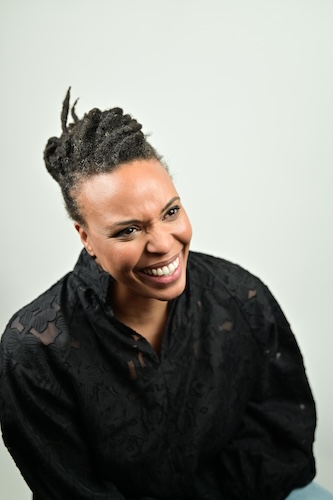
Playwright Miranda Austen ADEkoje. Photo: Annielly Camargo
In July 1895, members of Black women’s clubs from around the country gathered on Beacon Hill for the First National Conference of Colored Women, convened by Josephine St. Pierre Ruffin, founder of the Boston-based Woman’s Era Club. A New Era, Miranda Austen ADEkoje’s new play based on these events, will be produced by Company One July 18–August 8 at Dorchester’s Strand Theatre, directed by Summer L. Williams. It’s no spoiler to note that the weekend dramatized in the play culminated in the formation of what its characters hail as “a national organization of our very own”: the National Federation of Afro-American Women, soon to merge with another group into the National Association of Colored Women. How that coalition would be led, with whom it would ally, and what it would fight for — these are the questions that propel ADEkoje’s script.
The play’s action moves between the Ruffin living room, bustling with domesticity and activism, and the Charles Street Meeting House two blocks away. Five years ago, when ADEkoje began writing A New Era, she expected it would be staged in that same neighborhood. It had been commissioned by local company Plays in Place with funding from the National Parks Service as part of a site-specific series called “Suffrage in Black and White.” But its planned 2025 premiere became a casualty of DOGE-inflicted federal budget cuts. According to ADEkoje, the version of the script that’s receiving its production now became — over the course of a yearlong delay — something different, deeper and more human.
I spoke with ADEkoje about how she found dramatic and personal entry points into a lesser-known chapter of Boston’s history.
The Arts Fuse: How did you research A New Era?
ADEkoje: I visited Josephine St. Pierre Ruffin’s house on Charles Street; there’s a plaque there. And I read a dissertation about her by historian Teresa Blue Holden. But the greatest archival resource I had was the Woman’s Era newsletter, founded by Josephine, her daughter Florida Ruffin Ridley, Victoria Earle Matthews, and a couple of other folks. In rehearsal, we called it “Slow Twitter.” It featured editorials by Black and white women across the country. It was super informative, not only for how these women spoke — at least publicly — but also for how many issues were encapsulated in this amazing period.
AF: What does the Boston link to the story mean to you as someone who grew up here?
ADEkoje: I am at least a third-, at most fourth-generation Bostonian. My roots here go pretty deep. But my personal experience is not as enmeshed. I was a METCO kid, so I was bused to Weston, Massachusetts — a very wealthy suburb — from kindergarten all the way up till I graduated from high school. Then I went to Brown University. After that, I went to London to train as an actor and writer before I came back.
Being educated outside of my city and then coming back as an adult allowed me to be an observer, with a clarity of eye to see what is termed in the play as the snobbery of the North. Josephine was an elite. “Elite” back then wasn’t necessarily about your money but about being able to trace who you are through the generations of your family, and them being free people. There is a lack of awareness on her part, I believe, when she’s talking about uniting with white women for the sake of pushing the anti-lynching agenda, where she’s not recognizing what a different woman’s perspective would be.
Josephine was mixed-race: part African and Indigenous, part English, she had a white mother. Whereas a lot of her colleagues, even though they were mixed-race, were formerly enslaved. Their mixed blood was usually a result of plantation violence and rape. Black women from the South, formerly enslaved, had experienced 30 years of Reconstruction and the positive things that had happened as a result of that. But that was followed by the terror of the Klan and later on Jim Crow. Their experience was to go from being enslaved to seeing what could happen when they were fully recognized as equal citizens, and then to see that going away. The impetus was to go back into their homes and just enjoy the fact that they could live freely with their nuclear families. Whereas up in the North, they had had those freedoms and privileges for longer. Those women were like: “No, we’ve got to go out into the streets like the white suffrage movement is doing. That’s what it takes to make change.” And Southern women weren’t comfortable with that. That’s where the drama is: both parties want the best for the race and the best for their people, but they have very different ways of approaching it.
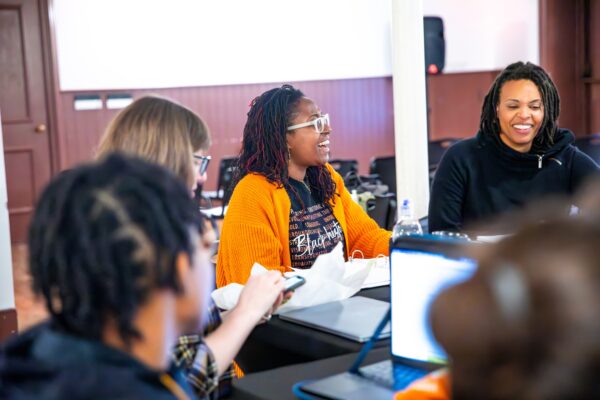
Director Summer L. Williams (center) and playwright Miranda Austen ADEkoje during a rehearsal session for A New Era. Photo: Lauren Miller
AF: The musical Suffs (Arts Fuse review) came through town a few months ago. Something this musical had in common with your play is that so much of the drama comes from tensions within the movement.
ADEkoje: Chronologically, Suffs takes place after my play ends, but Ida B. Wells and Mary Church Terrell are both mentioned in Suffs and in mine. After Ida B. Wells learned three of her friends had been lynched, she made a tour up to the North to tell people what happened. That’s what started most of these Black women’s clubs. She spoke, they acted.
AF: How do you strike the balance between giving your audience historical context and digging into the interpersonal stories you want to tell?
ADEkoje: When I was writing for Plays in Place, the imagined audience was mostly tourists. That iteration of the play did bend more toward just historical facts. But when it was re-taken up by Company One, I felt like I had a license to be more theatrical and bust it open a bit.
For all the arguments that were on the table at the time, the crux of the matter for me is the shared humanity that everybody has. Look at Suffs: there were a lot of things that the suffragists were fighting for that had to do with what our country is about. And yet there was a cohort of formerly enslaved Black women who were watching Black men be lynched by angry white mobs. Who takes precedence there? Which issue is more important, if you’re looking at life through a human lens? Sometimes the arguments can be an excuse for not keeping the main thing as the main thing. As a Black woman, the main thing is being able to live, in dignity, first and foremost.
AF: You have a mother-daughter pair among your cast of mostly historical characters: Josephine and her daughter Florida. How does the theme of motherhood fit into the play?
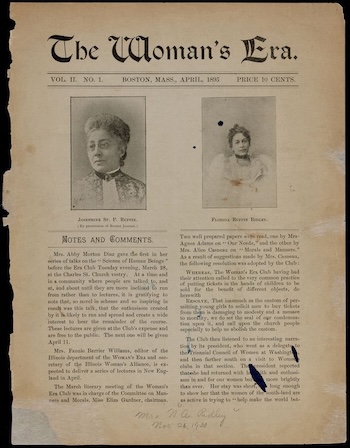
A front page of the Woman’s Era newsletter, featuring photos of Josephine and Florida Ruffin. Photo: Galatea Collection
ADEkoje: There was one little fact about Florida in the dissertation that completely set up her character for me: how she most likely was writing editorials for the Woman’s Era while rocking a baby. Florida’s postpartum, she’s got a three-year-old, she’s brilliant, and she has an opportunity to be at her mom’s house for the weekend because of the conference. I was like: “Oh, got it! I know this woman. I am this woman.” Because I was there when I started writing this. I had a two-year-old who I obviously adore, but I also had a lot of work to do and I was struggling with mom guilt, struggling with resentment that I didn’t have the time. And knowing what it’s like when I go home to where my parents live in Boston, how I become the daughter again — it was just a very human entryway into Florida.
AF: Whose head did you find it most challenging to get inside?
ADEkoje: Anna Julia Cooper. She wrote a book — basically the book on Black femininity and Black female mobilization — called A Voice from the South: By a Black Woman of the South. She is quoted in the back of the U.S. passport. She was one of the first Black women to get a PhD. And she was born enslaved. She was the hardest character to bring to life, because even though her theories and words and ideas are so pervasive in Black thought today, it was hard to find a personal detail about her. A lot of times, as Black Americans, our narratives were either distorted or disremembered. So part of me is like: You lovely clever woman, you knew how the narrative moved, so you made sure that how you were going to be represented in 2026 was with your words only.
What I have to offer is finding parts of all these women that make them full characters for an audience. My first draft was so tied to the words of the women and the newsletter that I couldn’t let them breathe. It was like the play itself was in Victorian clothing. It had the undergarments, the corset, the outer garment, it was buttoned up, you know? Being in the rehearsal room and realizing that these women’s humanity is going to be the access point — that’s what really got rounded out when the words came out of real mouths.
AF: How else has the rehearsal process helped bring the play into focus for you?
ADEkoje: Our dramaturg, Lizzie Cooper Davis, wanted to make a timeline that marked all the milestones of all the characters and also the actors: when they were born, when they went to school, when they got married, all that. The passing of the Constitutional amendments was on it. The discussion around that was so interesting because I came to the realization that these women would have known the words of the 14th Amendment.
Do you know what the 14th Amendment says, exactly? I didn’t. It’s talked about all the time, especially now with what’s going on in the Supreme Court, and yet very few of us know what the text of the 14th Amendment actually says, unless we’re constitutional lawyers. Whereas these women knew those words. Why? Because when they came out, they were published everywhere. Anybody who was an American could read that and be like: “OK, this applies to me.” There’s a scene now in the play where Florida says to Josephine, ‘You made us memorize the 14th Amendment,’ and the women recite it. These words were sacred.
Nicole Estvanik Taylor is a freelance writer and editor based in the Boston area. The former managing editor of American Theatre magazine as well as former content director of the MIT Alumni Association, she has written about the arts, culture, science, and other topics for publications including NPR, the Boston Globe, Science Friday, Edible Boston, TheatreForum, Theatre World, and the alumni magazines of several universities.
Tagged: "A New Era", Lizzy Cooper Davis, Miranda Austen ADEkoje