
Film Review: Alex Cox’s “Dead Souls” Recasts Gogol as a Spaghetti Western Fever Dream
By Betsy Sherman
The punk auteur’s late-career swan song is ragged, witty, and politically sharpened, though not always as cohesive as its ambitions.
Dead Souls – Directed by Alex Cox. Playing at The Brattle Theatre, Cambridge, on July 31 at 9 p.m., August 1 at 2 & 9 p.m., August 2 at 8:30 p.m. and August 3 at 10 p.m. The Brattle will also show Alex Cox’s 1987 spaghetti Western spoof Straight to Hell (with Joe Strummer, Courtney Love, and Sy Richardson) on August 1 at noon.
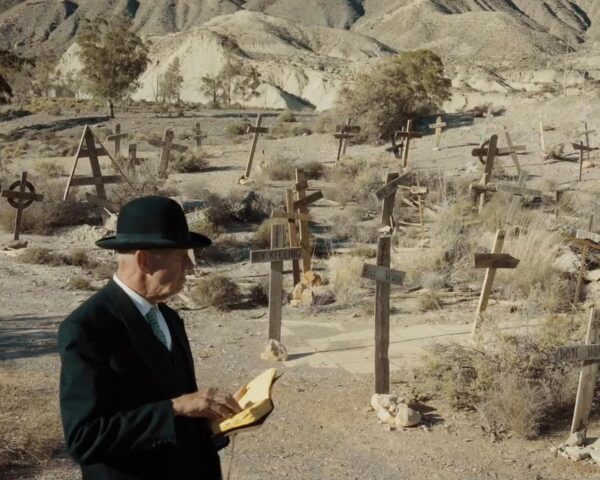
Alex Cox in Dead Souls. Photo: courtesy of the Brattle Theatre
I first heard of Nikolai Gogol’s novel Dead Souls in a 1975 Playboy interview with Mel Brooks. My idol Mel said it was a masterpiece, so I read it and happily went on to Gogol’s absurdist short stories, including The Nose and The Overcoat. The 19th-century Russian satirist is a favorite of Brooks’s (“Comedy and humanity, and he knew what he was talking about”), and an influence. Does this mean that Blazing Saddles is a little bit of an antecedent for British director Alex Cox’s setting his loose adaptation of Dead Souls in America’s Old West? As a comedy, Cox’s movie is more chuckle-funny than Blazing Saddles lose-your-shit-funny. But like the Brooks movie, it lampoons greed on the old frontier and indicts the deadly callousness of white settler society toward people who don’t look or speak like them.
In that respect, it will please fans of the director-writer, who began his career with the punk splendor of Repo Man and Sid & Nancy. Cox, now 71 years old, made the lovely late-career gesture of casting himself as the protagonist, a version of Gogol’s weaselly Chichikov. He’s delightful in the role. But the production as a whole may be too disjointed to win over viewers who like their movies more, well, jointed.
This crowd-funded project — publicized as Cox’s last film as director — transplants Gogol’s 1842 story into the world of the spaghetti Westerns the director loves so well (he wrote a book about the genre, 10,000 Ways to Die). In the Russian tale, a former bureaucrat bargains with landowners to sell him the names of their deceased serfs who are still on the census rolls as alive. Why, no one knows, not even readers, until a late chapter. The novel contains a panoply of vividly drawn supporting characters, as Gogol skewers bureaucracy, noxious trends from France, and Russia’s waste of talent and natural resources.
The film takes place in 1890 in the American Southwest. A man in a black suit and bowler hat strides across the arid landscape, examining a cemetery before he enters a border town with Western-movie trimmings. Named Strindler, he’s inquisitive and affable as he makes the acquaintance of the “big cheeses”: the mayor, the sheriff, the mine owner, and the major rancher in the area (along with his adult daughter). A buzz goes around about the stranger’s odd request: he asks people about “their” Mexican laborers, and offers cash for the names, ages, and birthplaces of the dead ones. His spiel varies by target. To one he claims to work for the US government, another the Mexican government, another a funeral business, and to others he poses as a clergyman.
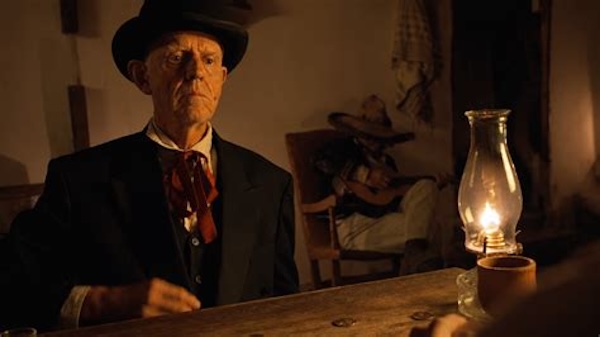
Alex Cox in in Dead Souls. Photo: courtesy of the Brattle Theatre
The harmless-looking Strindler finds himself challenged to a shootout, to take place in the morning. To avoid death, the stranger takes advantage of tensions over the law-enforcement killing of one of “the Zamora brothers” and that Mexican family’s wish for revenge. There are funny bits, such as the town doctor’s kids being hooked on a “temperance” beverage containing coca leaves and cola nuts. The standout supporting turn comes from Zander Schloss (one of many Cox regulars) as the town drunk who chauffeurs Strindler in a wagon. He’s an Anglo fittingly nicknamed Borracho (Spanish for drunkard).
Much of Dead Souls was shot in Almeria, Spain, the location for many European Westerns. The later scenes were shot by a different crew in Mescal, Arizona. Saguaros enhance the beauty of this landscape. Cox co-wrote the screenplay with legendary Italian spaghetti-Western actor Gianni Garko. Most characters are counterparts to characters in the novel, but in a Yosemite Sam cartoonish way (there are prize fake mustaches and muttonchops, and the sheriff has metal teeth). The original score by Dan Wool has the spaghetti feel, and song choices include a parody of “The Yellow Rose of Texas” and a “Streets of Laredo” number led by bombshell Sarah Vista, who plays a widow convinced that Strindler has cheated her. Movie references abound, and do I detect the articulation of John Huston in Cox’s adopted American accent?
In the wake of politically conscious Cox films like Walker (1987) — in which the mercenary activities of William Walker (name-checked in Dead Souls) in Central America pointed toward those of the Reagan administration — the director connects his story, real American history, and current headlines. For example, the repetition of the phrase “dead Mexicans” and the practice of deporting live ones back to Mexico conjure up the dehumanizing policies of Trump and Stephen Miller. The character of John H. Behan, with whom the “Reverend” Strindler meets in El Paso, Texas, is a real-life figure who also appeared in Cox’s Tombstone Rashomon (2015), both times played by Jesse Lee Pacheco. In the previous movie he was a sheriff; in Dead Souls, as was true, he works as a Chinese Exclusion Inspector, hunting down and removing Chinese workers. Swerving into the conspiracy-theory lane, there’s a surprising sequence that I wouldn’t dream of spoiling.
The picture ends with an assertion of identity. Alex Cox is back, and this is a good time for adventurous moviegoers to pay homage to the punk elder who has survived to where he can name in advance his own swan song.
Betsy Sherman has written about movies, old and new, for The Boston Globe, The Boston Phoenix, and The Improper Bostonian, among others. She holds a degree in archives management from Simmons Graduate School of Library and Information Science. When she grows up, she wants to be Barbara Stanwyck.
1 Comment
Leave a Comment

Terrific review of DEAD SOULS well written and researched with great references