
Theater Review: “Black Swan” — Beauty, Madness, and a Misguided Musical
By Martin Copenhaver
Despite striking choreography and a tour-de-force lead, the A.R.T.’s adaptation of Black Swan can’t escape the film’s excesses — or its own thin score.
Black Swan. Book by Jen Silverman. Music, lyrics, and orchestrations by Dave Malloy. Music supervision and direction by Or Matias, with additional arrangements by Matias. Directed and choreographed by Sonya Tayeh. Based on the Searchlight Pictures film Black Swan, story by Andrés Heinz. Staged by the American Repertory Theater at the Loeb Drama Center, 64 Brattle Street, Cambridge, through July 12.
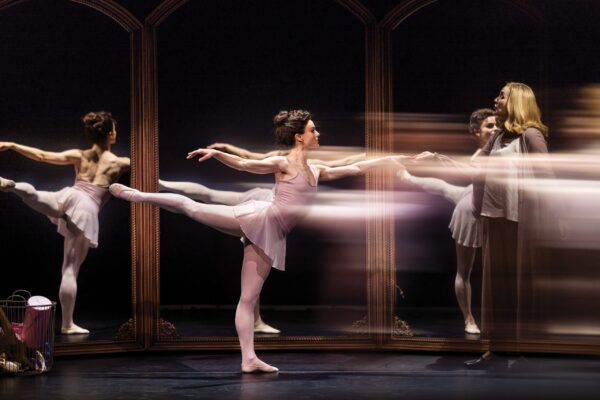
Melanie Moore and Kate Jennings Grant in the American Repertory Theater production of Black Swan. Photo: Hawver and Hall
Black Swan begins with a dance solo by the main character, Nina (played by Melanie Moore), on an otherwise empty stage. Bathed in soft light and the lush music of Tchaikovsky, she moves with exquisite grace. She is, in a word, perfect. And that’s a problem, because, as the harsh light of the rest of the play makes clear, the pursuit of perfection is not pretty. In the case of someone who aspires to be a prima ballerina, it includes binding feet in excruciating pointe shoes and taking unhealthy measures to stay thin, often leading to eating disorders. She must also endure the backbiting and snappish mockery that pollutes the competition with fellow dancers. Then, in the case of Nina, whose ambition is to play the lead in Swan Lake, the most devastating toll is psychosis. She sees people who are not there and imagines horrifying scenes that only she can see.
I should confess up front that I am not a fan of the film version of Black Swan, upon which this musical is based. Natalie Portman, as Nina, portrays the nightmarish existence of a person dealing with psychosis so believably that, as a viewer, I wanted to say, “Can we just stop the movie right now and get this woman some help?” No one would choose the life of a psychotic, so why would any of us want to inhabit the experience of a psychotic, even for a couple of agonizing hours? Worse still, the premise of the film is an over-the-top version of the tired trope of the suffering artist, as if great suffering is the sign and seal of great art. Unfortunately, these themes and characteristics are inherited by the new musical.
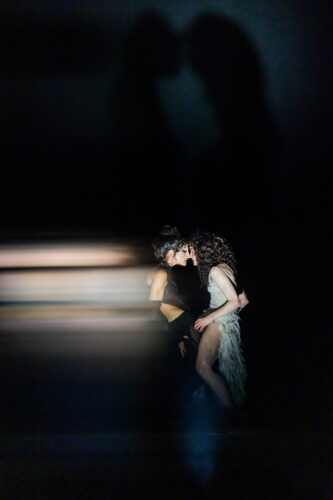
Ida Saki and Melanie Moore in the American Repertory Theater production of Black Swan.
Photo: Hawver and Hall
For much of the first act, this stage version avoids, or at least gives less emphasis to, the excesses of the film. One welcome change is that, in this version, the character of the choreographer is no longer a creepy, exploitative male. Instead, the role is played by a powerful Black woman (wonderfully played by Amber Iman). She is exacting and demanding, to be sure, but in a straightforward way. One might cower in her presence, but one does not feel the need to take a shower after encountering her.
The first act introduces us to the main characters. In addition to Nina, there is the older prima ballerina, Beth (Tory Trowbridge), who is being passed over for the lead role in Swan Lake and responds with self-destructive rage. Nina’s understudy and love interest, Lily (an outstanding Jada Simone Clark), also aspires to the lead role and will do almost anything to land it — a complex mix that, I would argue, makes her the most interesting character in the show. Nina’s mother, Barbara (played by the understudy, Mehry Eslaminia), takes every opportunity to remind Nina that she gave up her own promising career as a dancer to raise her. It is another trope, this time of the stage mother who is ambitious for her daughter to make up for her own stunted dreams. (The brilliant prototype is Mama Rose in Gypsy. Not sure we need another one.) It is easy to understand why Nina is annoyed by her because she is annoying to us, as well.
Although a sense of foreboding hangs over the first act, the mood is not yet pitch-black. There is even a bit of humor, something that is totally lacking in the film.
The second act turns up the volume, in both a literal and figurative sense, as Nina descends further and further into the morass of madness. Another character, Doppel (Nina’s doppelganger, played by Ida Saki), takes on increasing prominence as Nina’s grip on reality continues to loosen. At points, the special effects that portray Nina’s delusions are as spectacular as one might see at a Vegas magic show.
The music also becomes more strident in the second act. In one song, Nina sings about scratching herself as a form of self-mutilation. She continually repeats the phrase, “I feel you scratching in my head” in a way that is so nails-on-the-chalkboard unpleasant that I had to resist the impulse to cover my ears in self-protection.

Melanie Moore in the American Repertory Theater production of Black Swan. Photo: Hawver and Hall
Perhaps gratefully, most of the music (by Dave Malloy, who also wrote the lyrics) is rather bland and unremarkable. The songs neither advance the plot nor comment meaningfully on it. It is not clear why anyone would decide to make Black Swan a musical, except, perhaps, they thought music would ease the transition to the stage. I can only speculate on their motivations. What I can say is that the songs do not add much to the production.
The same is not true of the dance (choreographed by Sonya Tayeh, who also directed). It is beautifully staged and, in some instances, helps tell the story most powerfully. For instance, the romantic encounter between Nina and Lily is told through dance, which is both fitting and effective.
Melanie Moore gives a bravura performance as Nina. Her dancing is graceful, commanding, and, to my untrained eye, technically flawless. Her acting is both believable and affecting. And, completing this theatrical triathlon, she sings beautifully. Add to that, she also exhibits great endurance in a role that is incredibly demanding physically.
I don’t think I am “burying the lead” by saving my praise for Moore until the end of this review. Instead, unfortunately, it is the show itself that buries the lead, that is Moore, with a production that is not worthy of her talents.
Martin B. Copenhaver is a retired pastor and seminary president who lives in Woodstock, Vermont, and Cambridge. Once upon a time, he studied theater criticism with Stanley Kauffmann.
Tagged: Amber Iman, American Repertory Theater, Black Swan, Dave Malloy, Ida Saki, Jada Simone Clark, Melanie Moore
4 Comments
Leave a Comment

It’s lede, not lead, but i agree that music was bland and Nina was terrific.
The reason for making it into a musical is to bring it to Broadway.
I agree completely with Mr. Copenhaver. Technically flawless and performed by a fine cast, the music is without distinction and the show, on the whole, is unnecessary.
Mr Copenhaver, retired pastor and former student of Stanley Kauffmann and trope-fixated reviewer, is 180 degrees off base. The exhilaration of the production as dance, the brilliant lighting, the universality of the theme (controlling/hiding the darkness in each of us) is missed entirely. At best he gives a lukewarm acknowledgment at the end of his review. Which perhaps should have been buried along with his missed lede.