
Visual Arts Review: “Where’s Boston? 50 Years Later” — A City in Focus
By Lauren Kaufmann
Constantine Manos’s bicentennial-era photographs capture a city divided, resilient, and still recognizable half a century later.
Where’s Boston? 50 Years Later at the Boston Athenaeum. On view through December 12.
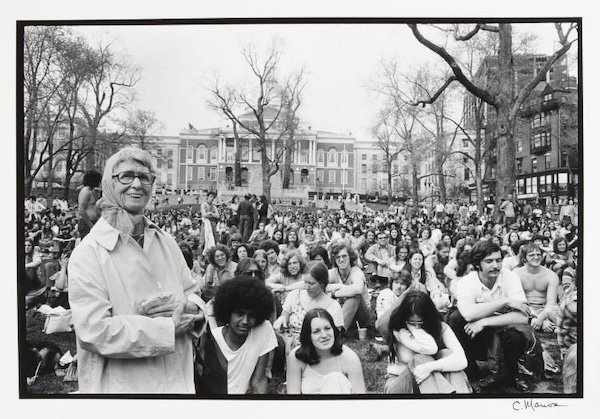
Constantine Manos, Crowd Gathered on Boston Common, [1976?]. Photo: courtesy of the Boston Athenaeum.
Where’s Boston? 50 Years Later at the Boston Athenaeum reconsiders a collection of photographs from a 1976 bicentennial exhibition. The pictures reveal the complex nature of the city’s personality—its diverse neighborhoods, public spaces, and cultural institutions–offering an opportunity to reflect back on the past five decades.
The majority of the photographs were taken by Constantine Manos (1934-2025), a photojournalist who grew up in South Carolina, where he began taking pictures at the age of 13. While in college in South Carolina, Manos wrote articles expressing his opposition to racial segregation, a sign of his personal politics. By the time he was 19 years old, Manos had moved to Boston, where he became the official photographer for the Boston Symphony Orchestra, a position that firmly established his credentials. In 1963, Manos joined Magnum Photos, the international photography collective.
In 1974, Manos embarked on a project aimed at capturing the varied faces and spaces of Boston for the upcoming bicentennial celebration. He set out to visit as many neighborhoods as possible to document the people and public places that make Boston distinctive. Reflecting on his Where’s Boston? series, Manos said: “I went into every neighborhood in the city of Boston and found them all to be rich in variety and in humanity. The people were great and helpful everywhere I went . . . My wish is that seeing these pictures will help them to better understand each other and their city.”
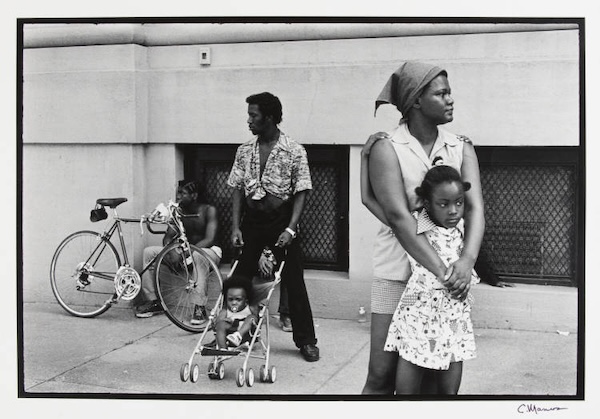
Constantine Manos, Street Scene along Parade Route, South Boston, 1976. Photo: courtesy of the Boston Athenaeum.
The original Where’s Boston? exhibition was comprised of a slideshow made up of 3,000 slides that were projected on eight screens outside the Prudential Center. Built in 1964, the Pru was a symbol of the ‘new Boston.’ The slideshow images were shot by Manos and fourteen other local photographers. Interspersed with the images were hundreds of recorded oral histories of public figures and everyday Bostonians. The current exhibit at the Boston Athenaeum features a slide machine with some of the photographs that appeared in the original exhibition in 1976.
In addition to the slideshow, 154 of Manos’s photos were enlarged and attached to the outside of the pavilion in front of the Pru. The current exhibit includes two photographs by local photographer Steve Rosenthal that show Manos’s photos on the pavilion. The original Where’s Boston? exhibition was installed in June 1975 and remained there until January 1978, when the infamous blizzard forced its relocation to a theater near Faneuil Hall.
Curator Lauren Graves says that in 2020, the Boston Athenaeum acquired 40 of the photos, with the intention of showing them in 2026. There are 53 images on display; 13 are on loan. In some cases, new prints were made from the original negatives. Graves notes that Manos was meticulous about printing his own photographs, and so, the Athenaeum took great pains to reproduce them with the utmost care.
It’s essential to consider the historical context of the original project; Manos undertook the assignment at a time of great tension and division in Boston. The school busing crisis had begun in 1974 and ignited racial protests and riots throughout the city. In an effort to integrate Boston’s schools, Judge Arthur Garrity Jr. had laid out a plan requiring school children to be bussed from predominantly black and white neighborhoods. The plan led to violence in the streets, a decline in public school enrollment, and white flight to the suburbs. It was during this tumultuous time that Manos photographed the city’s neighborhoods.
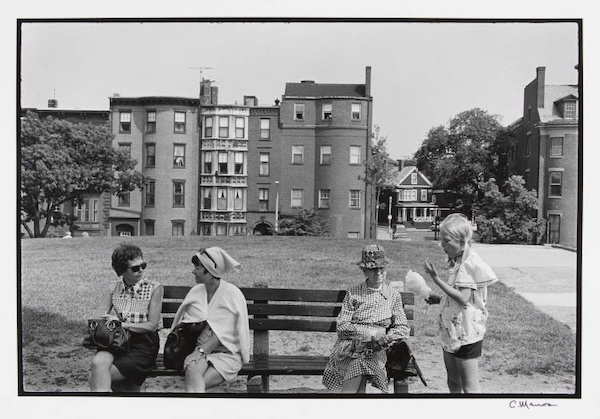
Constantine Manos, Sunday Afternoon on Monument Hill, Charlestown, 1976. Photo: courtesy of the Boston Athenaeum.
It is a testament to Manos and to the people of Boston that he captured so many positive aspects of the city’s communities, and that he was so impressed by the warmth and generosity of the people whom he photographed. This project serves as witness to the enduring spirit of the city during a time of great upheaval.
Looking at Manos’s photographs reminds me of the work of French photographer Henri Cartier-Bresson, a pioneer of street photography, whose pictures were celebrated for embodying the ‘decisive moment.’ Commenting on his technique, Cartier-Bresson once said, “Oop! The Moment! Once you miss it, it is gone forever.” To capture that moment, Cartier-Bresson waited to shoot until the exact instant when the visual elements all came together to form what he considered to be the perfect image. Cartier-Bresson photographed Parisians going about their everyday lives, framing his images of their doings with a keen sense of design. Whether the resonances are deliberate or not, Manos seems to have embraced that strategy, and the results are striking.
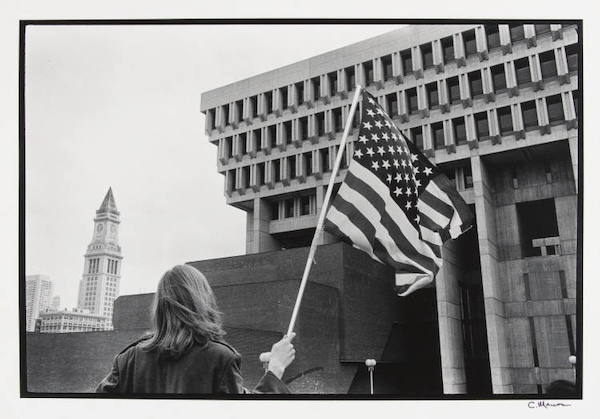
Constantine Manos, Demonstrator in front of City Hall, Government Center, 1976. Photo: courtesy of the Boston Athenaeum.
Many of Manos’s photographs for Where’s Boston? explore the fine line between patriotism and protest. The American flag is a recurrent motif, serving as a visual sign of division, belonging, and identity within the city. The flag appears in a variety of settings, at parades and protests. As our present-day demonstrations attest, patriotism and dissent go hand-in-hand in the United States. Standing up for our First Amendment rights propels many to gather together. In Demonstrator at City Hall, Manos captures a quiet moment—a lone protester holding an American flag outside of City Hall Plaza, with the Custom House Tower looming in the background. It’s a simple, yet strong, image, dramatizing the tension between government and citizenry, authority and resistance, belonging and exclusion.
The exhibit features a number of photographs depicting protests and parades, but there are also delightful images of everyday life around the city—people gathering on a park bench in the Boston Garden, children playing outdoors in the North End, a couple lounging on the beach on Castle Island, a waitress and diners at Durgin Park.
Manos’s photographs limn a particular time and place: Boston in the mid-’70s. If you consider the changes that have taken place since then, you realize how much the urban landscape has been physically altered. The Rose Kennedy Greenway now replaces the elevated I-93 highway that once bisected downtown Boston, removed as part of the “Big Dig” project. The South End has been gentrified; it is now filled with tony shops and restaurants. The Seaport, now bustling with technology and innovation, doesn’t appear in Manos’s work at all. Back then, it was just vacant wharves and empty parking lots. Most people had little reason to venture to the Seaport in the ’70s. That said, despite the changes, many of the city’s landmark sites in his photographs are still standing strong: the Boston Common, the Public Garden, City Hall Plaza, and the Museum of Fine Arts.
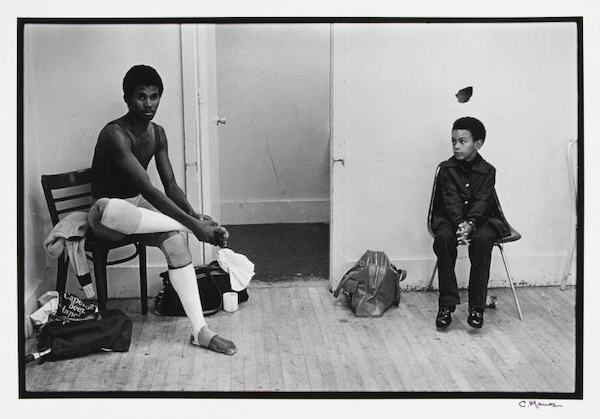
Constantine Manos, Dancer and Admirer at Rehearsal, Elma Lewis School, [1976?]. Photo: courtesy of the Boston Athenaeum.
Lauren Kaufmann has worked in the museum field for the past 14 years and has curated a number of exhibitions.
Tagged: "Where’s Boston? 50 Years Later ", Boston, Boston Athenaeum
5 Comments
Leave a Comment

A lovely, thorough piece on an exhibit that seems to beautifully capture a pivotal time in Boston’s history. Well done.
Thanks, Karen. I hope you get in to see the exhibit! It’s really special.
An article worth reading not only as a reminder that everything old is new again – vis-a-vis our struggle to maintain the health of our Republic, but also educational. My new word for today, “limn.” Thank you Lauren!
I am sure the writer of the review and even the Boston Athenaeum curator of the exhibit are well-intentioned, but I was around for the Where’s Boston? experience in 1976, and what has been described is not what was presented. In fact, I visited the exhibit twice. This was one of the first thoughtfully created, extensive multimedia exhibits/experiences in a formal institutional setting. This was more a mega happening than an exhibit. It was a celebration of the city and its history and progress. The viewer came out of it reacting to the visual effects, the intensity, and the rapid interplay of images and the sense of place established by the designers (Cambridge Seven Architects and graphic design master Ivan Chermayeff).
The photographs just were not memorable. For his part, Panos was a pretty pedestrian photographer. His work had none of the street-smart impact of a Weegee or Henri Cartier-Bresson. There was no Stanley Foreman Pulitzer Prize–winning iconic brilliance. His architectural backgrounds did not underscore the scale, history, or much of the beauty of Steven Rosenthal’s or Peter Vanderwarker’s award-winning and often romantic architectural portraiture. Two of his best photographs are used to illustrate Lauren’s article. No “wow.”
I guess my complaint about this current exhibit is that it is attempting, in a somewhat awkward way, to put in a present-day context something that was done 50 years ago without understanding that making a thematic point is not just a “then and now” comparison. It is much more. Fifty years ago, Boston was a very tribal place with all of the negativity that that entailed. Today, there are aspects of that, with even more recognition of inequality and problems with social justice. As Lauren suggests, despite all of Boston’s flaws throughout the decades, we can still love the city, including its imperfections. Our City on a Hill needs to be continued to be celebrated just as was attempted in 1976. This Boston Athenaeum exhibit just doesn’t do it justice.
What about Rusty Russell???
What about Comcorp inc.