
Arts Feature: The Museum of Modern Renaissance — The Urgency of Preserving a Living Work of Art
By Nicholas Shaplyko and Ekaterina Sorokina
We need to sustain the place where the Muses live — Somerville’s Museum of Modern Renaissance.
Museum of Modern Renaissance, 115 College Avenue, Somerville, Massachusetts 3D Virtual Tour
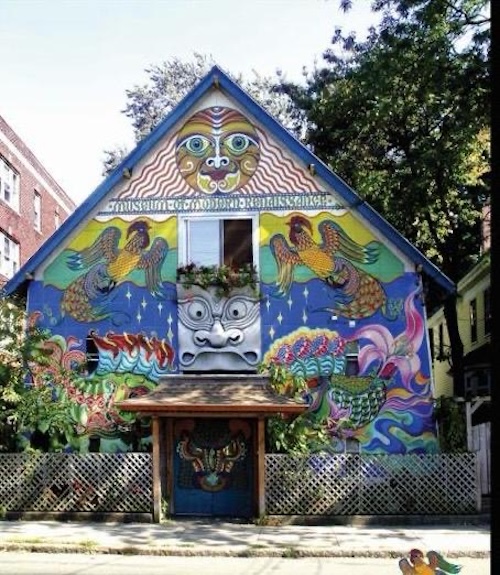
The Museum of Modern Renaissance. Photo: courtesy of the Museum of Modern Renaissance
Twenty-five years ago, we made a promise we had no logical right to make. We said we would create a Temple of Art. And that promise has become a place.
We called it a museum because we believed the Muses should be alive. We called it a Renaissance because imagination and humanity must continually be born again. We called it Modern because this responsibility belongs not to the past, but to our own century.
A museum is a message sent into the future. We have spent our lives writing this message in paint, architecture, sculpture, music, labor, and faith.
Now we are asking whether the future is willing to receive it.
In December 2002, we stood inside a former church in Somerville with the keys in our hands and made a promise that, at the time, had almost no practical logic behind it.
We had no institutional sponsor, no preservation fund, no curatorial committee, and no guarantee that anyone would understand what we intended to create. We were immigrant artists who had already spent years building a collaborative life in the United States. What we did have was a conviction: art could be more than an object placed inside a room. It could become the room, the architecture, the atmosphere, and the life that unfolds within it.
Nearly 25 years later, that promise has become the Museum of Modern Renaissance.
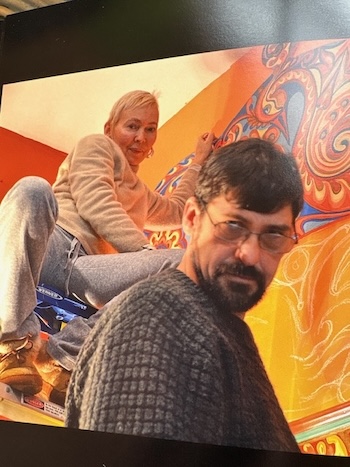
Ekaterina Sorokina and Nicholas Shaplyko working directly on the painted environment at architectural scale. Photo: courtesy of the Museum of Modern Renaissance
The building was completed in 1910 as the Second Unitarian Church, also known as the West Somerville Unitarian Church. In later decades, it served other community and fraternal organizations, including the Independent Order of Odd Fellows and a Masonic lodge. Each group left a layer of history behind. When we acquired the property in 2002, we did not see those earlier identities as something to erase. We saw a structure that had repeatedly gathered people around shared ideas, ritual, education, culture, and fellowship.
Our task was to give that history a new artistic life.
Since 2002, we have transformed all three levels of the building into one continuously evolving artist-created environment. Monumental paintings cover walls, ceilings, vaults, beams, stairways, passages, domestic rooms, and spaces of gathering. Sculpture, relief, furnishings, light, sound, music, and human movement all participate in the composition.
The Museum is therefore not a conventional museum in which individual works are displayed inside a neutral container. The building itself has become the principal work of art.
This distinction is essential. A painting can usually be removed from one wall and placed on another. The Museum of Modern Renaissance cannot be understood that way. Its meaning lies in the relationships among architecture, image, sequence, scale, sound, and bodily experience. A visitor does not simply look at the work. A visitor moves through it.
The Main Hall is the largest and most public expression of this idea. Its vaulted interior contains a monumental cycle we call “Creation of the World,” composed of 57 interconnected painted worlds. The imagery moves through cosmology, mythology, spiritual symbolism, memory, nature, human struggle, transformation, and rebirth. The painted ceiling is not an illustration placed above the room. It changes the room’s gravity. It turns architecture into a visual universe.
The artistic language continues beyond the Main Hall. It enters stairwells, corridors, the library, contemplative rooms, gathering spaces, the kitchen, and the conservatory. Some spaces are ceremonial; others remain domestic. That continuity matters to us. We did not want art to exist only where visitors expected to find it. We wanted it to enter ordinary life and to make the border between art and living increasingly difficult to locate.
Our collaborative process is equally inseparable from the environment. We have worked together for nearly four decades, and on the Museum we have often painted directly at architectural scale without completed preliminary sketches. One of us may begin a form, the other may alter its direction, and then both of us continue until the composition acquires a logic neither of us could have planned alone.
There was no production line and no division between concept and execution. We lived inside the work as we made it. The Museum became our home, studio, theater, library, sanctuary, and laboratory. The years of labor are visible not only in the finished imagery but also in the accumulation of decisions, revisions, risks, mistakes, discoveries, and physical endurance.
The name Museum of Modern Renaissance was never intended as branding. It was a compressed statement of purpose.
A museum, in its ancient sense, was a place of the Muses. We imagined a place where the Muses might still live—not as names from mythology, but as active creative forces. History, poetry, music, tragedy, comedy, sacred contemplation, dance, and astronomy have all entered the building in literal ways.
Since 2005, the Main Hall has hosted chamber concerts, opera singers, instrumentalists, writers, filmmakers, photographers, lectures, conversations, yoga, meditation, and intimate cultural gatherings. A singer’s voice reveals dimensions of the room that cannot be seen. A poem changes the way visitors read a mural. A meditation changes the quality of silence. A performance leaves no physical mark, yet it becomes part of the memory of the architecture.
That is why we describe the Museum as living. It is not finished in the sense of being sealed off from time. The environment remains active because people continue to enter it and bring their own forms of attention, creativity, and experience.
“Renaissance” means rebirth. For us, it does not mean imitating the style of another century. It means insisting that beauty, imagination, compassion, spiritual inquiry, and artistic commitment must be born again in each generation.
“Modern” means that this responsibility belongs to the present. The Museum is not a reconstruction of a lost historical world. It is a contemporary response to the question of whether total artistic commitment can still exist now.
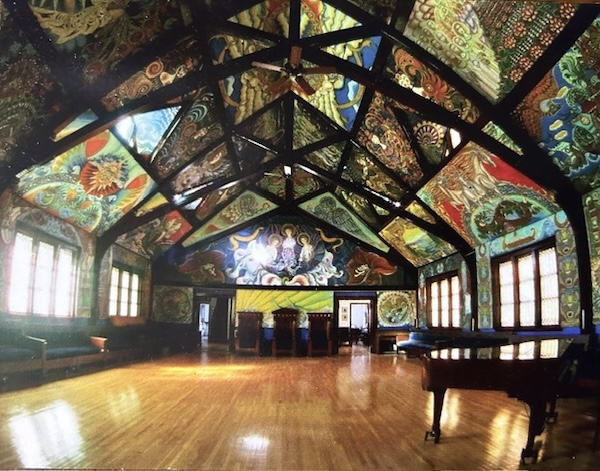
The Main Hall of the Museum of Modern Renaissance. Its vaulted interior forms the central monumental cycle, “Creation of the World.” Photo: courtesy of the Museum of Modern Renaissance
The Sistine Chapel has remained an important point of departure for us, not as an image to copy, but as a standard of artistic unity. Michelangelo’s work demonstrates that monumental painting, architecture, spiritual narrative, physical labor, and human presence can become one inseparable experience. Our response has been a dialogue across centuries: not imitation, but an attempt to ask whether artists today can still devote decades of life to a single environment.
The Museum also contains Christian, Buddhist, Hindu, mythological, philosophical, and cosmological imagery. It is not affiliated with a single religion and does not attempt to merge different traditions into a new doctrine. Instead, it allows images from different cultural and spiritual histories to coexist within one artistic field. Compassion, creation, destruction, rebirth, dignity, and humanity’s responsibility toward the world recur in many forms.
People respond to the Museum in radically different ways. Some are overwhelmed by the density of color and symbol. Some immediately begin asking how much time, money, and labor the project consumed. Others become quiet. They tell us that the rooms allow them to speak with themselves, or that something from the subconscious has moved outside the body and become visible.
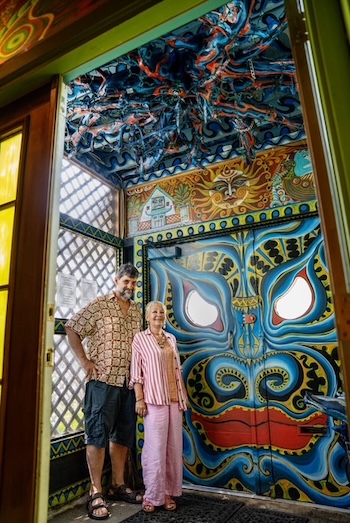
Ekaterina Sorokina and Nicholas Shaplyko standing by a doorway. Photo: courtesy of the Museum of Modern Renaissance
We value those different reactions. The Museum was not created to produce one correct interpretation. It was created as a field of encounter. A person may enter through painting, architecture, music, memory, religion, psychology, or simple curiosity. What matters is that the environment asks for attention and makes passive looking difficult.
As immigrant artists, we also understand the Museum as an American story. We arrived with education and experience, but without the institutional structure that usually makes monumental work possible. The project grew through private sacrifice, improvisation, and the belief that cultural value can sometimes emerge before official language exists to describe it. The absence of a commissioning institution is not incidental to the Museum’s history; it is one of the conditions that shaped the work.
Our broader artistic project has expanded beyond Somerville. In Gloucester, Massachusetts, we created the House of Art near the ocean and a Garden of Sculpture on 13 acres of land. These places differ from the Museum, but they belong to the same larger vision: art as an environment rather than an isolated commodity, and art as a way of living rather than an object displayed after life has happened.
Now the question is whether the Museum of Modern Renaissance can survive its creators.
This is not an abstract concern. A site-specific environment can be destroyed without being demolished. It can be divided, repainted, stripped of furnishings, separated from its archive, or reduced to a few removable objects. One might save individual paintings while losing the principal work: the relationship among the images, the architecture, the rooms, and the life that formed them.
For that reason, preservation has become urgent.
We have submitted a Massachusetts Historical Commission Form B to the City of Somerville, beginning a formal local preservation review. The documentation may support evaluation for potential eligibility for the National Register of Historic Places and, in the future, possible National Historic Landmark consideration. We are careful not to claim a designation that has not yet been granted. What we are asking for now is serious professional examination, accurate documentation, and a fair preservation process.
The archive is substantial. We have photographs from 2002, including the day we received the keys and the building’s early condition. We have architectural plans, permits, mural maps, books, press and broadcast materials, video, correspondence, professional photographs of all three levels, a complete three-dimensional virtual tour, and two handwritten diaries in Russian.
Those diaries are especially important because they were not written to prove historical significance. They record exhaustion, doubt, discovery, conflict, joy, and the strange intensity of living inside a work that was larger than any practical plan. At the time, we were not producing evidence for a future preservation campaign. We were trying to survive the work.
That is precisely why the record matters now. It shows that the Museum’s purpose was not invented after the fact. The intention existed from the beginning and continued through decades of labor.
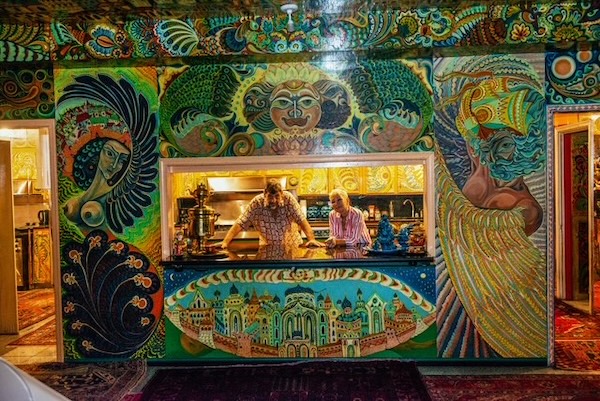
A gathering space within the Museum, integrating painted architecture, furnishings, and daily cultural life. Photo: courtesy of the Museum of Modern Renaissance
Preservation, however, should not turn the Museum into a lifeless artifact. We do not want recognition to freeze the creative process that made the place significant. Preservation should mean understanding what must remain intact, recording artistic intention, monitoring condition, planning responsible conservation, and creating a structure of stewardship that allows the Museum to continue breathing.
This story raises a larger cultural question. How does America recognize an independent artistic environment created outside conventional systems of commissioning, museum patronage, and institutional funding? How should a work be evaluated when the artists, the architecture, the archive, and the cultural life of the place have become inseparable?
Not every difficult dream deserves preservation simply because it was difficult. Struggle alone does not establish cultural significance. But when two artists devote nearly a quarter of a century to creating a rare, permanent, site-specific environment; when that environment continues to gather musicians, writers, visitors, students, and seekers; and when its development has been documented from the beginning, society has a reason to look carefully before allowing it to disappear.
We do not expect everyone to love the Museum. Art that asks something of the viewer will always divide opinion. Some may see excess. Some may see folly. Some may see beauty. Some may see a mirror.
What we ask is simpler: that the Museum be examined seriously, documented professionally, and given a fair chance to remain whole and intact.
Nicholas Shaplyko and Ekaterina Sorokina are Moscow-born, Massachusetts-based collaborative artists who have worked together for nearly four decades. Since 2002, they have transformed a historic former church in Somerville into the Museum of Modern Renaissance, a three-level artist-created environment integrating monumental painting, sculpture, architecture, performance, and cultural life. Their broader artistic project also includes the House of Art and Garden of Sculpture in Gloucester, Massachusetts.
2 Comments
Leave a Comment
What an extraordinary place!
As an artist, I would love to make a visit, and let the glories of your carried out intentions, infuse my spirit.
Is it possible to arrange a visit?
Hi Janet:
Email Nicholas Shaplyko and Ekaterina Sorokina to set up an appointment: [email protected]
Editor Bill Marx