Classical Album Review: Paul Huang Performs Korngold & Barber Violin Concertos
By Jonathan Blumhofer
A polished, detail-rich account of two lyrical concertos, distinguished more by clarity and refinement than by risk or fire.
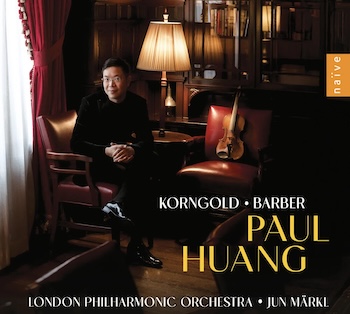
Erich Wolfgang Korngold and Samuel Barber aren’t exactly strange bedfellows: the one was a scion of upper crust, fin de siècle Viennese musical society, the other the son of a well-to-do suburban Philadelphia family. They were both, also, fundamentally conservative musical actors operating within a decidedly Modernist-leaning musical world.
Still, if they don’t share too many programs together, the pairing of their Violin Concertos on this new album has some precedence: Gil Shaham offered the same duologue more than 30 years ago. On that occasion, the violinist was backed by André Previn and the London Symphony Orchestra, whose collective background in film music was second-to-none (Korngold famously landed at Warner Brothers after fleeing Nazi-annexed Austria).
For his part, Huang’s got Jun Märkl and the London Philharmonic Orchestra — and that’s not a bad combination: Naïve’s engineering manages, if anything, to bring out more detail in both works’ orchestral writing than Deutsche Grammophon accomplished in the ’90s, and it sounds terrific. Even so, one misses a bit of the electricity of the earlier release. Those performances were, especially in the respective finales, more explosive and freewheeling. Even so, there’s no question of Huang’s grasp of the essentials of Korngold’s and Barber’s styles.
It’s heartening to see so many recordings of Korngold’s 1945 effort turning up, especially in the last 10 or 15 years. Dismissed as a “Hollywood concerto” after its New York premiere, the score does draw considerably on melodies from various of his film scores. But its thematic arguments are so strong and seamlessly woven together as to make such an epithet meaningless.
Huang has a fine command of the rhapsodic character of the opening movement: there’s a wonderful clarity to his playing as well as a becoming flexibility to his phrasing. The violinist’s sweet tone also fits the Andante quite well, and he brings a sense of delicate mystery to the central “Meno” episode. Throughout, there’s a precision to his playing that is very well recorded.
Märkl and the LPO deliver their parts with a good bit of warmth and color. The Romance, in particular, benefits from a close attention to nuances of dynamics, while the finale’s woodwind writing really sparkles — despite that movement feeling a shade cautious, tempo-wise.
The pairing’s take on Barber’s 1939 chestnut is, in many regards, similar to their handling of the Korngold.
Again, there’s an embrace of the composer’s mellifluous voice: the opening of the first movement is conspicuously airy and spacious ,while the Andante is exceedingly well-balanced and lean. True, Huang’s playing in the latter may not capture the full heat of Barber’s lyricism — Hilary Hahn, for one, mines more intensity out of the music in this regard. Still, the soloist’s approach to the first two movements conveys their requisite strengths, while Märkl and the orchestra deliver their parts with clarity and sympathy of articulation and style.
The finale, though, is a few ticks under tempo and, while Huang’s performance isn’t slow, it does feel a touch precious. In this transparently textured music, that’s not ideal, and even an energetic coda doesn’t quite compensate.
Regardless, there’s much to admire in these performances, even as the album’s short runtime — just 52 minutes — makes one wish Huang had included some short items from one or both composers as filler.
Jonathan Blumhofer is a composer and violist who has been active in the greater Boston area since 2004. His music has received numerous awards and been performed by various ensembles, including the American Composers Orchestra, Kiev Philharmonic, Camerata Chicago, Xanthos Ensemble, and Juventas New Music Group. Since receiving his doctorate from Boston University in 2010, Jon has taught at Clark University, Worcester Polytechnic Institute, and online for the University of Phoenix, in addition to writing music criticism for the Worcester Telegram & Gazette.
Tagged: Jun Märkl, London Philharmonic Orchestra, Naïve