Author Interview: Rethinking 1968 — Beyond the Stereotypes
By Blake Maddux
In 1968, historian Alexander Bloom challenges the clichés of counterculture and reflects on a year of global rupture.
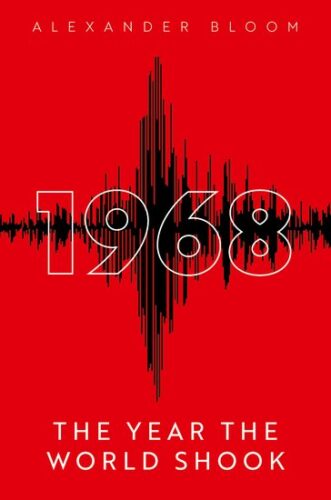
Professor Alexander (“Alex”) Bloom first became an East Coaster when he left his native California in pursuit of a PhD in American history at Boston College. That status became permanent when, after BC awarded him his doctorate, he secured a tenure-track position at Wheaton College. After a career of teaching 20th-century American intellectual, social, and cultural history, he is now Professor of History, emeritus.
However, he is hardly treating retirement as a chance to indulge in a well-deserved permanent vacation. This past February saw the publication of his substantial new book, 1968: The Year the World Shook.
Despite comprising nearly 400 pages of text, the initial idea was for it to be an entry in Oxford University Press’s Very Short Introductions series. Needless to say, the 150 or so pages that these books usually run just wasn’t going to suffice.
In fact, as he told me in the Q&A below, “It could have been twice as long.”
1968 explores this volatile year from beyond the water’s edge of the United States. While Chicago was the epicenter in the United States, Paris, Prague, and Mexico City each had their own version of 1968. Moreover, things were not going as planned (if they were at all) in Vietnam. The United States understandably receives the lion’s share of coverage, but Bloom devotes full chapters to each of these crucial hot spots, thereby affording the study a worldwide reach.
Professor Bloom kindly spoke with me by phone for a lively discussion that forms the basis of the following interview.
The Arts Fuse: Given all the scholarly and popular history about 1968, was there anything that you purposely de-emphasized in writing this book?
Alexander Bloom: No. I wanted to sort of reshape the way things have come down stereotypically. For example, the ideal of the counterculture, which I think has been stereotyped to be about sex, drugs, and rock ‘n’ roll, which means that it loses some of its meaning and importance. I thought that several things have begun to be turn into popular history, which is simplified and therefore becomes increasingly inaccurate as an explanatory framework.
AF: Your editor at Oxford University Press initially proposed that you write an entry for its Very Short Introductions series. How did it turn out to be the longer volume that it is?
Bloom: It’s not as big as it could have been. There were so many places that I could have written about, through which I could reiterate things. But I wanted it to be accessible. It was pitched to a general audience. It’s not a book that was written as a monograph for me and my history friends. I taught at an undergraduate liberal arts institution, and I wanted to write this in the same voice that I used with my students. Also, I wanted to keep it manageable by building it around individual episodes. It could have been twice as long, but I would have died in the process!
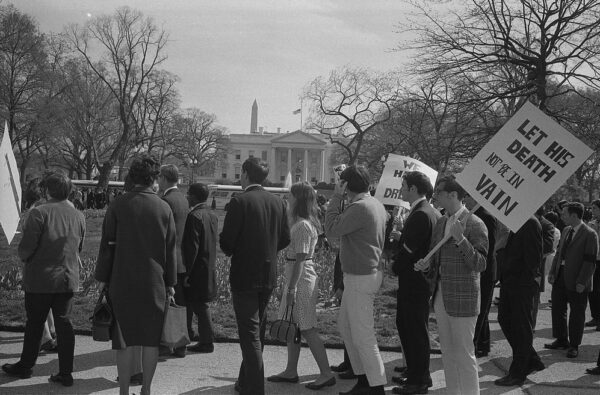
Demonstrators with signs, one reading “Let not his death be in vain,” in front of the White House, after the assassination of Martin Luther King, April, 1968. Photo: Wikimedia
AF: Did anything in the years immediately prior to 1968 foreshadow the events of that year?
Bloom: A lot of things built up to that, there are hints that came along. Some of the precursor events noted in the book occur in ’67, like Martin Luther King’s speech on Vietnam, which marked a diversion for him, and the belief on the part of the war planners and the generals that the war was going very well. But you also had more and more establishment people turning against the war. Beginning in ’66, civil rights began to move north. King was in Chicago, trying to desegregate the suburban neighborhoods, which were all-white and all-black, just because of real estate, not because of Jim Crow laws.
AF: Writing a book is both a teaching and a learning experience. What did you learn from writing 1968?
Bloom: As a US historian, I knew less about Paris, Prague, and Mexico City than I did about Chicago. I learned something in every chapter. On various topics I found out things that I thought I knew, but I began to discover different dimensions about them. The one personal thing that I found was from investigating the presidential campaign. I mean, I was one of those McCarthy kids, antiwar and all the rest. I thought that Robert Kennedy was more of an opportunist. And the more I researched that chapter, my whole mentality reversed. I immediately began to see the whole Kennedy experience and its failed potentiality. I really do believe that not only did Kennedy represent something very powerful, but that he had also changed significantly from when he was attorney general to when he ran for president. I also believe that he would have won. It was a lost moment.
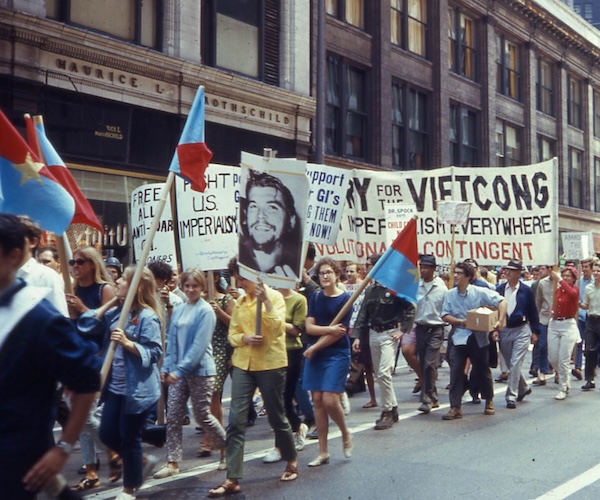
Antiwar March. This demonstration took place as Chicago was preparing to host the Democratic National Convention. Photo: Wikimedia
AF: Do you have any particular individual memories of 1968?
Bloom: That was the year that I graduated from college. I was at the University of California at Santa Cruz, which was very countercultural, both because of its proximity to San Francisco and its experimental nature. When I graduated, I enrolled in an accelerated program that allowed you to become a teacher within a few months. Being a teacher meant a deferment, and I thought that my time would be better spent teaching inner-city kids. And I remember, of course, the Chicago convention.
AF: Has there been a year in the 21st century that is an analogue to 1968? If not, are the conditions ripe for there to be one?
Bloom: The years that we know just by the number — like 1776 or 1929 — are usually because of one event that shakes things, like the stock market crash. There was a point when we could have talked about 2001 because of 9/11. But, since then, I’m not sure. I have interesting memories now of 2008 and the election of Obama. I’ve spent a lot of time in Italy, and I’ve taught there, and wherever I went in 2009, people would ask, “Where can we can we get an Obama?” But, other than that, I can’t think of any particular year. In the good way, I’d like there to be another one like 1968. In the bad way, I wouldn’t! I think that the enthusiasm now is not for a utopian vision of a golden future. We just want a sort of tolerable present! The hoped for result is less optimistic. We just want to right the ship.
Blake Maddux is a freelance journalist who regularly contributes to The Arts Fuse, Somerville Times, and Beverly Citizen. He has also written for DigBoston, the ARTery, Lynn Happens, the Providence Journal, The Onion’s A.V. Club, and the Columbus Dispatch. A native Ohioan, he moved to Boston in 2002 and currently lives with his wife and eight-year-old twins — Elliot Samuel and Xander Jackson — in Salem, MA.
Tagged: "1968: The Year the World Shook", Alexander Bloom, Martin Luther King, counterculture