
Theater Review: Harold Pinter’s “Betrayal” Finds Its Knife-Edge at Gloucester Stage
By David Greenham
This crisp revival turns emotional recoil, backward chronology, and elegant restraint into a sharp study of infidelity.
Betrayal by Harold Pinter. Directed by Shana Gozansky. Scenic design by Jeffrey Petersen. Costume design by Nia Safarr Banks. Lighting design by Amanda E. Fallon. Sound design and composition by Julian Crocamo. Produced by Gloucester Stage at the Natti-Willsky Performance Center, Gloucester, through August 1.
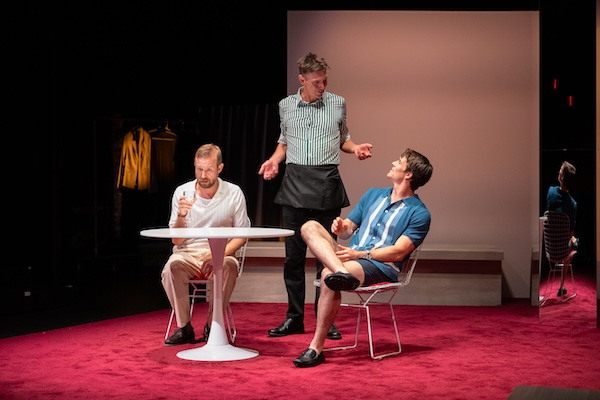
Tanner Efinger, Jeremy Beazlie, and Michael Underhill in the Gloucester Stage production of Harold Pinter’s Betrayal. Photo: Shawn G. Henry
Harold Pinter’s drama begins when Emma (Liza Giangrande) meets Jerry (Michael Underhill) in a London pub in the spring of 1977. The affair has been over for two years. The awkward small talk reveals a few details, scattered like enigmatic breadcrumbs onto the floor.
Jerry is pretty sure he’s gotten away with it unscathed. He’s had a sexual relationship with his best friend’s wife for seven years, and neither of their spouses knows. Their lives as married couples continue. It’s a dalliance, a side road. In his mind, no harm is done, and he can live with that.
But Emma mentions that she and her husband are going to separate. They’ve had a long night of conversation and confessions. “He’s betrayed me for years. He’s had…other women for years,” she says. “But we betrayed him for years,” Jerry replies. He’s suddenly uncomfortable, and made more so by Emma’s matter-of-fact attitude. He gets up the courage to ask the only question that really matters to him: “You didn’t tell Robert about me last night, did you?”
“I had to,” she says. “He told me everything, I told him everything. We were up…all night.”
Scene two, the most predictable in the play, is set at Jerry’s house. He has hastily invited Robert (Tanner Efinger) over for a drink. Jerry’s wife is at work, and the kids are asleep. “You look quite rough,” Robert tells him, adding, “It’s not about you and Emma, is it? I know all about that.”
Jerry fumbles his way through what he thinks is an apology, but it’s clear that he’s more upset by the fact that Emma admitted to the affair. “The fact is I can’t understand … why she thought it necessary … after all these years … to tell you … so suddenly … last night,” he stammers. Robert drops the bomb: “She didn’t tell me about you and her last night. She told me about you and her four years ago.” Emma has not been truthful with Jerry. It is the straw on top of a heap of betrayals.
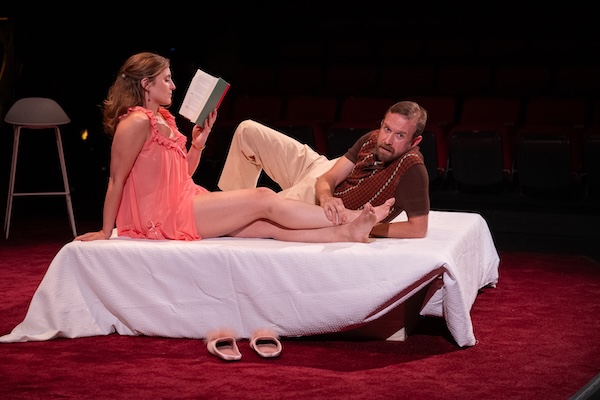
Liza Giangrande and Tanner Efinger in the Gloucester Stage Company production of Harold Pinter’s Betrayal. Photo: Shawn G. Henry
Widely considered by critics to be one of Pinter’s masterworks, Betrayal is reported to be autobiographical, based on the writer’s affair with a BBC TV presenter in the 1960s. The script features the requisite economy of stage language that many — including Gloucester’s Producing Artistic Director Rebecca Bradshaw — find daunting. “He creates these scenes with gargantuan pauses where our own discomfort, self-loathing, or unease can fester,” she writes in the program notes. The pauses are exactingly noted in the script, embedded around the legendarily sparse dialogue. An exhaustive monologue in Pinter’s theater world is just three or four sentences. The Gloucester Stage production supplies a strong treatment of his nuanced script, particularly in how deftly it dramatizes the outward discomfort triggered by unspoken feelings.
But it was not the language, but the structure, of Betrayal that captured critical and popular attention when it premiered more than half a century ago. Scenes one and two are set chronologically, in the spring of 1977. From then on, the tale is told backward, with subsequent scenes placed in the winter of 1975, 1974, three snapshots from 1973, and 1971. The final chapter, set in the winter of 1968, ends with an icily ironical touch: the moment Emma and Jerry’s affair begins.
Director Shana Gozansky and her cast — Giangrande, Underhill, Efinger, and Jeremy Beazlie, who turns in a fine comic performance as the waiter — keep the mordant psychological drama humming through the nine scenes, making effective use of concise transitions and nimble costume changes. Set designer Jeffrey Petersen has come up with a slick and simple set that boasts distinctive acting areas to signify the various locations.
Nia Safarr Banks’ period costumes reflect the awkward fashions and colors of the times, while lighting designer Amanda E. Fallon’s intelligent approach — a collaboration with Petersen — backlights peek-a-boo walls, which help tell the story. Likewise, even though the majority of the scenes are two-handers, Gozansky selects key moments in which we are made aware of the third member of the love triangle via the backstage shadows.
Julian Crocamo’s bold and disjointed soundscape underlines the plot’s truncated, backward motion.
Over the course of this 90-minute dissection of infidelity, Pinter does not invite the audience to root for anyone in this unfortunate trio of friends, nor are we supposed to take sides. Betrayal is a portrait, a refined satire, of the self-important cocktail set. Drinks in hand, with suggestions of emotional hollowness peppered through all the small talk.
Underhill’s boyish Jerry is the least mature of the three. Good-looking and a smooth talker, his appeal is obvious, but the character’s lack of depth, his sterility of feeling, makes him more of a train wreck than a home wrecker. Efinger’s Robert maintains detachment and indifference. Despite a successful career, wife, children, and close relationships with Jerry and others, the man seems to find little joy in living — unless it presents the possibility of playing squash.
Only Giangrande’s Emma reveals moments of melancholy in dealing with her predicament. The role is the most challenging because of its call for a broad range of passions, and the actress serves the character with admirable skill.
Back in 1971, Pinter’s use of pinprick dialogue and pregnant pauses was deemed the height of minimalism. Not so today. In our compressed-to-the-max world of memes, Instagram, TikTok, Snapchat, and other social media, Betrayal comes off as somewhat long-winded.
David Greenham is an arts and culture consultant, adjunct lecturer on Drama at the University of Maine at Augusta, and is the former executive director of the Maine Arts Commission. He can be found at https://davidgreenham.com/
1 Comment
Leave a Comment

As one of my favorite Pinter plays, I’ve seen it many times. In the 1983 film version with Jeremy Irons, Ben Kingsley, and Patricia Hodge, there is such emotional reserve that each scene is like a cruel game of subtle wounds and one-upmanship. With Pinter, the ambiguity and unspoken motives are part of the fun. In this production, I loved how specific moments of guilt, jealousy, ennui, and, dare I say, Weltschmerz were much clearer. It was an interesting directorial choice, and it worked.
In the first scenes, I was laughing to tears; I had to rein myself in. But gradually it became much less comic, and quite sad as the three buried their emotions and anxieties with intellectual jabber. All of this was achieved with remarkable economy: a minimal set, jagged incidental jazz bridging the scenes, and a fragmented lighting design (that recalled the graphics of Saul Bass’s film title sequences).
A wonderful production.