Film Review: “Young Mothers” Finds Grace in Hardship
By Tim Jackson
The Dardenne brothers’ latest film transforms a series of fragile stories about teenage motherhood into an unsentimental, deeply compassionate study of resilience.
Young Mothers, directed by Jean-Pierre and Luc Dardenne. Now Available on DVD and Amazon Prime
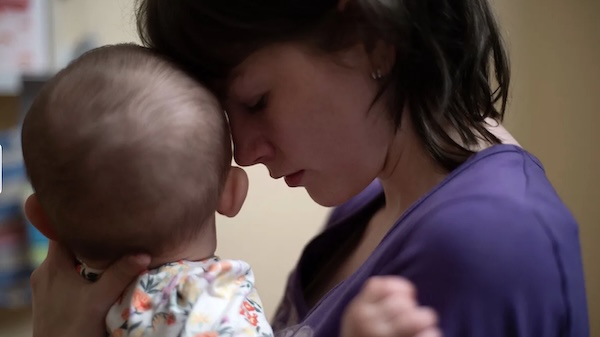
A scene from Young Mothers. Photo: Amazon Prime
These days, some of the best films of world cinema are found on streaming services. That Young Mothers, from celebrated filmmakers Jean-Pierre and Luc Dardenne, received little or no theatrical distribution here is another sad sign of the times. With films such as Rosetta (1999), L’Enfant (2005), The Kid with a Bike (2011), Two Days, One Night (2014), and many more, the brothers’ films rank among the masterpieces of cinematic social realism. Their work is defined by extensive research and rehearsal, nonprofessional actors, natural lighting, long takes, and handheld cameras. The goal of the Dardennes, as filmmakers, has been to portray vulnerable lives with compassion. Young Mothers is their first ensemble film; five intertwined stories follow the trials and tribulations of teenage mothers, including the story of a young woman about to give birth. The narratives probe the difficulties experienced by young women who come from unstable or impoverished backgrounds. Barely out of childhood themselves, each woman struggles, psychologically and financially, to meet the challenge of finding the emotional resources to raise a newborn.
After discovering La Maison Heureuse, a residential home for young mothers in Alleur, Belgium, a region where many of their films are set, the Dardennes came to feel that no single story could fully hold what they had encountered. “There was this kind of life force there that both energized and attracted us. And then we said to each other, ‘We must make the film here,’” Jean-Pierre recalled in an interview. Inspired by that experience, they wrote the five interwoven stories. The young women must grapple with parenthood with minimal emotional preparation and practical experience. They are supported by staff, educators, some families, and one another, but the challenges they meet are formidable. The Dardennes do not lean into despair. Each story arrives at a measure of promise — fragile, hard-won, and genuine. Unlike their previous films, the pair have cast this one with young actresses with varying levels of acting experience. The results are a collection of raw, truthful, and naturalistic performances.
The film opens with Jessica, played by Babette Verbeek, a pregnant young woman nervously awaiting the mother who gave her up at birth. Her subdued, almost slack-jawed expression rarely shifts, and the low affect of her face and voice suggests a life shaped by fear and emotional deprivation. Jessica must confront her own abandoned past before she can imagine becoming a mother herself. Having never known parental love, she fears she cannot offer it, and may repeat her mother’s pattern of neglect. That first step toward understanding is a wrenching scene: her mother resists any connection, leaving Jessica reduced to stalking her in search of some fragile path toward healing. Her questions are devastatingly direct: “I want to know if I was nothing to you,” she asks. “Why didn’t you just abort me?”
Perla (Lucie Laruelle), a young Black woman who, at first, carries her infant everywhere she goes, expects that the child’s father, Robin (Günter Duret), recently released from jail after a drug conviction, will embrace his responsibilities. She proudly introduces him to the baby, confident that they will become a family. From the moment they meet, however, it is clear that her hopes are misplaced. Robin has neither the desire to be a father nor the courage to admit his decision. Gradually, Perla confronts the reality that she is on her own. Emotionally starved, physically exhausted, and with only a fragile relationship with her sister to lean on, she finds unexpected reserves of inner strength. With the modest support of the women at the residential home, Perla finds the confidence, with her child, to go it alone.
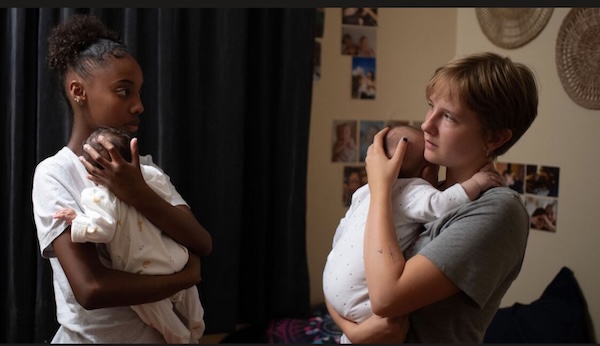
A scene from Young Mothers. Photo: Amazon Prime
Ariane’s (Janaïna Halloy Fokan) story returns to the generational trauma created by failed parenting. Her unpredictable mother (Christelle Cornil) veers between hurling cruel insults and begging Ariane and her granddaughter to move in with her. Ariane loves her mother, but years of passive-aggressive manipulation, emotional abuse, and (implied) exposure to her abusive partners have left wounds that cannot easily be healed. “I don’t blame you for being poor,” she tells her mother, and refuses to condemn her. Still, she recognizes that remaining close would perpetuate the cycle. Ariane makes the heartbreaking decision to give up her child because she is wise enough to know that she cannot overcome the psychological harm rooted in her upbringing. For her, love ultimately takes the form of sacrifice.
Naïma’s story dramatizes the possibility of overcoming hard obstacles with assistance and moving on. Julie (Elsa Houben)’s experience is the most redemptive, and it concludes the film. She and her partner, Dylan (Jef Jacobs), are recovering addicts. Rather than treating the male as a limited emotional partner, the Dardennes show how addiction deepens his sympathetic understanding when Julie briefly relapses. Approved for an apartment, the pair prepare to begin a new life together — though it is not without uncertainty. One of the film’s most affecting moments comes when a former teacher offers Julie and Dylan much-needed reassurance through quiet compassion. It is a moment of inspiring grace.
Family, in all its fragile forms, is the elemental theme of Young Mothers. As with any Dardenne film, the story’s power doesn’t come from plot twists but from detailing human behavior, often under pressure. The performances, the patient directorial observation, and the subtle movements of the stories accumulate into a compelling emotional journey. Each of the narratives is a bit more hopeful than the last, though they intertwine and reflect on one another.
Honesty and compassion are at the heart of Dardenne brothers’ films, and Young Mothers is no exception. People are flawed because the circumstances that shape them are flawed; families, institutions, and society have failed them. Like the mothers in this film, the characters the pair focus on are often poor, undereducated, and lacking emotional support. Theirs is a vision dedicated to looking at the struggles of the most vulnerable among us. For the Dardennes, nobility is not found in perfection, but in perseverance. Young Mothers asks that we not judge these young women, but observe them with compassion. And that, if we do so, we will be all the better for it.
Tim Jackson was an assistant professor of Digital Film and Video for 20 years. His music career in Boston began in the 1970s and includes some 20 groups, recordings, national and international tours, and contributions to film soundtracks. He studied theater and English as an undergraduate, and has also worked helter-skelter as an actor and member of SAG and AFTRA since the 1980s. He has directed four feature documentaries: Chaos and Order: Making American Theater, which is about the American Repertory Theater; Radical Jesters, which profiles the practices of 11 interventionist artists and agit-prop performance groups; When Things Go Wrong: The Robin Lane Story, and Marblehead Morning: Daring & Stahl: 50 Years in Harmony. He has made two short films as well: Joan Walsh Anglund: Life in Story and Poem and The American Gurner. He is a member of the Boston Society of Film Critics. You can read more of his work on his substack.