Film Reviews: Two “Rocky Horror” Documentaries Mark the Film’s Golden Anniversary
By Christopher Caggiano
Strange Journey traces the origins of one of cinema’s most unlikely cults. Time Warp shows why it still matters.
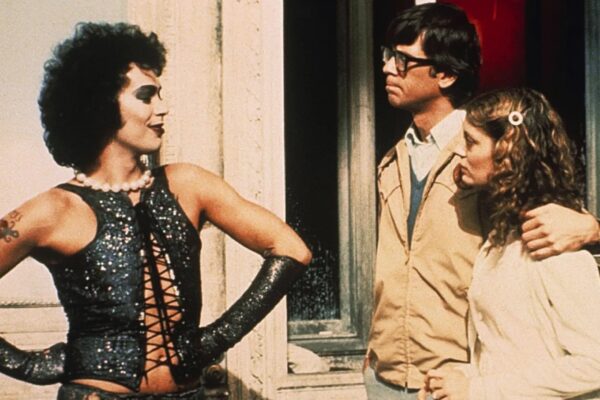
A scene from 1975’s The Rocky Horror Picture Show. Photo: courtesy of 20th Century Fox
The Rocky Horror Picture Show turns 50 this year. (Exactly how old does that make you feel?) And the anniversary has unleashed a wave of retrospective attention – books, reissues, and documentary films all arriving to explore one of the more unlikely cultural phenomena of the 20th century. It’s really no surprise that the anniversary is getting so much attention. The surprise is how much there still is to say.
I recently had the chance to catch two of the documentary films making the rounds. I came to Rocky Horror the way a lot of queer kids did in the early 1980s – with my friends, in costume, in the dark. For a stretch of my high school years, the Exeter Street Theater in Boston’s Back Bay was kind of a place of pilgrimage. The shadow cast, the shouted callbacks, the competitive sport of landing the best line at the screen. In my review of the current Broadway revival, I discussed the nostalgic feelings the production stirred up in me. Together, these new documentaries explore the phenomenon that Rocky Horror has become, and the power it still has to bring people together.
Strange Journey: The Story of Rocky Horror is something like an official origin story – how a cult was born, where it went, and why it spread. Time Warp is something more intimate: a portrait of a shadow cast production in a conservative Wyoming mining town, and what Rocky Horror still means to people. Together these documentaries encapsulate the full Rocky arc – where it came from, and what it became.
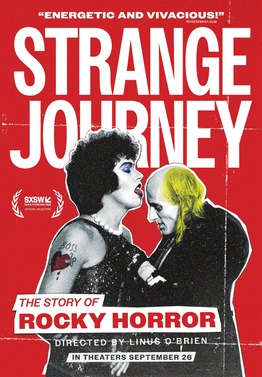 The title, Strange Journey: The Story of Rocky Horror, tells you what you’re in for: a film about as surprising and innovative as its perfunctory name. Director Linus O’Brien, son of Rocky creator Richard O’Brien, had access to virtually everyone still standing, and the result is a heartfelt, if somewhat conventional, documentary that will give longtime fans little they don’t already know, but delivers the considerable pleasure of watching the people who created the show and the film reflect on what it became.
The film opens with Richard O’Brien visiting his childhood home in New Zealand, where a neighbor informs him that everyone in the area calls it the Rocky Horror house. A statue of Riff Raff now stands on the spot where O’Brien once worked as a hairdresser. From there, the film traces his journey to London, arriving at exactly the right moment for oddballs. O’Brien was quickly cast in Hair, then went on to play Herod in Jesus Christ Superstar, a stint that didn’t go especially well but introduced him to director Jim Sharman. Rocky Horror itself was written quickly to fill a programming hole at the Royal Court Theatre’s upstairs studio space, the Theatre Upstairs, opening in June 1973.
The talking heads here are a mix of major players and minor ones, and the recollections range from fond “boy did we have fun” reminiscences to something approaching genuine sociological analysis, particularly from Tim Curry and Susan Sarandon. Especially welcome is the reclusive Peter Hinwood, the film’s Rocky, who apparently hadn’t given an interview in decades.
Outside the cast and crews there are some welcome appearances from stars who felt the Rocky allure. Jack Black discusses how seeing Meat Loaf as Eddie changed the course of his life, opening his eyes to the possibilities of rock and roll’s effect on an audience.
Drag superstar Trixie Mattel traces her drag name at least partially to her time performing in a Rocky shadow cast – she played Trixie the usherette before graduating to Riff Raff. (The name is also a sort of “fuck you” to Trixie’s stepfather, who used to call a young Brian Firkus “Trixie” as a taunt.) Trixie delivers the film’s most incisive observation about the show’s enduring appeal: that cross-dressing creates a paradox of power, forfeiting masculine privilege in a way that somehow amplifies rather than diminishes it.
The film is also sharp on the mechanics of how the Rocky Horror phenomenon actually developed. After successful runs in London and Los Angeles, the Broadway production quickly flopped. The film flopped too, at least initially. But a number of developments told the producers that they might have something on their hands.
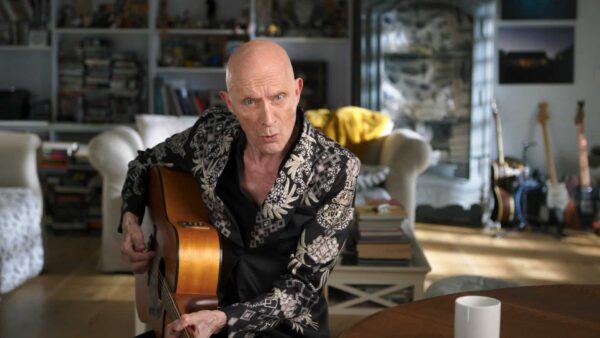
Richard O’Brien in Strange Journey: The Story of Rocky Horror. Photo: Warren Kommers
A preview screening in Santa Barbara drew a mixed crowd; the older audience walked out, but the college-age contingent stayed and responded enthusiastically, giving the producers a read on where their audience actually lived. They tried midnight screenings at the Waverly in New York in 1976, and simultaneously in Austin, where only 50 people showed up. But those same 50 people kept coming back week after week. And, by 1978, there were over 50 prints of the film in circulation.
What followed – the shout-outs from audience members, the costumes, the props, the shadow casts – evolved entirely without the producers’ intervention. They hit upon the midnight screening format, but everything else came from the audience. O’Brien puts it well: “We couldn’t have rehearsed and organized like this. This is a spontaneous moment where live theater and live audience and cinema have come together in a way that I’ve never seen before.”
Producer John Goldstone is equally direct: “It clearly has to be considered the major cult movie of all time. But you don’t make cults. Audiences make cults.” There’s a fitting historical footnote here: the very first live performances of the stage show were performed in front of a movie screen, to hide the band in a space that lacked an orchestra pit. The shadow casts that followed were, in a sense, an homage to that necessity.
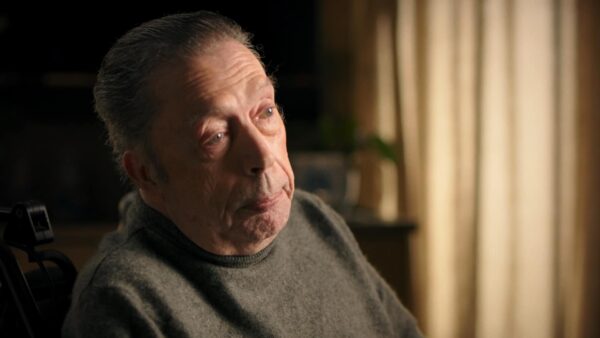
Tim Curry in Strange Journey: The Story of Rocky Horror. Photo: Warren Kommers
There’s a generous segment on the late Sal Piro, president of the Rocky Horror fan club, who understood the show’s function as a refuge for marginalized people, a place where queer kids could feel less alone. O’Brien echoes the sentiment: “Those people who are marginalized, those people who are on the fringes and feel lonely, they can come together. It gives them a place where they’re not alone.” But O’Brien is gracious about having relinquished ownership: someone once told him that Rocky Horror didn’t belong to him anymore; it belonged to the wonderful weirdos who created the phenomenon. “In many ways, that’s absolutely true.”
Again, Strange Journey will seem like familiar territory for the Rocky faithful, and as a piece of filmmaking it doesn’t take many risks. But it’s warm, thorough, and at times unexpectedly moving.
In Time Warp, directors Allison Berg and Frank Keraudren take a somewhat different approach. Rather than surveying the full sweep of Rocky Horror history, they zoom in on a single production in a single town: Rock Springs, Wyoming, where a young man named Kenny Starling has assembled a troupe of local misfits to stage a shadow cast performance of the film. The mission, as Starling puts it, is straightforward: “We’re here to bring queer joy.”
The film has attracted some big-name backers: Josh Gad, Billy Porter, and John Cameron Mitchell are all on board as executive producers, a signal that some people with clout have recognized what’s at stake in a story that might otherwise never have found its audience.
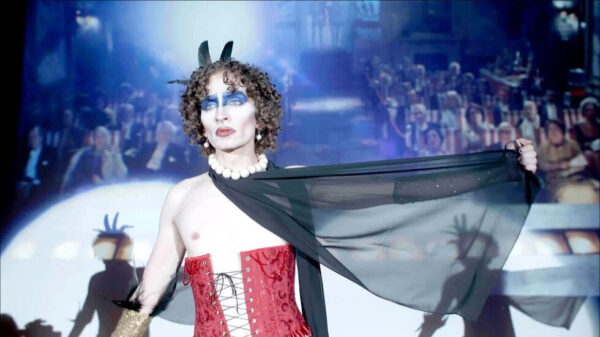
A scene from Time Warp. Photo: Tribeca Film Festival
I caught the film at its world premiere at the Tribeca Festival, at the Village East by Angelika in New York City, with nearly the entire cast and crew in attendance, including Gad, who spoke before the screening but then slipped out to rehearse for the Tony broadcast. The film is part of a program called Subject Matter, which offers grants both to documentaries about important issues and to the organizations that the films cover.
The performers are mostly untrained – local queer kids, supportive town elders, most of whom have never been near a stage – and the resulting film is occasionally awkward to watch for exactly that reason. But their enthusiasm is infectious, and the production generates some genuinely unintentional comic gold.
While driving down a street, cast members watch a literal tumbleweed cross their path; one of them deadpans, “Tumbleweeds have rights in Wyoming.” When discussing the atmosphere in which these people are operating, one cast member observes, “This is Wyoming. Everyone has a gun.” Beat. “Not me. I’m more of a knife person.” One cast member’s mother, discussing what she makes of the whole situation, offers the film’s most sensible take: “There’s a million things worse than wearing fishnets.”
The film seems to want to generate tension around community opposition to the production, and here it runs into a problem: the opposition essentially consists of one man who writes an email and shows up to a town meeting, where he attempts to equate queer culture with pedophilia and is summarily dismissed by the city council. The camera repeatedly pans past the façade of the town’s gun store, during costume and prop shopping excursions, as though the hardware might become relevant. It doesn’t. The specter of genuine threat never quite materializes, and the manufactured tension is the film’s most significant weakness.
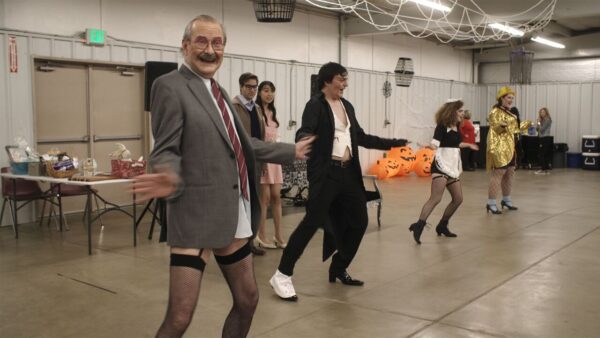
A scene from Time Warp. Photo: Tribeca Film Festival
What does materialize is something warmer and more surprising. A preview performance at a local extreme bingo event – essentially converted into drag bingo for the occasion – starts awkwardly but ends with the audience fully on board. The opening night crowd, consisting of family members, friends, and curious locals, turns out to be genuinely enthusiastic, filling the room with a warm frisson that sets the tone before the show even begins. When the film breaks down mid-floor show, Kenny – who in addition to directing plays Frank N. Furter in the shadow cast – improvises an audience chant of “Don’t Dream It, Be It” that adds to the supportive atmosphere.
Of course, this documentary was shot and released in a political environment that makes its subject matter feel considerably more than academic. It’s easy for those of us living inside a progressive urban bubble to lose track of what’s actually at stake for people outside it.
After the screening, I walked to the Astor Place subway station, where two preppy NYU students were openly flirting in front of the entrance. On the 6 train up to Grand Central, a young gay couple – one tall, one slight, both clearly smitten – sat mooning over each other, oblivious to everyone around them. All of this stood amid a full complement of queer kids being their authentic selves on a Saturday night in Manhattan. It’s the kind of thing you stop noticing when you live here.
Time Warp is a useful corrective – earnest, sweet, and forgivably overreaching – a reminder that what passes for mundane in one zip code can be an act of courage in another.
Christopher Caggiano is a freelance writer and editor living in Stamford, CT. He has written about theater for a variety of outlets, including TheaterMania, American Theatre, and Dramatics magazine. He taught musical theater history at the college level for 16 years and is an active member of the Outer Critics Circle.
Tagged: "Strange Journey: The Story of Rocky Horror", "The Rocky Horror Picture Show", "Time Warp", Linus O'Brien