Poetry Review: Karen Solie’s “Wellwater” — Poetry Callused, yet not Callous
By Jim Kates
Stark prairie lyrics of survival, memory, and reluctant belonging.
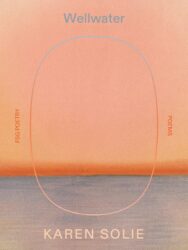
Wellwater by Karen Solie. Farrar, Straus, and Giroux, 112 pages, $18 (paperback)
 In her landmark 1972 survey of Canadian literature, Survival, Margaret Atwood characterized the dominant theme of her native literature as just that — survival — in contrast with more expansive frontier themes south of the border and insular themes of the mother country. “The main idea is staying alive . . . hanging on,” Atwood wrote, hanging on both physically and spiritually.
Karen Solie was six years old when Survival was published, and now, after winning prestigious awards around the English-speaking world, her place as a voice in Canadian literature is firmly established. It may be surprising that she is not better known in the United States, but it is unsurprising that the poems in her new book, Wellwater, move inexorably forward in full-throttle survival mode:
An escape, some say, from the pain
that owes its life to us, from the imperative
to act. But it’s not escape, is it,
when you know you have to go back.
Solie’s poems are callused, yet not callous. Hard skin protecting flesh and nerve. And the poet is firmly rooted in Canada. She can write from the streets of Toronto, where “New City’s functionalist aesthetic now seems witlessly / ironic, like dressing as a miner or a maid for Halloween” and where in “Riverdale Park the diagonal walks like diagrams / may be said to describe themselves.”
Solie writes most feelingly and deeply from the Midwestern expanse of the Saskatchewan prairie that gave her birth: “Not much of a place for a holiday, not much to do . . . where / can you even buy a compass, you are lost / long before you know it.” Here, the antelope “appear out of nowhere as if they know where all the doors are / between our dimension and where they are called / by their true name.” She cannot keep from loving her landscape, hard as it sometimes seems she tries. In “Red Spring” she angrily chronicles and laments the plague of GMO patented seeding and pesticides, “a zombie technology,” but
when the ancient science of a cover crop of yellow sweet clover
or alfalfa sings into the air a fragrance
drawing to itself the fragile pollinators,
butterflies, ladybugs, and the bees to their harvest —
the colony come forth to sport and play
so deep their love of flowers —
it’s beautiful . . .
Beautiful and hard. We do not get the impression that anything comes easy in these verses. In “The Bluebird,” a poem I keep coming back to, “Each old thing in its new place must prove its worth yet again.” And what is the bluebird of the title? Unspecified, though most likely the name of the “roadside motel whose name ameliorated / the experience of staying there” and certainly the bluebird of happiness, “great happiness,” immediately coupled with “great sorrow.”
In “Horseshoe,” an anecdote about luck is spun out and then retracted, just as the luck in the story seems to be, and then the story itself. So much is provisional in Solie’s perception of things, except, perhaps, for the things themselves, both good and bad: particulates of smoke from wildfire, Monsanto chemicals, cottonwood trees. Toward the end of Wellwater a significant character emerges, a bemused father at a food court in the West Edmonton Mall, that same father in a 14-foot aluminum Starcraft, “our contentment of few words,” to whom she gives almost the last word in “Canopy,” the concluding poem of her collection.
At its worst, survival is victimhood; at best, it is intrepid accomplishment. It is the latter that Solie’s poetry expresses.
“The things you remember” (when you know you have to go back), she writes early on in the poem that gives its title to the collection, are balanced with what “I didn’t know I had.” Then the speaker pauses at last to find her waters and her watering place, where she can drink and be whole again beyond confusion. She writes as a generation’s voice of survival, “in excess of their average lifespan / and function.”
Wellwater has already been published in Canada with prize-winning acclaim, but distribution from Canadian publishers is scandalously scant in the United States, so we should be grateful to Farrar, Straus, and Giroux for paying professional attention to her work.
J. Kates is a poet, feature journalist, reviewer, literary translator, and the president and co-director of Zephyr Press, a nonprofit press that focuses on contemporary works in translation from Russia, Eastern Europe, and Asia. His latest book of poetry is Places of Permanent Shade (Accents Publishing) and his newest translation is Sixty Years Selected Poems: 1957-2017, the works of the Russian poet Mikhail Yeryomin.