Film Review: “Blue Heron” — Director Sophy Romvari Turns Childhood Trauma into Art
By Steve Erickson
A fractured childhood remembered through a lens of distance and grief.
Blue Heron, directed by Sophy Romvari. Starting May 8, screening at the Coolidge Corner Theatre in Brookline and AMC Loews Boston Common 19 in downtown Boston.
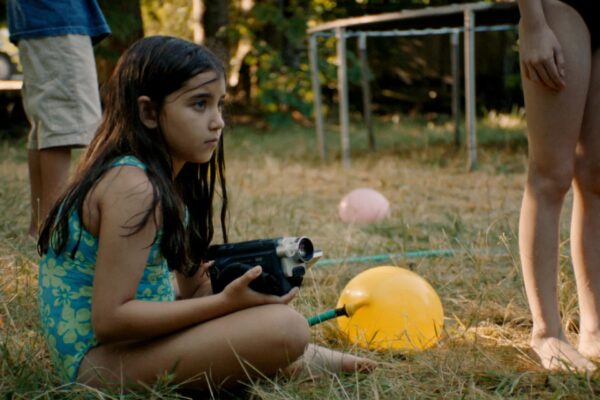
A scene from Blue Heron. Photo: Nine Behind Productions
Blue Heron immerses viewers in a story about lives that are heading out of control. Hungarian immigrants to Canada in the ‘90s, the alarmed parents (Adam Tonda and Iringo Réti) are struggling with the self-destructive behavior of their teenage son, Jeremy (Edik Beddoes). (Réti’s character is not his biological mother.) With his blonde hair and huge aviator glasses, Jeremy is a doppelganger for the young Jeffrey Dahmer, but his crimes aren’t nearly as horrific. Still he is headed down an inexplicable, ruinous path. He is caught shoplifting. He breaks his bedroom window and injures his arm. He even goes as far as climbing onto the roof and threatening suicide.
His younger sister Sasha (Eyul Guven) witnesses his decline from a slightly disassociated perspective. The film flashes ahead to depict her life as an adult, when she’s played by Amy Zimmer. In her 20s, the woman tries to comprehend what happened to Jeremy.
Romvari is relating the story of her own childhood. Jeremy was a real person. From the start, Blue Heron is framed as a memory piece. Time blurs, past and present intermingle. There are scenes that border on the paranormal. At one point, the adult Sasha visualizes herself telling her parents what they will go through as Jeremy battles with existence in the future.
Romvari’s camerawork adopts a child’s gaze, so the narrative can avoid even an illusion of understanding what is going on. The camera’s focus tends to drift. Sasha doesn’t see her family’s life as a story, nor is she privy to everything that’s going on. Jeremy’s narrative takes its time coming into firm shape. (The seeds of the adult filmmaker are already present in the impressionistic perspective of her child alter ego.) Many of the worst details of Jeremy’s behavior – selling fake drugs at school, threatening to burn the house down with his family inside — are discussed rather than shown. He is separated from his siblings because he’s older. Jeremy looks different from them, with lighter hair and skin. Ironically, when we are given a glimpse of the teen, he doesn’t seem malicious, despite the danger he causes for his family. He consistently comes off as inarticulate and dazed.
Romvari and cinematographer Maya Bankovic use shallow focus as a way to express their characters’ confusion. When people speak, their faces are frequently blurred or outside of the frame. For example, in a scene where Sasha is talking to her mother, the camera offers a sharp close-up of potatoes being peeled. The girl is seen as a blur in the background; her mother’s head is entirely offscreen. (The technique of hiding people’s faces was already used in some of Romvari’s shorts.) Placed at a respectful remove, the camera doesn’t pretend to share an intimacy with the story’s figures. It’s incapable of knowing their inner lives directly, but Romvari creates a grammar that probes their thoughts indirectly.
Blue Heron doesn’t try to make any grand statements about the immigrants’ experience, but they can’t help poking through. For the first half hour, the family seems happy much of the time. Their Vancouver neighborhood looks pleasant, but it’s an isolated place with no sense of community. They don’t interact much with their neighbors. Cops, therapists, and social workers are their link to Canadian life; there is a sense of regret that they need to rely so heavily on representatives of these institutions. Food becomes a way of reaching back to the comforts of Hungarian culture. (When an emergency takes place, we see potato pancakes burn up in the frying pan.) The film recreates the ‘90s casually; there are glimpses of Internet Explorer as well as a nature show that warns children against believing everything they see on TV.
This is not Romvari’s origin story as a film director. When Blue Heron leaps into the future, she’s already on her way to becoming one. And, with this project, she is using film as a way to understand her brother’s experiences. Her earlier documentary shorts have already grappled with her family’s history. One chronicles the life of her grandfather, a production designer who worked on director István Szabó’s Mephisto and Colonel Redl. Still Processing tackled the deaths of her brothers David and Jonathan in a rawer fashion, turning a box of family photos into a slide show that’s presented in an empty theater. Throughout her career, she has brought a degree of vulnerability to filming herself that most directors would have edited out. Grief is a running theme in Romvari’s films, even when they are about animals: Norman, Norman and In Dog Years center on people who love dogs while knowing how short their lifespans can be.
That sense of displaying strength in the face of life’s fragility is contained in every frame of Blue Heron, but the fictional framework gives it more space to develop and deepen. At the film’s climax, we finally move outside of Sasha’s head on a quest to explore the mysteries of other people’s inner lives and to see how effectively the cinema can tap into human interiority. As a debut feature, it’s a stunner.
Steve Erickson writes about film and music for Gay City News, Slant Magazine, the Nashville Scene, Trouser Press, and other outlets. He also produces electronic music under the tag callinamagician. His latest album, Bells and Whistles, was released in January 2024, and is available to stream here. He presents a biweekly freeform radio show, Radio Not Radio, featuring an eclectic selection of music from around the world.