Arts Commentary: The Boston Symphony’s New Humanities Blueprint Makes Sense
By Joseph Horowitz
Why festival programming — and humanities partnerships — can help the BSO.
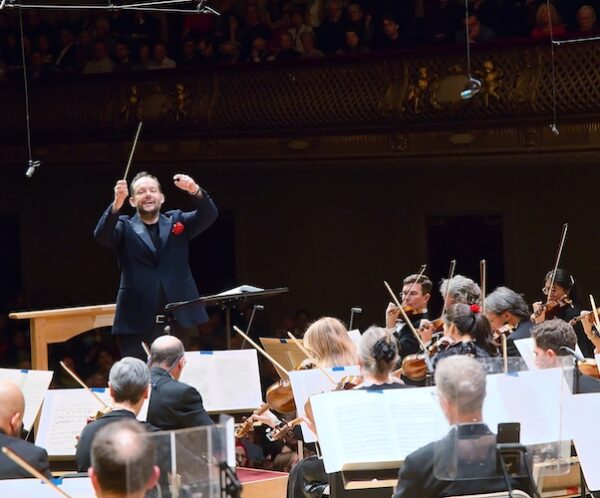
Andris Nelsons conducting Dvořák Symphony No. 9 with the Boston Symphony Orchestra. Photo: Hilary Scott
Early last March it became known that Andris Nelsons would be terminated as music director of the Boston Symphony Orchestra. The fallout from that decision, apparently made without due regard to the manner in which it was promulgated and disclosed, has ignited a lacerating crisis pitting enraged musicians against the management and board. And it has turned Nelsons into a martyr.
A 14-page “State of the Boston Symphony Orchestra” manifesto, dated April 17, 2026 (but first circulated earlier), sketches a new strategic plan. It adds detail to what the administration and board have in mind for the future. This document has now been widely shared and castigated. It claims a financial emergency that may or may not endure scrutiny. Lost in the shuffle is the credibility of the programmatic prescriptions at hand.
It equally bears mentioning that the orchestra — at least during the Carnegie Hall visits I have attended — sounds impaired. I was startled to read a glowing account of the recent Carnegie performance of Dvořák’s “New World” Symphony led by Nelsons. It was written by Nathan Cole, the orchestra’s concertmaster. What had he gleaned from his seat at the front? To my ears, the orchestra did not play that well. I could share many examples. The second subject of the first movement, in G minor, is an example of Dvořák’s “Indian” mode. There is an exotic accent on the 10th note (a C). Some members of the orchestra observed it, others did not. The pounding beginning of the Scherzo (inspired by the dance of Pau-Puk Keewis at Hiawatha’s wedding, in Longfellow’s poem) was not rhythmically tight and the winds lagged behind the strings. A video of Nelsons conducting the same music with the Bavarian Radio Orchestra captures a similar interpretation — full of affecting personal touches — seamlessly realized by a better orchestra years ago.
The board documents a series of challenges that in fact afflict the symphonic field generally in the United States. “Much of the BSO’s traditional audience has deserted it: paid attendance at its Symphony Hall classical concert has declined by a startling 40% over [the past 20 years]. Much of the time, the Orchestra performs to a hall that is nearly half empty.” Other factors include “chronic deficit spending on operations, an underinvestment in the educational efforts needed to help build the future audience for orchestral music, and inadequate resources to address the deteriorating conditions of our facilities.”
The proposed template lists “symphonic cycles,” “festivals,” and “programmatic themes that build connections across several weeks of BSO concerts.” Such programming is “easier to market to targeted audiences.” BSO concerts “will be accompanied by more humanities-based collateral presentations, including lectures, panel discussions, demonstrations and workshops…. There will be some affinity programming, intended to appeal to segments of our communities who have not traditionally felt welcomed.” These changes, the document adds, “are neither radical nor even especially novel.”
There’s also a paragraph about the impending search for a new music director — “ideally, [someone who] will make the Boston Symphony the principal (although not necessarily the exclusive ) focus of his or her artistic endeavors.” (Nelsons is concurrently the music director of Leipzig’s Gewandhaus Orchestra.)
Having myself been engaged in a comparable initiative, with a variety of orchestras, for more than three decades, I would like to contribute to the debate my impression that these strategies, as stated, sound plausible and timely. And if they prove “especially novel,” so much the better. I also feel competent to furnish some advice.
I left my job as a New York Times music critic in 1980 partly because I discovered classical music in crisis. Its institutions seemed moribund to me, with worse to come. I next discovered myself working for New York’s 92nd Street Y. When the Y undertook a multiyear Schubert festival in collaboration with the baritone Hermann Prey, I volunteered to create an annual all-day “symposium” tackling such themes as “Schubert the Man,” “Perspectives on Erlkönig,” and Schubert and the Piano.” Prominent scholars took part alongside prominent performers. An avid audience instantly materialized.
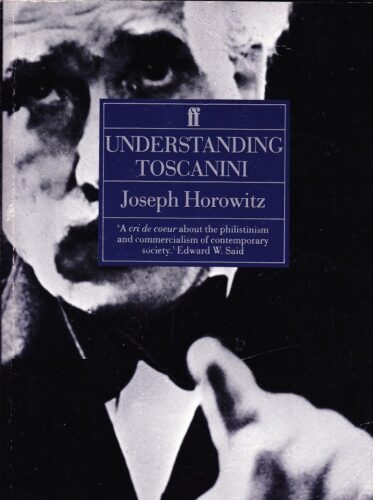
Not long after, I wound up running an orchestra: the Brooklyn Philharmonic at the Brooklyn Academy of Music. Harvey Lichtenstein, an impresario of genius (the last of his kind), had created a state-of-the-art performance venue by presenting what could not be seen or heard at Carnegie Hall or Lincoln Center. He had also entrusted his resident orchestra to Dennis Russell Davies and implemented a draconian shift in repertoire. As a result, the BPO was deserted by more than two-thirds of its subscribers over two agonizing seasons. It was playing to audiences of 350 in a 2,000-seat hall. I had written a notorious book, Understanding Toscanini: How He Became an American Culture-God and Helped Create a New Audience for Old Music, in which I situated BAM as an antidote to Lincoln Center. Harvey invited me to lunch. I proposed that the BPO be remodeled with the Schubert symposiums in mind. Harvey was a gambler and had nothing left to lose.
And so BPO seasons were structured as a series of thematic festivals, many with multiple events. The biggest was “The Russian Stravinsky,” which included two symphonic programs and a six-hour Sunday “Interplay” featuring Les Noces and Renard performed by the Pokrovsky Folk Ensemble from Moscow — which also recreated a traditional Russian wedding. For The Rite of Spring the preceding Saturday night, the opening bassoon solo was preceded by a reenactment of the ritual sacrifice of a virgin as witnessed by Stravinsky and Nicolas Roerich in rural Russia, a torrent of singing and dancing that deposited piles of straw on the lip of the stage. Five scholars — a music historian, two ethnomusicologists, and two art historians — participated. The program book (which won an ASCAP Deems Taylor Award) was 68 pages long. (A detailed description of it all may be found in my book The Post-Classical Predicament.)
Other BPO festivals included “Dvořák and America,” “Charles Ives’ America,” “Flamenco” (with a leading Spanish cantaora), “Orientalism” (with both Balinese and Javanese gamelan ensembles), “From Gospel to Gershwin” (with Boston’s Gunther Schuller, touting Black classical music before it became a widespread cause) — some incorporating film or drama, all with ancillary events in smaller spaces, all with participating scholars, all with thick program companions.
During my tenure, attendance increased four-fold and grant income exploded — Mellon, Knight, Hearst, Rockefeller all stepped up. We also became the first orchestra to land NEH support (heading a national consortium). We sustained an educational partnership with Brooklyn’s Pratt Institute, which was looking to supplement its humanities offerings. Our “educational” concerts, in middle and high schools, were also thematic, linked to our 1994 celebration of the centenary of Dvořák’s “New World” Symphony (for which we supplied a “visual presentation,” by Peter Bogdanoff, clinching Dvořák’s debt to Longfellow’s The Song of Hiawatha; it is still widely seen).
Nothing ever invalidated this experiment. It ended when an audit disclosed BAM deeply in debt. Harvey fired his CFO and terminated the symbiotic relationship linking BAM with the Brooklyn Philharmonic. From that moment, the orchestra died a lingering death.
I initiated a second incarnation of “festival programming” shortly after, when Larry Tamburri — an exceptional CEO — invited me to curate an annual three-week “winter festival” for the New Jersey Symphony. Larry had trouble selling tickets during the month of January. The winter festivals cured that. Some festival weeks featured five and even six events, including recitals and symposia. As important, they generated ongoing partnerships with the Newark Museum, Montclair State University, the history department of a superb suburban high school, and the music department of an embattled Newark high school (whose band was invited to perform on the stage of the New Jersey Performing Arts Center, a preconcert event attended by the families of the musicians). It all ended with Larry’s departure for the Pittsburgh Symphony, where such things proved impossible to implement because of in-house conflicts.
My next such stint was with the Pacific Symphony, inaugurating an annual American Music festival. I learned that enduring educational partnerships require avid partners — and ultimately there were none in Orange County, California. But thanks to a suggestion from Gary Good, on the PSO staff, I renewed the NEH consortium I had created at BAM. I called it “Music Unwound.” Funded four times, it endured from 2010 until last April, when it was terminated — along with 1,476 other NEH initiatives — by a couple of knuckleheads working for Elon Musk’s DOGE task force.
Music Unwound implemented more than three dozen humanities-infused, cross-disciplinary festivals via orchestras, universities, and conservatories in all parts of the United States. The participating scholars were leaders in their fields. The topics included “Dvořák and America,” “Kurt Weill’s America,” “Charles Ives’s America,” and “Copland and Mexico.” While I cannot claim that every participating institution proved ideally equipped to participate, the success rate was high. In El Paso, Texas, and Sioux Falls, South Dakota, especially, Music Unwound demonstrated the full promise of festival programming — for audience development; for focusing and expanding institutional mission.
In El Paso, the crucial ingredient was Frank Candelaria, then an associate provost at the University of Texas/El Paso and also a proactive board member of the El Paso Symphony. (Frank now teaches at Vanderbilt University.) Hundreds of UTEP students, and their families, experienced symphonic music for the first time. They learned about Dvořák’s historic advocacy of “Negro melodies,” and about their own cultural inheritance: the Mexican Revolution of Diego Rivera, Frida Kahlo, and Silvestre Revueltas. But the sleeper was the Kurt Weill story — about an exemplary immigrant who insisted on only speaking English from the moment he arrived, a refugee from Hitler’s Germany, in 1935. One morning I found myself addressing hundreds of high school students in a semi-rural “colonia.” When the assembly ended, the stage was occupied by the school chorus. They were eager to sing for me. They chose “The Star-Spangled Banner.”
But it is the South Dakota Symphony, among the nation’s most innovative orchestras, that seals the potential impact of the Boston Symphony’s new blueprint. Its music director, Delta David Gier, had been an associate conductor with the New York Philharmonic. He moved to Sioux Falls and has raised a family there. He has come to believe that “an orchestra should serve its unique community uniquely.” In South Dakota, that has meant connecting with Native America. Gier first met with Lakota and Dakota leaders in 2005 and encountered a wall of mistrust. After 20 years of patience and persistence (Gier did not delegate this effort), the SDSO Lakota Music Project has become its signature initiative, linking to reservations throughout the state.
It’s a visionary example of the “affinity programming” that the Boston Symphony foresees. In fact, many ethnic facets of Sioux Falls have been targeted, including refugees from Africa. And the relationship is mutual. When the city’s Arab community (including many doctors) asked Gier to help “show our culture to our children,” he engaged an oud master, Simone Shaheen, for a Sioux Falls residency. (The forthcoming South Dakota Symphony Lakota Music Project program, next November, would be a revelation in Boston. It juxtaposes the “New World” Symphony — plus visuals — with Arthur Farwell’s Indianist choruses and Derek Bermel’s Lakota Refrains for the Creekside Singers and orchestra — a new composition worthy of a Pulitzer. The Longfellow connection is local to Boston. And so is Farwell).
Music Unwound expanded the SDSO arts network to include four universities, two of which are an hour’s drive from Sioux Falls. For the Music Unwound “Dvorak and America” festival, the orchestra took a Lakota drumming group and Dvořák’s “New World” Symphony to the Sisseton reservation. For “Copland and Mexico,” 650 free tickets were claimed by Hispanic families. “New World Encounters,” exploring the influence of jazz abroad, brought former US Ambassador to Russia John Beyrle to two high schools and two universities.
Joining the SDSO members in such adventures is an inspiration. Alex Ross has repeatedly extolled the South Dakota Symphony in The New Yorker. The New York Times pays close attention. But other orchestras do not. In fact, with the cancellation of Music Unwound by DOGE, South Dakota’s is the only member orchestra that’s opted to maintain humanities-infused festival and affinity programing sans NEH support. This is a symptom of symphonic stagnation.
I would like to suggest a few lessons that may be extrapolated from the tale at hand.
The first, however self-evident, is that success depends on people: conductors, administrators, board members, and musicians who embrace an institutional mission rather than self-interest. For decades, the template of the “jet-set conductor,” with trans-Atlantic commitments, has crippled capacity for leadership and reform. When the Chicago Symphony decided to engage Klaus Mäkelä as its new music director, on top of his responsibilities as principal conductor of Amsterdam’s Concertgebouw Orchestra, that was a step backwards. It deserves to be seen as an anachronism.
“Education,” traditionally, has been a satellite department for American orchestras large and small. It functions as a cash-cow, enticing funding that is otherwise deployed. It produces young people’s concerts. It does not link to the music director or to the main subscription series. Any orchestra that opts for festival programming should resituate “education” as a central activity fortified by visiting scholars or, better, a scholar-in-residence. That’s what museums and theater companies have. The resulting template facilitates partnerships with universities and conservatories. It redefines the orchestra as a “humanities” institution. There was a time when charitable foundations and the NEH responded to such thinking with grants of substantial size. The foundations opted out because they discovered that orchestras could not implement fundamental change. The NEH opted out because it’s become a slush fund for ideological reform. These trends will not endure forever.
At BAM, I was handed an ideal classical-music audience, with little interest in celebrity soloists or standard repertoire. That constituency is gone today. What becomes crucial is that the music director inspire trust. Trust can lead. In South Dakota, David Gier can program boldly with impunity. The New York Philharmonic enjoys a similar opportunity right now: its incoming music director, Gustavo Dudamel, is already immensely popular.
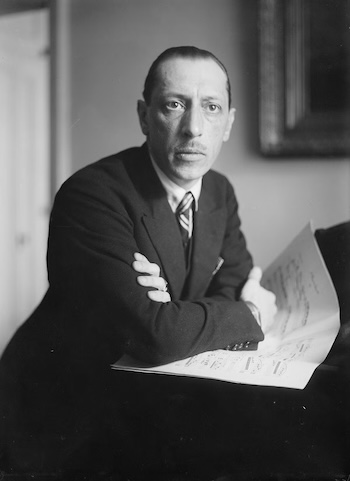
Composer Igor Stravinsky. Photo: Wikimedia
When my Classical Music in America was published in 2005, the Boston Symphony invited me talk about it. I took the opportunity to propose that the orchestra consider a festival exploring “Stravinsky in Boston,” partnered with Harvard University. It was at Harvard that Stravinsky in 1939-40 delivered his famous Norton lectures, controversially insisting that music is only about itself. And it was Serge Koussevitzky, majestically piloting the BSO, who most championed Stravinsky in the United States.
Both at Harvard and at Symphony Hall, I encountered no interest. And yet Boston, with its sophisticated audiences and stellar educational institutions, may be ideally configured to undertake the Boston Symphony transition now being proposed. (Whether the Los Angeles Philharmonic model of humanities infusion, prioritizing cutting-edge creative adventure, is a better Boston fit than cultivating cultural memory — e.g., exploring Boston’s own distinctive cultural inheritance — is another matter.)
As for the cleavage between musicians, management, and trustees — it is an old American story, played out many times over. In recent years, the Seattle Symphony and San Francisco Symphony have experienced similar upheavals that cost Seattle a transformational conductor (Thomas Dausgaard) and San Francisco a pedigreed institutional leader (Esa-Pekka Salonen). In South Dakota, the orchestra’s salaried core comprises a string quartet and wind quintet, both of which are largely self-governing; these are the nine happiest, most fulfilled symphonic musicians I have ever met. In Detroit, a brutal 2010-11 labor dispute yielded a fresh template empowering the musicians as crucial participants in every phase of the Detroit Symphony’s operations. Detroit’s may also be the major American orchestra that has most prioritized outreach to targeted urban communities. In the process, it has shrunk its main subscription season by one-third. (Many American orchestras give too many concerts, with supply far outstripping demand.) In Europe, the Bergen Philharmonic (Gramophone magazine’s “orchestra of the year” in 2025), while structured with a CEO and a board, is in many respects run by the players; everybody seems happy with the outcome.
Another story for another time.
Joseph Horowitz’s previous Arts Fuse pieces about the Boston Symphony are “Boston’s Lost Opportunity” and “What’s Next for the Boston Symphony?” He writes about the history of the BSO in Classical Music in America: A History of Its Rise and Fall and Moral Fire: Musical Portraits from America’s Fin-de-Siecle. He is also scholar-in-residence for the South Dakota Symphony. His blog is www.artsjournal.com/uq
Tagged: "Music Unwound", Andris Nelsons, Boston Symphony Orchestra