Film Review: “Erupcja” is Peak Entertainment
By Peter Keough
A volcanic comedy of fate and missed connections.
Erupcja, co-written and directed by Pete Ohs. At the Boston Common and in the suburbs.
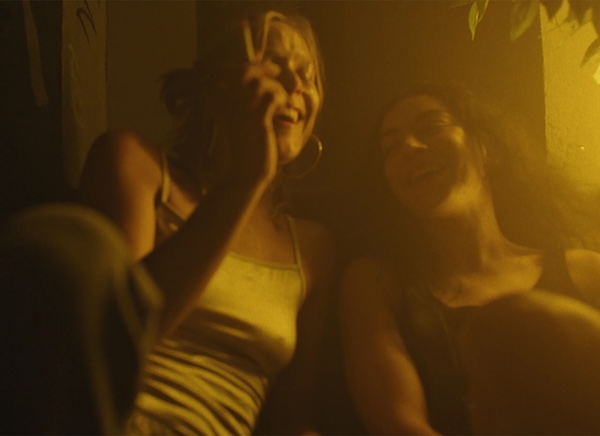
A scene from Pete Ohs’s Erupcja, Photo: TIFF
If A Real Pain whet your appetite for films set in everyday contemporary Poland and you don’t have time to peruse the oeuvre of Krzysztof Kieslowski, you could do worse than spend 71 minutes with indie innovator Pete Ohs’s capricious but calculated Erupcja. It’s a deceptively slight, engagingly effervescent, and sneakily profound study of desire, self-deception, and the mysteries of synchronicity.
Like, why do coincidences happen? From the small ones, such as thinking about eating an apricot tart and then your sister shows up with an apricot tart? To the more cosmological: why is it that every time there’s a major volcanic eruption, it plays havoc with airline routes, and you end up stranded in Warsaw?
That’s what happens to Londoners Bethany (musician/multi-hyphenate Charli xcx, affecting in her film debut, who also co-wrote the screenplay) and Rob (frequent Ohs collaborator Will Madden). They have travelled to the city because Bethany found it romantic (“Are you sure you don’t mean Krakow?,” someone incredulously asks when Rob mentions this) on prior visits. A perfect place to pop the question, Rob thinks, packing his grandmother’s wedding ring, newly refitted, for the occasion. But it’s clear when Bethany brushes her teeth and Rob unceremoniously takes a dump behind her that the magic might have left this relationship.
When her travel-weary mate hits the rack, Bethany decides to take in the city sights. She laments some of the changes, like the replacement of the old trams and Metro trains with new ones, though she notes (the thoughts and reflections are provided by a stern, lucid voiceover in Polish) that they still make the same noises. In some ways the city of Warsaw, a battered survivor of World War II and Soviet domination, with its cynically romantic, terminally ironic population, is one of the protagonists of the film. Like the Tokyo in Wim Wenders’s Perfect Days, it’s rendered in hardscrabble, everyday details ranging from a pedestrian overpass, to grungy apartment buildings, to the looming, Stalin-era Palace of Art and Culture and the iconic Mermaid Statue by the Vistula River.
One of those local attractions that she hopes hasn’t changed much is the “Cute Little Flower Shop” and its proprietor Nel. Wheir travel plans are disrupted by the eruption of Mt. Etna, Bethany decides to pay a call. Nel is played in a nuanced performance by Lena Góra, also an Ohs regular and contributor to the screenplay, which — like in a Mike Leigh film — seems to have been largely improvised by the cast. As it turns out, Nel and Bethany have some history together, if not a cosmic connection, then a thermo-geological one, connected by the serendipity of volcanic eruptions.
Like Kieslowski’s Blind Chance (1981), except instead of a missed train the turning point is a cancelled flight, Ohs’s film ponders the mysteries of free will and fate, of rued choices and missed opportunities. And beyond that, the fate of the world and of the universe beyond the hill of beans that is our own little affairs. As one character points out, volcanoes are more than just cute plot devices; they kill people. And in one uncharacteristically long, whimsy-free take (Ohs has a puckish, Nouvelle Vague-like sensibility) Bethany recites a chunk of Byron’s apocalyptic poem “Darkness,” written in 1816 during the so-called “Year Without a Summer,” an environmental disaster caused by the world-consuming ash cloud from the catastrophic eruption, the year before, of Mount Tambora in Indonesia.
“I had a dream, which was not all a dream,” the poem goes. “The bright sun was extinguish’d…/And men forgot their passions in the dread/Of this their desolation.” So even for the ultimate Romantic, it’s all fun and games until the lights go out.
Peter Keough writes about film and other topics and has contributed to numerous publications. He was the film editor of the Boston Phoenix from 1989 to its demise in 2013 and has edited three books on film, including Kathryn Bigelow: Interviews (University Press of Mississippi, 2013) and For Kids of All Ages: The National Society of Film Critics on Children’s Movies (Rowman & Littlefield, 2019).