
Visual Arts Review: Rewriting the Machine — Raffaella della Olga’s Radical Typewriter Art
By Debra Cash
Raffaella della Olga prepares manual typewriters the way John Cage prepared pianos, using their percussive power to completely subvert their original purpose.
Raffaella della Olga: Typescripts at Clark Art Institute, Eugene V. Thaw Gallery for Works on Paper in the Manton Research Center, Williamstown, MA. Runs through May 31.
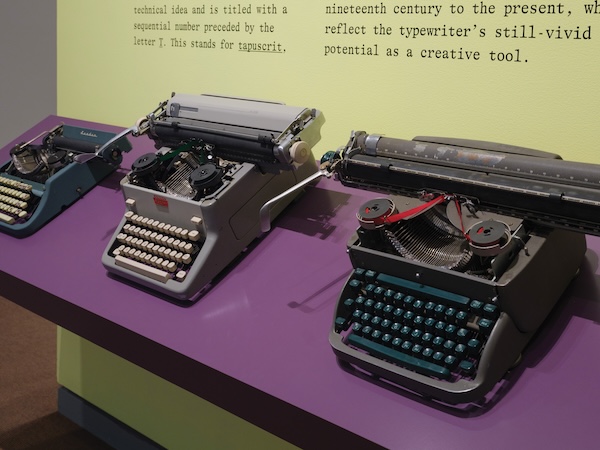
Installation view of Raffaella della Olga: Typescript. Photo: Mandy Johnson
My first typewriter was a monster.
A manual Swedish Facit, it was about the size of a small microwave oven, and weighed a ton. It had been scooped up by our next door neighbor, a carpenter and contractor who was working in an office building where, apparently, the typewriter had been abandoned. He gave it my father saying “you got a daughter who writes?”
By the time I went to college, I had a Smith Corona electric typewriter – a portable, also heavy but manageable – and used it so much that the platen – that black roller the keys hit – dried out and had to be replaced every six months. (Rest in peace, University Typewriter repair of Harvard Square.)
Along the way, I had a dull summer job at a law office where I got to use a fancy IBM Selectric with a “golfball” mechanism that you could pop out of the machine and replace with another golfball that let you type in italics.
I saw Jack Kerouac’s typewriter with the continuous 120’ roll of paper on which he hammered out On the Road set up like a relic to be venerated. I applauded the antics of the Boston Typewriter Orchestra one-upping Leroy Anderson’s symphonic novelty Typewriter.
But I never, ever thought to type on sandpaper.
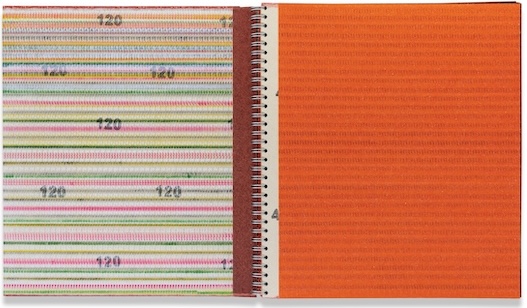
Raffaella della Olga, T44, 2023. Typewritten with carbon paper and ink ribbon on sandpaper. Courtesy of the artist and Three Star Books. Photo: Christophe Boutin
Raffaella della Olga: Typescripts on view at the Manton Research Center at the Clark Art Institute in the Berkshires displays an art that I would have thought to call completely original, except that the wise curators at the Clark have juxtaposed her achievement with that of her avant-garde typewriter-besotted predecessors. Born in 1967 near Bergamo Italy, the lawyer-turned-artist now lives in France; the small Clark exhibit curated by Robert Wiesenberger is her first solo museum show, spanning typewritten “paintings” and other wall-hung work, artist’s books (spiral bound and accordion folded) and deconstructed textiles.
Della Olga prepares manual typewriters the way John Cage prepared pianos, using their percussive power to completely subvert their original purpose. “I transform typewriters, I modify the alphabet to achieve an abstract writing,” she says in a sprightly gallery videotape that shows her hunkered down in her studio wearing headphones against the clatter. “I am like a musician who never stops exploring the potentialities of the instrument.”
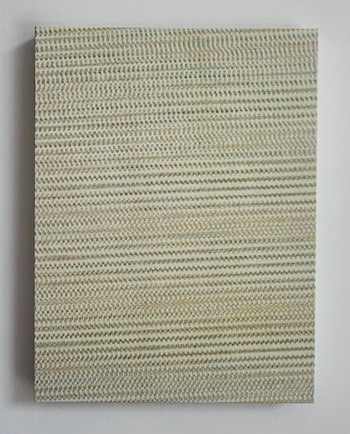
Raffaella della Olga, TP Haute-Isle 2, 2025. Typewritten with ink ribbon and carbon paper on canvas with oil paint. Courtesy of the artist and Three Star Books, Paris.
She grinds down the alphanumeric characters in her machines. Sandpaper and textiles make the process of writing “auto-destructive.” She types onto various surfaces, and obligingly, the curators have provided materials you can touch –paper, cloth, tissue paper, foil, carbon paper. (The museum explains what carbon paper is and that you have to put it in the typewriter dark-side down.)
Nonetheless, a typewriter without letters bears its own mechanical language in its sturdy repetitive grid. Della Olga uses different colored typewriter ribbons to “weave” a series of tightly laced geometries that play homage to objects as traditional as woven blankets, and as mindfully art historical as tributes to minimalists Dan Flavin and Sol LeWitt. (The Manton Research Center has mounted a small complementary exhibit of works in its own holdings, Gridlocked, dedicated to weaving before and after the Industrial Revolution, and in particular the patterns books kept by design apprentices and professionals.) Typing onto a piece of sandpaper, for instance, on a rectangle marked only by the number that indicates its grit level, the marks are alternately faint and distinct, like a ticking stripe. Other della Olga works move into the realm of embossing, but almost always along a grid that reads reassuringly rational against the occlusion of the typewriter’s “language.” I don’t know exactly how a stencil enabled della Olga to create a circular typewritten “clock” face, or what she had to do to master creating wavy lines without tearing fabric to shreds in the typewriter’s mechanism, but it’s all satisfyingly coherent.
Cutting negative spaces into the surface of wool suiting – she calls these works Stoffe, from the Italian word for textiles — I found myself most interested in the ways the regular pattern of gingham or tartan, raw threads left hanging, revealed their inherent angularity.
The graphic tradition of using a typewriter to make images dates back to as early as 1898, and the Clark owns a copy of the magazine Phonetic Journal to which British stenographer Flora Stacey contributed an image of a butterfly drawn entirely of typescript. Graduate student Natalie Ginsberg has done an admirable job of assembling instructive and often formally beautiful examples that came after that turn of the century experiment. It’s hardly surprising that members of the Bauhaus explored typewritten images, or that typewriting was a critical element in concrete poetry’s visualization strategies, but in an intricate red 2024 work by Egidija Čiricaitė that combines typing with the pattern of traditional Lithuanian bedspreads, mechanical abstraction paradoxically gestures towards comfort.
Writing this piece in Microsoft Word on a desktop PC, I still hear faintly clacking keys, but boy, I miss hearing that little bell at the end of a line.
Debra Cash, is a Founding Contributing Writer to the Arts Fuse and a member of its Board.
Tagged: "Raffaella della Olga: Typescripts", Clark Art Institute
2 Comments
Leave a Comment

Such a fun informative review. Thank you.
This sounds like a delightful exhibit! I wish it were possible for me to get there, but sadly I won’t.