Doc Talk: In “Steal This Story, Please!,” the Free, Independent Press Persists
By Peter Keough
A brisk, galvanizing portrait of Democracy Now!‘s Amy Goodman and the stubborn fight for adversarial journalism.
Steal This Story, Please! Directed by Carl Deal and Tia Lessin. At the Coolidge Corner Theatre April 30. Goodman and the directors will participate a Q&A after the 7 p.m. April 30 screening and Goodman will introduce the 9:55 p.m. screening.
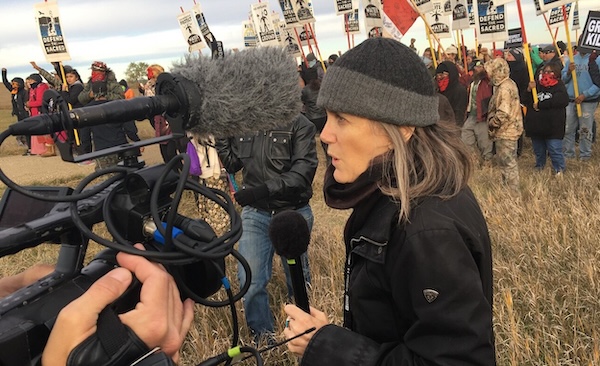
A scene featuring Amy Goodman in Steal This Story, Please! Photo: Coolidge Corner Theatre
According to the Nieman Reports and other sources, courageous independent journalists who defied government censorship and retaliation played a significant role in overthrowing Viktor Orban in the recent Hungarian election (to get an idea of what they were up against check out the 2024 documentary Democracy Noir). Here in the U.S., where the dominant corporate media—driven solely by the bottom line—supinely bends the knee to the administration, one wonders whether anything similar could happen.
Maybe if journalists were as determined as Amy Goodman of Democracy Now!, the maverick radio, TV, and internet news program she founded in 1996 just two weeks after the 1996 Telecommunications Act gave virtual carte blanche to the corporate takeover of the media. As Carl Deal and Tia Lessin’s infuriating and inspiring documentary begins, she is shown literally chasing down a story. Mic in hand, breathless, she pursues Trump shill P. Wells Griffith III (since confirmed in 2025 as Undersecretary of Labor) at the 2018 U.N. climate talks to ask him why he’s pitching fossil fuels as the antidote for environmental ills. He flees, racing down hallways and up staircases, and refuses to answer her repeated questions. In the end, he slams a door in her face, which, considering some of the responses Goodman has gotten over the years, was relatively benign.
Like her experience in East Timor in 1991, when she was on assignment at a demonstration against the Indonesian government. Soldiers opened fire, killing at least 250 unarmed civilians. They seized Goodman and her colleague Alan Nairn, and beat them, fracturing Nairn’s skull. Their report compelled Congress to end military aid to Indonesia – at least for a while.
Or at the 2008 Republican National Convention in St. Paul, when Goodman was arrested trying to rescue two other Democracy Now! staff members who were manhandled and detained by police (along with around thirty other journalists) while covering an anti-war demonstration. Later, Goodman would confront Katie Couric of CBS, ensconced comfortably as she schmoozed in the convention hall. Why were she and her crew not on the street, reporting on this violation of First Amendment rights? “Well, they’re packing in speeches and a lot of videos people want to see,” Couric explains. “But I’m definitely paying attention to it.”
And so on. With so much injustice, misery, and corruption to cover in under two hours, the Trump years pass by almost in a blur, condensed to a kind of horrific montage of greatest hits. Meanwhile, Deal and Lessin briskly recall Goodman’s career (at one point we see an eighth grade fan interviewing her), starting with her soliciting the Phil Donahue Show for a job, which led not to employment but an invitation to appear on a program about being unemployed. She declined the opportunity, but was grateful for the experience because it taught her that the only way she was going to maintain her journalistic integrity was to avoid the mainstream media and remain independent. After serving for several years as a producer for the progressive New York City FM station WBAI, she started Democracy Now!, which has expanded from its humble, hardscrabble origins to over 1500 radio and TV stations around the world.
Like one of Goodman’s shows, the film is briskly put together, breathlessly intercutting its sometimes harrowing footage with the occasional heartwarming scene, as when Goodman and company play Nina Simone’s “I Wish I Knew How It Would Feel to Be Free” to an elderly man released after being unjustly incarcerated for 38 years. In one throwaway moment, Goodman walks her dog Zazou (“She’s a girl but she marks everywhere”) who, she explains, is not named after Zazu, the red-billed hornbill from The Lion King, but after the French anti-Nazi Resistance group.
There are frequent interviews with admiring and grateful colleagues and others (a few detractors would have supplied an intriguing contrast), but the most compelling voice is Goodman’s, who attributes her “secret” to “Just showing up and asking the questions no one else bothers to ask.” In the end she quotes a statement by the members of the White Rose, a group of young Germans beheaded by the Third Reich for distributing anti-Nazi pamphlets: “We will not be silent.”
Peter Keough writes about film and other topics and has contributed to numerous publications. He was the film editor of the Boston Phoenix from 1989 to its demise in 2013 and has edited three books on film, including Kathryn Bigelow: Interviews (University Press of Mississippi, 2013) and For Kids of All Ages: The National Society of Film Critics on Children’s Movies (Rowman & Littlefield, 2019).
Tagged: "Democracy Now!", "Steal This Story Please!", Amy Goodman, Carl Deal