
Author Interview: Annie Zaleski on Stevie Nicks’s Lasting Power
By Blake Maddux
The author of Stevie Nicks in 50 Songs talks about Nicks’s enduring mystique, her influence on younger artists, and the challenge of choosing just 50 tracks.
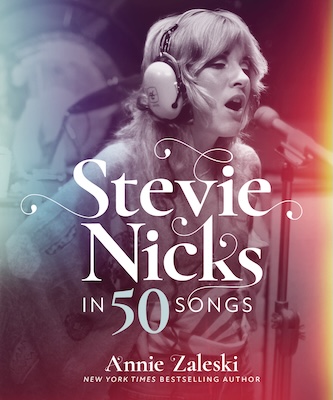 When my Arts Fuse editor forwarded an email about an upcoming book called Stevie Nicks in 50 Songs, I was interested but skeptical. Sure, I grew up hearing Nicks’s hugely popular solo hits, which included “Edge of Seventeen,” “Stand Back,” and the Tom Petty duet “Stop Draggin’ My Heart Around,” as well as Fleetwood Mac’s “Gypsy” (which is no longer the preferred nomenclature) and “Hold Me,” all of which to this day evoke vivid memories of my childhood. All the while, I was oblivious to the fact that Fleetwood Mac was neck-and-neck with the Eagles for the most popular band of late 1970s America. And she was responsible for their lone No. 1 hit.
But I didn’t really think that I was the person to write about a Stevie Nicks book, or that I was interested in doing so. That was, however, until I saw who the author was.
Annie Zaleski and I are close enough in age to both be children of the MTV revolution. Having the privilege of simultaneously hearing and “seeing” songs afforded our generation uniquely indelible images of the soundtrack of our lives. (Note: I am not suggesting that our experience was superior to previous or subsequent generations.)
Zaleski’s prolificacy as a commentator on this era — via several books and countless articles — has made me more informed and appreciative of the musical milieu of my youth.
Furthermore, the fact that she is as interested in the 2000s as she is any other period of our lifetimes made my Christmas shopping significantly easier a few years ago when she sent me copies of her 33-1/3 book about Duran Duran’s Rio for my Duranie sister-in-law and Taylor Swift: The Stories Behind the Songs for my Swiftie spouse.
Stevie Nicks in 50 Songs allows Zaleski to examine the significance of the two-time Rock and Roll Hall of Fame inductee (the first woman to be so honored) from her struggling pre–Fleetwood Mac days up to the present, when she serves as an inspiration for several of the world’s biggest contemporary superstars, including Beyoncé, Lady Gaga, Pink, Tay Tay, and Harry Styles, all of whom were subjects of Zaleski’s previous books.
So, Annie, thank you for answering my questions about your brand new book. And Bill, the aforementioned Arts Fuse editor, thanks for the email.
Arts Fuse: How did you land on this subject and why did you decide to sort of live with Stevie Nicks for the amount of time that it takes to write a book?
Annie Zaleski: First off, living in Stevie Nicks world is a great place to be. It’s all black lace, and mysticism, and spirituality, and beautiful lyrics. So it’s a good place to be.
I’ve loved Fleetwood Mac for as long as I can remember. My parents were big fans, so they’re a band that I sort of grew up knowing. Stevie Nicks in particular has really fascinated me by the way she has really resonated with younger generations. It’s been super, super cool to see her popularity outside of Fleetwood Mac continue to skyrocket. She’s headlining stadiums. That is like Taylor Swift and Beyoncé level.
So I’m fascinated by how she got there. What is it about her that made her stay at this level? And then after writing a book on Taylor Swift and Beyoncé, Stevie seemed like a very natural next step because they’re all influenced by her. She is such a godmother to everyone. So it just seemed to fit.
AF: When you were picking 50 songs, did you divide them into categories such as “definitely,” “probably,” “maybe,” and “sorry, but no”?
AZ: It was very, very complicated. First off, we have the hits. So I knew we were gonna have the big chunk of songs that if those weren’t in the book, everyone would wonder what was going on. Why is “Landslide” not in the book? Why is “Stop Draggin’ My Heart Around” not in the book? So there were the ones that had to be in there.
And then beyond that, the way I wanted to structure the book is, let’s look at who she was influenced by. We talk so much about who she influences and her own music, but she’s really influenced by Joni Mitchell, for example, and Linda Ronstadt, and The Mamas and the Papas, so I wanted to set the stage for where she came from.
Then, at the end, I talk about who she has influenced. Obviously Harry Styles, and Taylor, and Vanessa Carlton. And to show the continuum of her legacy. The hard part was everything in between. I could have had everything from Bella Donna and everything from The Wild Heart, but that would be a little bit much. So it was just looking at the songs that stood out. I think that those two records were the hardest to figure out.
AF: What was your first experience of hearing Stevie Nicks?
AZ: It was probably in the ’80s. I have a vague memory of hearing “I Can’t Wait” because I listened to Top 40 radio. But I will say that my most vivid early memory comes from my parents playing Fleetwood Mac when I was barely conscious. I loved Tango in the Night. A lot of Christine [McVie]’s songs were the big hits — the kinds of things you’d hear on the radio. But I remember being a kid and hearing “Everywhere” and “Little Lies” and thinking, “Yes, this is my jam!” So that was sort of my introduction. They’ve been the soundtrack to my life, and she has as well.
AF: Do you think that Stevie Nicks would have been a successful musician on her own if she and Lindsey Buckingham had separated before they joined Fleetwood Mac, or had never been together at all?
AZ: That’s a good question. It sounds like a movie script waiting to be made: “What if Stevie and Lindsey broke up before that?” But some of her most iconic songs came out of a challenging period in their lives — for example, “Landslide.”
She probably would have become a star in some form. Whether it would have taken longer, taken a different form, or happened on her own terms, we don’t know. But so much of what she was able to accomplish came from these amazing songs drawn from her lived experience. It’s a good question. It’s a philosophical question.
AF: What through-line connects the artists you have written about?
AZ: All of them have become musical successes on their own terms. All of the artists I’ve written about are singular. They’re very iconoclastic and make art in alignment with their particular vision. They’re also strong-willed and believe deeply in themselves, showing resilience, grit, and determination.
AF: Everyone has a reason to hate the recent New York Times list of the 30 Greatest Living American Songwriters. Stevie was not among them. Should she have been?
AZ: I think so. Absolutely. Oh yeah. Obviously they had very specific criteria. But there’s the impact she had on a lot of the artists on that list. And then there is also the way she reframed what a woman in a band could be. She was her own person — a very singular and charismatic character. She leaned into mysticism and spirituality and a kind of literary way of looking at the world. She was the blueprint for so much of what came after her. Of course, I’m biased because I wrote a book about her, but yeah, I think she should have been on the list.
Blake Maddux is a freelance journalist who regularly contributes to The Arts Fuse, Somerville Times, and Beverly Citizen. He has also written for DigBoston, the ARTery, Lynn Happens, the Providence Journal, The Onion’s A.V. Club, and the Columbus Dispatch. A native Ohioan, he moved to Boston in 2002 and currently lives with his wife and eight-year-old twins — Elliot Samuel and Xander Jackson — in Salem, MA.
Tagged: "Stevie Nicks in 50 Songs", Annie Zaleski, Fleetwood Mac
I’m hoping beyond hope that you included “Leather & Lace” in the book. It’s a beautiful love song between 2 people who had a tragic love story. I’m 51, Stevie is my spirit animal and I’ve been her fan since Rumors. Can’t wait for the book. Thank You.