
Poetry Review: Devin Johnston’s “Bright Thorn” — Observation Without Illumination
By Jim Kates
All too often, Devin Johnston’s poems remain at the level of reportage.
Bright Thorn: 2000-2026 by Devin Johnston. Farrar Straus & Giroux, 256 pages, $24
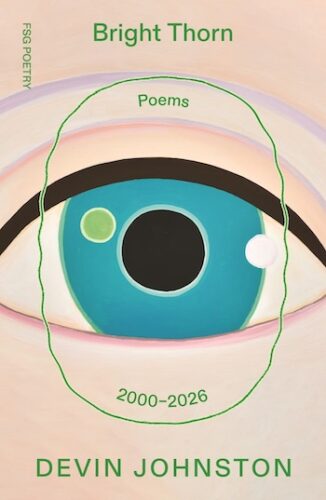
“Poetry is news that stays news,” according to Ezra Pound. For the most part, the lines in Devin Johnston’s Bright Thorn are reportage passing as poetry: stale observations along with feelings about what we find around us, expressed in language that’s sometimes sensitive and clever, but seldom startling or moving.
Here is “Geode.”
In a farmhouse at dusk,
a young girl sorts her rocks
and stores them in a cardboard box
where they nestle in tissue paper,
at rest from erosion.
Her fingers, soft as tissue,
lift and turn a geode
(the accident of epochs)
as if it were an egg.
For her, the stone is new.
I’m happy for the girl, but what is going on here? There’s a tad of sensitivity in the sound — the “rocks / box” and “nestle / rest” rhymes — yet they feel accidental. They serve no purpose to the poem, convey no music to the listener. We learn nothing about the girl herself, nothing about geodes, and less than nothing about the observing narrator. Does it matter that it’s dusk, or is that just a one-word poetic time of day? Why a farmhouse? Readers are expected to import the magic of a geode, if we want any magic here at all. If it is egg-like, it is a mineral, sterile egg. The point of the poem seems to be simply the observation itself: reportage.
Page after page is like this, with looks at ordinary subjects that are not illuminated by the kind of expanding awareness we expect from Zen-influenced poets nor enriched by the resources of more traditional verse, modernist experimentation, or slam exuberance. Starting from nowhere — in spite of the vague references to a great number of different geographical settings — most of the poems also go nowhere.
The drabness of Johnston’s verse is not for want of craft. The ho-hum of it all is underlined by occasional flashes of deft adaptations of other, much older poets, whose news comes across as especially new set against the background of Johnston’s own local commonplaces. Even the no-news of one of these adaptations, “Nothing Song,” lit from the inside by Johnston’s formal imitation, outshines most of the poet’s own work. Appreciate how he deploys the rhymes of the Provençal of William of Aquitaine’s “Farai un vers de dreit nien,” and uses the final troche to drop the deadbolt on negation. It’s not quite a translation, but Johnston follows the original in lightness and sentiment, and makes it his own.
My song of nothing done,
I ride from Avignon
and leave my words to one
who turns a key
to find the deadbolt drawn
and stable empty.
So he does also with Guiraut Riquier, and the Latin poets Horace and Ovid.
To be fair, a few of Johnston’s poems stand out, demonstrate real urgency and poignancy. In “Fourteen,” Johnston provides an aching portrayal of adolescence:
You shut the blinds against the sun, against the trees in bloom,
and test a gift you gave yourself, a bottle of perfume.
* * *
A pungent odor, dark yet brisk. Sequestered in your room,
you text or scribble furtively to concentrate the gloom.
And “Chester, Illinois,” puts myth and language to powerful use as it paints a genre landscape that suggests a life far beneath the surface:
Far from the sea,
far from its whip and precipitous glare,
a floodplain streaked with rills
condenses the leaden light.
Perhaps it’s not a coincidence that the more compelling poems are in the fourth section (of five) in Bright Thorn, which does not inform readers which poems (the collection ranges over a quarter of a century) are earlier and which are later.
The poem that gives its title to the collection speaks of suffering in a most minimalist way: “you learn / nothing but pain / from pain.” It promises that “each bright thorn / collects / a bead of rain,” but nothing more.
In “A Poetry of Place,” Johnston’s speaker addresses an unspecified “you” who had lived as a neighbor, but who “had packed your bags and flitted back to Brooklyn, / from what, and to what end, I never knew.” The reader is left in a similarly empty space after reading all too many of Johnston’s poems.
J. Kates is a poet, feature journalist, reviewer, literary translator, and the president and co-director of Zephyr Press, a nonprofit press that focuses on contemporary works in translation from Russia, Eastern Europe, and Asia. His latest book of poetry is Places of Permanent Shade (Accents Publishing) and his newest translation is Sixty Years Selected Poems: 1957-2017, the works of the Russian poet Mikhail Yeryomin.