
Film Review: “The Last One for the Road” — Booze Crews
By Peter Keough
This soused picaresque is heading for a DUI.
The Last One for the Road, directed by Francesco Sossai. At the Brattle Theatre June 5-8.
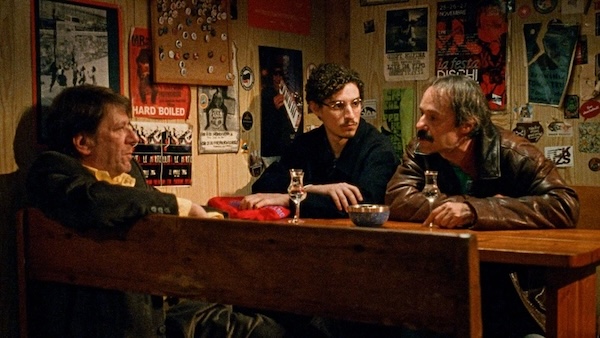
A scene featuring the tipsy trio in The Last One for the Road. Photo: Music Box Films
It is probably one of those meaningless movie release coincidences, but two European films that have opened in the past couple of weeks share remarkable similarities. Or maybe it’s just a quirk of the Brattle Theatre’s scheduling.
Be that as it may, in Hungarian director Radu Jude’s Kontinental ’25, a middle-aged bureaucrat faces an existential crisis by going on an uncharacteristic bender with a jaded former law student. The bad guys here are the parasitic real estate developers who make cities unlivable for poor people.
Meanwhile, in Italian director Francesco Sossai’s soused picaresque The Last One for the Road, two middle-aged, alcoholic grifters enlist a naïve, aspiring architecture student in their perpetual bender. Again, the bad guys are the real estate developers, who in this case are making the countryside unlivable for rich people and those who aspire to be like them.
That, anyway, is one of the sodden arguments the pair maintain, though their point is understandably foggy, as is the point of the film, which is a virtue as well as a drawback. Another virtue is the casting. This is not one of those films about drunks that stars a slumming hunk as in Thomas Vinterberg’s Another Round with Mads Mikkelsen. Instead, Pierpaolo Capovilla, who plays Doriano, and Sergio Romano, who plays Carlobianchi, have faces that look like they’ve seen their share of last ones for the road.
First seen passed out late at night in their Jaguar as a traffic light changes their faces from red to green while other motorists sound their horns, they are ostensibly en route to pick up their long-lost crony Genio at the airport. But is it the airport in Venice or Treviso? Before that can be resolved, they crash a graduation party and bump into Giulio (Filippo Scotti, resembling a cross between Timothée Chalamet and Harpo Marx), who has just been jilted by the celebration’s honoree (maybe it was because he wanted to take her on a date to visit the Brion Tomb, Carlo Scarpa’s modernist masterpiece). Why not drag the kid along, they impulsively decide, wherever they might be going? Though Giulio has an important test in the morning, he’s the type of guy whom guys like Doriano and Carlobianchi are used to finagling into doing things that are against his better judgment.
So, what starts as a bibulous Waiting for Godot segues into a riff on The Last Detail. As might be expected, one of the many stops on their way includes a visit to a woman who will initiate Giulio into the mysteries of non-committal sex. Another stop is at the villa of a count who mistakes the trio for architects he has employed to help him deal with the encroachment of a mystery highway onto his estate. Here Giulio’s skills come in handy as he ponders the situation while the two others commiserate with the count that such boondoggles are the downfall of traditional (i.e., aristocratic) Italian values. The film’s Italian title Le città di pianura translates to “cities of the plain,” which refers not to Sodom and Gomorrah or the Proust volume but to the cutthroat industrial metropolises of the Po Valley, which, according to Doriano and Carlobianchi, have been taken over by the big-time con artists who have squeezed out the failed small-time operators like themselves.
And what of Genio? He shows up at the end, a victim, in a way, of the same rampant commercial development. But the film works best when these plot details and thematic notions remain blurry, a state of blithering bliss enhanced by the Tom Waits-like soundtrack from Krano. These moments celebrate the cloud of unknowing, like the opening sequence where a guy gets a retirement watch and the company owner’s words of advice are washed out as his helicopter takes off. Or Carlobianchi’s tips to Giulio which are lost as his train pulls out. Or the meaning of life that Doriano discovered while wasted one night but can’t remember. And is the actor who plays Giulio also playing the younger version of Genio in flashbacks? Maybe a few more drinks might help in figuring it all out.
Peter Keough writes about film and other topics and has contributed to numerous publications. He was the film editor of the Boston Phoenix from 1989 to its demise in 2013 and has edited three books on film, including Kathryn Bigelow: Interviews (University Press of Mississippi, 2013) and For Kids of All Ages: The National Society of Film Critics on Children’s Movies (Rowman & Littlefield, 2019).
Tagged: "The Last One for the Road", Filippo Scotti, Francesco Sossai, Pierpaolo Capovilla
2 Comments
Leave a Comment

There was too much meandering and fogginess for me with this film. I walked out after an hour of pointlessness.
my feelings about life in general