
Film Review: “The End of Oak Street” — Dinosaurs in the ’Burbs
By Michael Marano
David Robert Mitchell’s affectionate, unsettling return to an early-’80s Detroit suburb brings Spielbergian wonder and suburban anxiety into collision—though its dinosaur-driven black comedy eventually wears thin.
The End of Oak Street, directed by David Robert Mitchell. Screening at AMC Boston Common 19, AMC Causeway, Alamo Drafthouse, AMC South Bay Center, and Landmark Kendall Square Cinema.
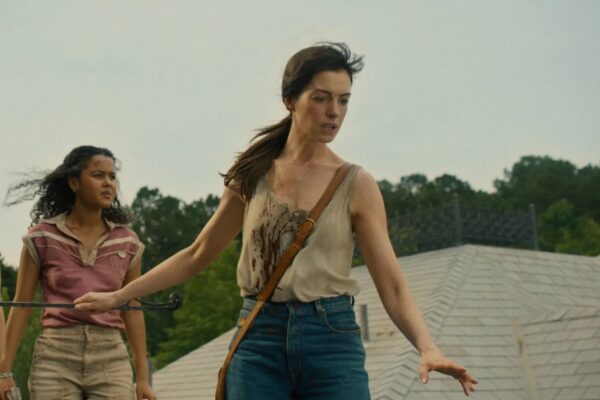
A scene from The End of Oak Street. Photo: Photo: Warner Bros.
I’m a big fan of “crazy shit in the suburbs” movies, shows, and stories. Maybe because I’ve never lived in suburbia — it’s foreign and familiar to me at the same time? Kinda like the Shire? It’s a deliciously thin line, especially as articulated by W.H. Auden’s post-war “Age of Anxiety,” between the psychodramas of John Cheever like O Youth and Beauty! (about a guy risking his life to recapture his glory days) and Twilight Zone episodes like The Monsters Are Due on Maple Street (about the paranoia that’d ensue if suburban amenities like electricity were switched on and off).
The American suburb harbors a darkness that Don Draper on Mad Men could opportunistically harness. It reflects a scrambling for prosperity and stability that has driven a good part of the our economy and culture. It simmers behind Richard Yates’s Revolutionary Road and Updike’s Rabbit stories, in the horror stories of Richard Matheson and the novels of Stephen King. It’s generated an American suburban folklore, an unreality fragile enough at the dawn of the Reagan era to be credibly intruded upon by a friendly alien in E.T. and by vengeful ghosts in Poltergeist.
The End of Oak Street, directed by the maker of It Follows, David Robert Mitchell, may tap into the same vibes as the classic Outer Limits episode A Feasibility Study (about the disappearance of an entire suburban neighborhood), but in an early 1980s Detroit suburb iteration. Mitchell’s 1981 suburbia feels remarkably unfragile, probably because Mitchell was too young living in his Detroit suburb to have felt Auden’s aura of “Anxiety.” The intrusion of the unreal doesn’t hit the way Spielberg’s aliens and ghosts did back in the days in which this movie is set. It hits harder. Why?
This “crazy shit in the suburbs” movie is different from its antecedents, because it’s basically Fellini’s Amarcord with dinosaurs.
There’s an intensely personal stamp to Oak Street, a richness and sincerity that feels like the freshest take on the “crazy shit in the suburbs” genre since Donnie Darko. Mitchell doesn’t infuse the film with saccharine nostalgia. Yes, Oak Street begins with a block party, Brady-esque potato sack races, and early-era MTV hits needle-dropping all over the soundtrack. But none of the reconstructed past feels irritatingly precious, in the way 1950s nostalgia did in the Happy Days era or in the way that made Wonder Woman 1984 unwatchable. As with Stranger Things, Andy Muschietti’s It duology, Teenage Sex and Death at Camp Miasma, The Black Phone, and Super 8, the ’80s aren’t made cuddly and cute.
The End of Oak Street and the ’80s suburbia in which it is set are given a deeply personal vibe. This movie is defined by real memories, and they are not used for the sake of a conceit or gimmick. (What kid hasn’t imagined, Calvin and Hobbes-like, dinosaurs rampaging through their neighborhood while walking to school?) There is the unquestionable sense that this is how Mitchell grew up, as if we’re watching his folks’ home movies courtesy of a rattling home projector. As a flick about dinosaurs that’s also a Fabelmans-like recollection of family life, this movie, set when Spielberg was turning this exact version of the ‘burbs into myth, is more of a Spielberg movie than anything he himself has made in years. Michael Giacchino’s soundtrack is indistinguishable from a John Williams score, with almost identical cues and beats. If you came out of the really dismal Disclosure Day hungry for a real Spielberg fix, Oak Street, which has more real dinosaur thrills than all the shitty Jurassic movies going back to 2001’s Jurassic Park III, is the movie for you.
Mitchell doesn’t rose-tint his past. Of course, we have some issues with our protagonist family’s dad, Greg (Ewan McGregor), who is dealing with job troubles at the Chrysler plant and has to make money on the side delivering pizzas. Mom Denise (Anne Hathaway) is making like Peyton Place author Grace Metalious, sitting in her basement writing a novel deconstructing her life and asking, same as Betty Friedan, “Is this all?” Daughter Audrey (Maisy Stella) has the grades, but not the cash, to study astrophysics at Cornell with her idol, Carl Sagan. And sonny Brian (Christian Convery), has a lovable dog named Starbuck with behavior problems and, of course, is being stalked by a local bully.
Our protagonists’ neighborhood is whisked back to the Age of Dinosaurs through means that are never explained, because they don’t need to be explained. The stresses of being hunted by apex predator theropods cause frayed and strained familial bonds to be reforged in ways that don’t come across as schmaltzy, and what schmaltz there is feels earned.
Still, despite all the really admirable stuff in The End of Oak Street, there comes a point when the fun runs out.
The End of Oak Street is kind of a black comedy, despite, or maybe because of, all the suburbanites, clad in poly/cotton blends and pastels, who are devoured. The movie, with oblivious people initially going about their business while terrifying, humongous flesh-eating monsters lurk just on the other side of their porches, hits the same deadpan/grotesque notes as do Gahan Wilson and Charles Addams cartoons.
But the same joke is told, over and over again. Eventually, it strains credibility that people scared shitless about being eaten would remain so oblivious to the very large things trying to eat them. And I know how absurd the phrase “strains credibility” sounds when we’re talking about a movie in which a Spinosaurus bellows on a lawn better suited for the placement of plastic pink flamingos, but I stand by my statement.
On the whole, the fun in The End of Oak Street offsets the drag. But there’s no denying that, at times, Mitchell overplays his hand. If I were less grouchy, or maybe jacked on more caffeine when I saw it, I might have liked it better.
But, hey… after FOUR atrocious Jurassic World movies, Hollywood owes us some good dinosaur thrills, and Oak Street at least partly pays that debt.
Critic, author, writing instructor and personal trainer Michael Marano has loved dinosaur movies since toddler-hood, and at the age of five was blown away by Ray Harryhausen’s dinosaurs in One Million Years B.C. Many years later, he met Harryhausen and actually got to shake the hand that moved the dinosaurs and brought them to life.
Tagged: "The End of Oak Street", Anne Hathaway, Christian Convery, David Robert Mitchell’
1 Comment
Leave a Comment
This was such a nice neighborhood until the allosauruses moved in.