Film Review: In Radu Jude’s “Kontinental ’25,” There’s No Room at the Inn
By Peter Keough
Radu Jude’s latest begins in Ken Loach–like realism before veering into a savage, cine-literate black comedy about complicity and conscience.
Kontinental ’25. Directed by Radu Jude. At the Brattle Theatre May 29-31.
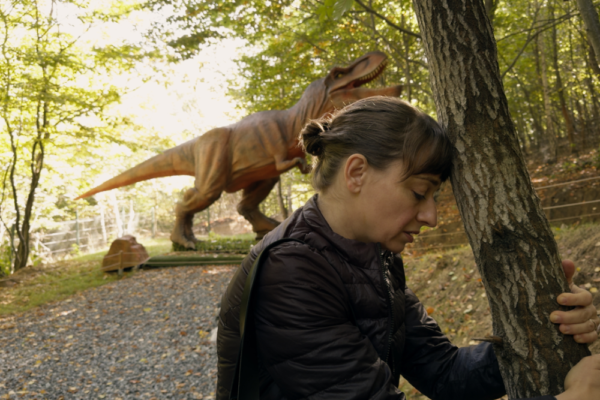
Eszter Tompa in Kontinental ’25. Photo: Berlin Film Festival
Kontinental ’25 doesn’t reveal itself as a Radu Jude movie until the appearance of the animatronic dinosaurs. The camera follows Ion (Gabriel Spahiu), a noisome, elderly indigent, as he roams through the Transylvanian city of Cluj, picking up cans and pestering residents for spare change, in what seems at first a somber social problem movie, say, something by the Dardenne brothers or Ken Loach.
But when Ion saunters into the local Dino Park, cursing and dragging his bags of cans past the highly realistic replicas of extinct saurians, the filmmaker’s skewed sensibility takes over. It’s the surreal, absurdist vision one associates with the director of Aferim (2015) and Do Not Expect Too Much from the End of the World (2023). His deceptively ludic spirit and bitter glee underscore the grim truths his films dissect and expose.
After his wanderings, Ion returns to the cramped basement he calls home. But the building has been sold to real estate developers who want to raze it and build a luxury boutique hotel called The Kontinental. Assigned to extricate Ion from his lodgings, the humane bailiff Orsolya (Eszter Tompa, who resembles SNL’s Rachel Dratch of Debbie Downer fame), backed by a crew of gung-ho, balaclava-clad gendarmes, allows Ion a little extra time to gather his belongings. When they return, they discover he has hanged himself from the radiator. With its blunt depiction of the fate of the poor and helpless trapped in a heartless system, the scene recalls Cristi Puiu’s breakthrough Romanian New Wave masterpiece The Death of Mr. Lazarescu (2005), a film on which Jude served as assistant director.
The radiator detail is the part that those who hear the story (Orsolya will tell it to anyone who will listen, like the protagonist in Katherine Anne Porter’s 1937 novella Noon Wine) can’t quite make sense of. How do you hang yourself from a radiator? And it’s a detail Orsolya can’t forget, along with the man’s bulging eyes and the smell of urine. In vain, she had a standee of scimitar-wielding horsemen moved to cover the radiator in her office. She’s so upset, so guilty, that she can’t bring herself to join her family on their holiday trip to Greece.
Instead, she stays home alone, filling her downtime by unconsciously retracing the route we saw Ion follow at the beginning of the film—past monuments, churches, and tourist areas, and up to the Dino Park. There, in moments of sardonic poignancy, she pets a brachiosaurus as it’s devoured by raptors and recites the Lord’s Prayer next to a rampant T. rex. She looks for interlocutors who might console her, including her pro-Orbán Hungarian mother and a former student from her law school days, with whom she indulges in a drunken escapade. At last, she turns to her priest for guidance, with mixed results.
The priest episode recalls a similar scene in Roberto Rossellini’s Europe ’51 (1952), which, as noted in a recent New Yorker interview with Jude, inspired his movie (a poster for it appears on the wall of a cinema bar where Orsolya tries to drink away her grief). It is one of several films Jude alludes to, sometimes playfully, always pointedly (others include Schindler’s List, Perfect Days, and Detour). As with Rossellini’s film—in which a wealthy woman’s neglect of her son has dire consequences that she tries to amend through good deeds—Jude’s black comic tragedy shows how common human decency is not enough to counter the ills of an evil system.
Another classic Italian film evoked by Kontinental ’25, perhaps more pertinently, is Michelangelo Antonioni’s L’eclisse (1962), which ends with a wordless series of desolate urban landscapes. Jude similarly concludes his film with a montage of buildings in Cluj—not the landmarks featured earlier, but luxury residential developments under construction or derelict housing awaiting demolition—structures that remain empty yet inaccessible to Ion, who is granted a resting place only when he is buried in a pauper’s grave.
Peter Keough writes about film and other topics and has contributed to numerous publications. He was the film editor of the Boston Phoenix from 1989 to its demise in 2013 and has edited three books on film, including Kathryn Bigelow: Interviews (University Press of Mississippi, 2013) and For Kids of All Ages: The National Society of Film Critics on Children’s Movies (Rowman & Littlefield, 2019).