Book Review: The Roots of the Thin Blue Line — How Slavery Created American Policing
By Bill Littlefield
A powerful new book exposes how the fear of Black liberation shaped the American legal order—and how the legacy of the slave patrol endures today.
White Power: Policing American Slavery by Gautham Rao. The University of North Carolina Press, 287 pages, $30.
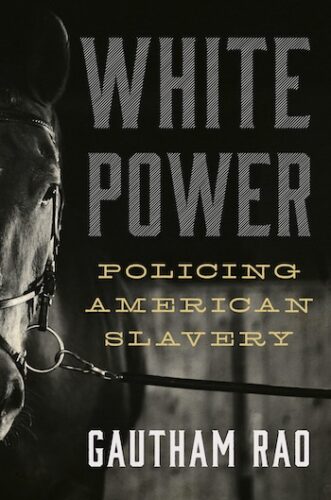 Gautham Rao, Associate Professor of History at American University in Washington, D.C., has traced the origins and development of the system in which “white power and police power” have been one in the same. His account provides massive historical evidence that the marriage of the two “powers” “existed from the earliest days of colonial Virginia’s tobacco plantations in the 1600’s until after the Civil War,” and, as he puts it, “some wonder whether it ever actually ended.”
Accounts of the abuses and insane cruelty built into the system of enslavement in this country will not necessarily shock readers familiar with the nation’s history. But even those aware of rebellions such as Nat Turner’s revolt and the German Coast Uprising may be surprised by how often and with what determination enslaved people tried to escape or fight against their circumstances, as well as how often they succeeded. Rao explains how the attempts of enslaved people to flee their enslavement compounded the White population’s persistent fear that insurrections and revolts were always in the works. This anxiety drove the enslavers (and their sympathizers) to create a system of policing that went far beyond the vigilance and discipline plantation owners could exercise on their own behalf. As Rao notes, “It didn’t take much to get a ‘company’ of armed white men to go looking for a slave insurrection” in this “permanent state of emergency.” The result was a series of ever-more severe practices generated by the popular contention that White men, whether individually or as part of “patrols,” deputized or not, had the authority to disrupt — even end — the lives of Black men and women without cause or fear of consequence. Such was the case well beyond the end of the Civil War.
Some of the most extreme consequences of the “policing” Rao describes might seem at first hard to believe. One of the “most infamous policing laws” in force in the 1820’s was the Negro Seaman Act. It required “the incarceration of all free Black sailors who arrived in Charleston, South Carolina, until the ship on which they arrived departed.” The panic driving this legislation was that the “free” Black sailors would somehow infect enslaved men and women with an urge to revolt or run away. Because of this foreboding, whatever rights the “free” sailors had were negated via the establishment of a “permanent state of emergency.” White enslavers were frightened that free Black people had the potential to disrupt, perhaps violently, their society and its economy, which gave rise to associations such as the American Colonization Society, which facilitated the deportation of Black citizens to what would become Monrovia, in Liberia. Among the members of the American Colonization Society: Thomas Jefferson and James Madison. A couple of decades before the Civil War, the legislature in Mississippi passed a law that made it illegal to free enslaved men and women — unless they were going to be deported.
In a chapter titled “Slavery Captures the Federal Government,” Rao argues that, thanks in part to Roger B. Taney, Chief Justice of the Supreme Court, “the federal government’s young policing power” was inspired by “the slave policing laws that had long reigned supreme in the South.” The Fugitive Slave Law of 1850 was designed to insure that enslavers would have the opportunity to recover their “property,” wherever that “property” might go. But the real life result of the legislation was to encourage White citizens to act as self-appointed agents of the law in shaping the affairs of Black men and women, whether or not the latter had ever been enslaved. As Rao contends, “the law gave enslavers a new level of influence over the inner workings of the federal government,” and “a new, coercive authority unprecedented in the history of the republic.”
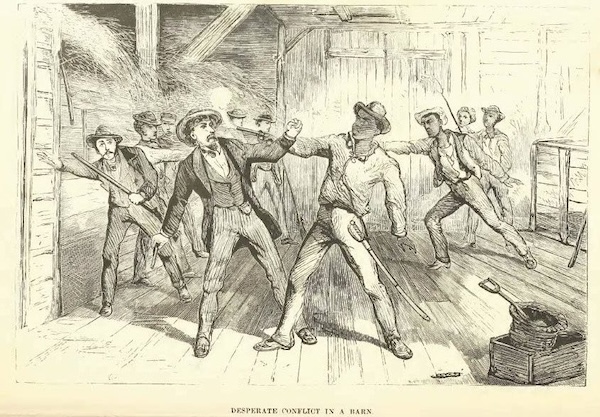
Indentured Servant and Slave Patrols in Virginia — “Desperate Conflict in a Barn.” Photo: Encyclopedia Virginia
While fighting the institution of slavery itself, Black citizens and abolitionists frequently resisted—and overcame—the Fugitive Slave Law. In 1851, a Black man named William Parker, who had dedicated himself to thwarting slave catchers in Pennsylvania, formed a network of “self-emancipated and free Black locals.” When a posse of enslavers arrived, Parker’s network killed the group’s leader and wounded several of his deputies. As Rao reports, Parker then fled to the home of Frederick Douglass before ultimately escaping to Canada.
After the Civil War, White southerners who refused to accept defeat worked tirelessly to develop “draconian systems of racialized public policing that aimed to subordinate Black Americans.” This backlash ultimately derailed Reconstruction, ushered in the era of Jim Crow, and left Black citizens “assassinated, whipped, and persecuted” simply because they were asserting their freedom. At the same time, according to historian John Bardes, a broader national trend was emerging that “put the prison at the center of the American understanding of criminality.” The tragic reality, as Rao observes, is that after the devastation of the Civil War, ex-Confederates clung to White supremacy, using it to build new policing measures designed to control and subjugate emancipated people. Ultimately, they spent decades working to weave White supremacist violence directly into the fabric of the nation’s legal order.

Historian Gautham Rao. Photo: courtesy of the artist
The latter part of White Power details how these historical tactics extended to voter intimidation, which included stationing paramilitaries at the polls to terrorize Black voters. It also highlights how politicians ginned up racial hatred against Black migrants moving north, weaponizing “Great Replacement” rhetoric by claiming these new arrivals were determined to replace White men in the workforce and society.
Today, these shameful practices endure and evolve. As Rao points out, “modern policing bestows police officers with virtually limitless authority to use violence.” However, unlike the era of the Fugitive Slave Law, when virtually any White citizen could be deputized to hunt enslaved people, modern violence is often state-sanctioned. Rao warns that unless we confront the legacy of this “old system” and recognize its echoes in modern legislation like “Stand Your Ground” laws, we risk backsliding into a world where the government delegates policing to citizens, who will be given the social permission and legal authority to exercise their ‘right’ to be violent. In such a world, masked, heavily armed men will be able to stop a person of color without a warrant to demand their papers under threat of arrest and deportation—a reality that sounds chillingly identical to the operations of modern-day ICE.
The hope is that Rao’s thorough research and urgent warning will resonate with the citizens of an already deeply embattled nation.
Bill Littlefield volunteers with the Emerson Prison Initiative. His most recent novel is Mercy (Black Rose Writing)
Tagged: "White Power: Policing American Slavery", Gautham Rao, Policing, Slavery, civil-war