Book Review: “American Rambler” — The Myth of the Open Road
By Debra Cash
Essayist and memoirist Isaac Fitzgerald follows Johnny Appleseed into a landscape shaped as much by omission and privilege as by history.
American Rambler: Walking the Trail of Johnny Appleseed by Isaac Fitzgerald. Knopf, 336 pages, $32
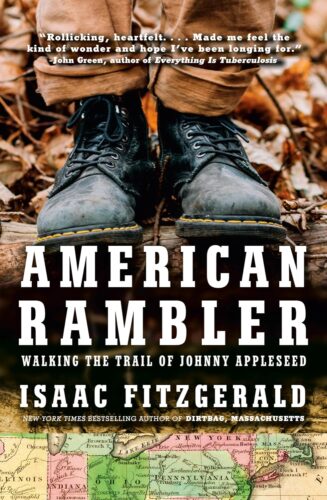
Do you still think of Johnny Appleseed as a barefoot guy wearing a tin pot as a hat, strewing seeds into an unplowed American wilderness?
Or maybe you think of him as a prescient environmentalist, proclaiming nature his cathedral, a vegetarian increasing food sustainability for all.
Or a crazed Swedenborgian evangelist, seeing angels wherever he glanced.
Or the entrepreneurial wedge of colonial American expansionism.
In this fraught semiquincentennial year, the icons of American mythology need some brushing off and polishing up. Evidence? Who needs it? Critical thinking? The supply chain seems to be broken. Looking more deeply into those figures offers readers a chance to take the measure of the American experiment in the shifting narratives we tell about people like the nurseryman John Chapman.
Isaac Fitzgerald sees traces of John Chapman as an underground stream shaping America’s rural communities without their knowing it. His life has been transmuted into the granite of scattered monument markers, the names of trails and public parks, and local community festivals both opulent and pared down. None, really, depend on historical veracity.
Yes, Chapman was born in 1774 in Leominster, Massachusetts and died in 1885, apparently on the floor of a friend’s cabin near Fort Wayne, Indiana. (According to Fitzgerald, in his 70s he remained vigorous: he had walked 15 miles earlier that day.) But there are many gaps hidden in the hyphen between those years. Gaps, rumors, and flat-out inaccuracies. For instance, Johnny Appleseed wasn’t poor, although he may have dressed like it. He bought some of the land his nurseries stood on, fencing it against animals and checking on it during annual or near-annual visits. When he died, he left more than a thousand acres to his sister.
As our lives become more sedentary and our attention more fractured, this is not the first such memoir I’ve read recently. Ben Shattuck followed the peregrinations of Henry David Thoreau in his 2022 Six Walks. Despite the invocation of singular elders, both Shattuck and Fitzgerald find that the American landscapes they passed through (and that Thoreau wrote so brilliantly about) are now barely recognizable: built up, paved over, inaccessible, or disappeared.
As a child, Isaac Fitzgerald considered Johnny Appleseed his “patron saint.” Massachusetts born—born in Athol to parents who, he wryly notes, were married to other people at the time—he was proud that Chapman grew up just down the road from his mother’s run-down family farm. As a kid, he had it hard, living in a homeless shelter and then in derelict settings ripe with resentment, not fully understanding but having to cope with his mother’s mental illness. (Arts Fuse review of Fitzgerald’s Dirtbag, Massachusetts, A Confessional.)
From the get-go, Fitzgerald knows that Chapman’s story is serving as a convenient channel for his own 21st-century restlessness. Facing 40, “I’d felt stuck in my life recently, and wanted to spend time outside, away from people, or at least around people I didn’t yet know: very possibly the same thing that may have brought Chapman here two hundred and twenty-something years ago.”
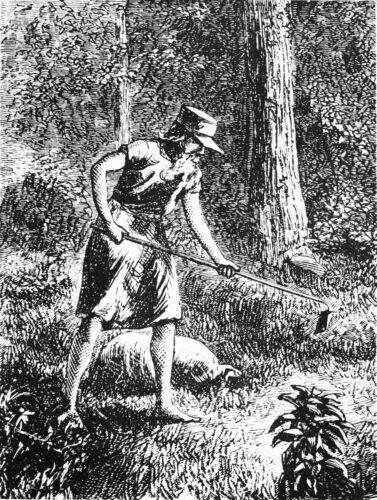
An etching of John Chapman, aka Johnny Appleseed, from Harper’s New Monthly Magazine in 1871. Photo: WikiMedia
He decides to begin his quest at the head of the Johnny Appleseed Trail of North Central Massachusetts—and discovers that it isn’t a trail at all. It’s a random stretch of highway, with the visitors’ center surrounded by a chain-link fence. Throughout American Rambler, places with names that suggest lofty historical import turn out to have no such thing, while events— and people—that have been overlooked reveal depths and complexity that fill in gaps in the American story.
Fitzgerald walks through overgrown areas and past “No Trespassing” signs; he buys a white two-door Jeep that he christens Rabbit, putting over 40,000 miles on it in under a year as he crosses the places Chapman lived and where people have commemorated him: New England, Pennsylvania, Ohio, and Indiana. He sleeps outside, couch-surfs, and occasionally floats down a river. He thinks about his parents. He thinks about his lapsed Catholicism and wonders whether Chapman’s Swedenborgianism offered better comfort.
And in each town—and place that is barely a town, more like a rest stop—he visits, Fitzgerald finds a bar. Oh, so many bars. Kerouac-number bars. He drinks beers, a lot of them, and occasionally something harder. He drinks to get warm, and he drinks so strangers will continue talking to him. He drinks to flirt, and he drinks to sleep alone under a busted tarp in the rain. The stories he relates are full of understated home truths about how people in America are coping with hard living, and edge of the paycheck disappointments and friendships that began in childhood. I started to wonder how Fitzgerald could have been sober enough to remember, much less reconstruct, any stories anyone told him.
But that’s a suppressed truth hidden in Johnny Appleseed’s story, too: Fitzgerald explains that where clean, uncontaminated water was hard to come by, hard cider was young America’s daily beverage. The fruit of the apple saplings Chapman planted was destined for cider, not apple pie. Just one factoid: between 1800 and 1830, Americans drank, on average, 15 gallons of cider per person —children not excluded.
There’s one thing you can say about Fitzgerald from reading this book, and it’s that he’s not a snob—or even, despite his evident familial tendency toward depression, much of a cynic. Genuine curiosity abounds, whether he is thinking hard about the displacement of Native Americans or the ways merchandising is built into entertainment at Appleseed-themed country fairs and sports teams.
Both Fitzgerald and Shattuck journey toward a more coherent understanding of themselves. It’s certainly a coincidence, but both memoirs close with their authors turning to settled domesticity. Ben Shattuck marries comedian/writer Jenny Slate and, with his brother, takes over the venerable Davoll’s General Store in Dartmouth, built in 1793. Fitzgerald returns to his apparently abundantly patient girlfriend, Kelly Farber, on the North Fork of Long Island, and ruminates on the lessons of a harrowing family death.
Inadvertently, though, both Fitzgerald’s and Shattuck’s books underscore the entitlement of white American masculinity. Like Thoreau and John Chapman, these two writers can wander about with some—not a lot, but some—money in their pockets, open themselves to conversations with strangers they meet along the way, and get by without much fear of assault—except, maybe, by bears.
As I read American Rambler I kept thinking about comedian Taylor Tomlinson’s recent bit answering a question from her audience: “If you were a man for a day what’s the first thing you would do?”
Her eventual answer: “I would probably just walk around all night.”
Debra Cash is a Founding Contributing Writer to the Arts Fuse and a member of its Board