
Theater Review: A Barrio-Born Oedipus That Engages, but Rarely Devastates
By Bill Marx
Set amid the rituals and turmoils of barrio life, this contemporary take on Oedipus Rex trades Sophoclean complexity for theatrical vitality.
Oedipus El Rey by Luis Alfaro. Directed by Loretta Greco. Staged by the Huntington Theatre Company in the Roberts Theatre at The Calderwood Pavilion, 527 Tremont St. Boston, through June 14.
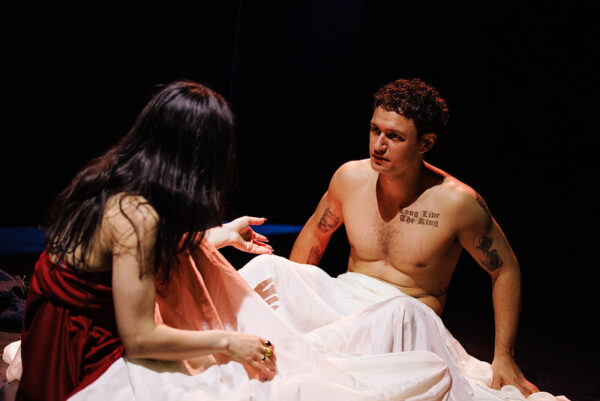
Melisa Pereyra and Juan Arturo in the Huntington Theatre Company’s production of Oedipus El Rey. Photo: Marc J. Franklin
Director Robert Icke’s modern revamping of Oedipus Rex landed with particular force because it recast Sophocles’s tragedy as a high-stakes political thriller—one in which collapse feels not fated but frighteningly imminent. In this 2024 stage version (which I saw via streaming), the plague becomes a seething, polarized electorate, its bigotry and volatility threatening to spin beyond control; salvation seems to hinge on the re-election of Oedipus as as head of state, a figure who has been branded by himself and others (perhaps accurately) as a unifying “man of the people.” A countdown clock dominates the stage as the votes are tallied in real time—until the democratic process is cut off by catastrophe. Oedipus secures a landslide victory as revelations of the truth about his past bury him and, perhaps, the future of the polis.
Dramatist Luis Alfaro’s Oedipus El Rey (2010), set within the world of Los Angeles gang culture, offers a different but still chilling contemporary inflection on the theme of blindness. Here, Oedipus is propelled toward ruin by a combustible mix of macho bravado, contempt for prophecy, and a childlike conviction of his own godlike invincibility. The production’s authoritarian undertones come off as a partial diagnosis of our ills. The parallels to our present moment—especially to a leader who openly indulges in fantasies of messianic control—are not merely suggestive but inescapable.
That said, the psychological and spiritual pressure-cooker setup of Sophocles’s brilliant tragedy—in which we follow the rationally minded Oedipus in real time as he searches, with a mix of repression and determination, for the truth, grappling with prophetic clues and fending off demoralizing revelations until he is forced to acknowledge his actions—has been jettisoned. After a scene in prison, Oedipus El Rey chronicles, with agreeable vim and vigor, the story of Oedipus, moving from Laius’s brutal plan to murder his child to Oedipus, freed from prison, pushing Creon aside by marrying Jocasta, thus becoming the “king” of the barrio. Alfaro rejiggers Sophocles’s narrative (here, Sophocles’s bisexual seer, Tiresias, becomes a servant who raises Oedipus and joins him in prison). These changes are interesting but, on the whole, they tend to smooth out difficulties, undercutting the tragedy’s complexity—Oedipus and the characters around him all too often end up explaining themselves and their motives to the audience. (There’s also some wasted theatrical underlining—do we need to see the self-worshipping Oedipus gild the lily by ripping pages out of a Bible?) The members of the chorus do not register the shifting attitudes of the public (complaints about Oedipus’s domination of the barrio, for instance), but instead play a number of different roles, often providing show-biz entertainment along the way (as prisoners, doo-wop singers, enthused party throwers, street hawkers, etc.).

Javier David in foreground, with L to R: Jaime José Hernández, Juan Arturo, and Gabe Martínez in HTC’s Oedipus El Rey. Photo: Marc J. Franklin
One event follows another, which means, theatrically, that the climax registers as just another scene in the progression of “the old story.” What this approach loses is what critic Bernard Knox recognized as the central complexity of both character and play: “The discovery of Oedipus’s identity is the most catastrophic defeat imaginable, but there is a sense in which it is also a great victory.” This fusion of horror and heroism—a conflation of human depth and heights—is absent from the Huntington Theatre Company’s energetically performed production. There is pathos, music, and humor, yes—but no catharsis, no assault of fear or pity. Alfaro’s choice to have Jocasta blind a sobbing, contrite Oedipus intrigues, but it also robs the tragic protagonist of a decisive action that signifies his painful mastery over himself, the price he is willing to pay to regain his “sight.” (Icke’s interpretation also fell short in this regard—the possibility of finding nobility in the face of disaster seems, for now, beyond us.)
This said, the evening is consistently engaging; it moves along with fluid, economical ease. Director Loretta Greco was at the helm of the world premiere production of Oedipus El Rey at San Francisco’s Magic Theatre, and she draws on past experience to integrate the script’s jumbled emotional journey—serious, romantic, satiric, and silly. The show’s spirited, feel-good elements tend to outshine its forays into the serious or traumatic. The performances are lively, with the members of the versatile chorus (Gabe Martínez, Jaime José Hernández, and Javier David) jumping feet-first into various comic personae. Juan Arturo, as Oedipus, comes off as disappointingly one-note, though that is partly the fault of the script, which focuses on Oedipus’s belligerence and adolescent unruliness and slights the figure’s secular smarts. As Jocasta, Melisa Soledad Pereyra provides the most powerful performance; she deftly balances hardness and vulnerability, shifting with ease among sarcasm, grief, longing, protectiveness, and sensuality. (Pereyra’s short-tempered, man-eating Sphinx is impressively grouchy.)
Greco’s production makes an animated case for Sophocles’s play—2,500 years old and still relevant for riffing. Alfaro’s adaptation sharply critiques a culture that’s captivated by swaggering, self-mythologizing power, one in which domination and destiny are inextricably linked. Yet the play’s tragic core remains curiously untouched.
Bill Marx is the editor-in-chief of The Arts Fuse. For over four decades, he has written about arts and culture for print, broadcast, and online. He has regularly reviewed theater for National Public Radio Station WBUR and The Boston Globe. He created and edited WBUR Online Arts, a cultural webzine that in 2004 won an Online Journalism Award for Specialty Journalism. In 2007 he created The Arts Fuse, an online magazine dedicated to covering arts and culture in Boston and throughout New England.
Tagged: "Oedipus El Rey", Huntington-Theatre-Company, Juan Arturo, Loretta Greco, Luis Alfaro