
Design and Visual Arts: Affordable Housing, By Design
By Mark Favermann
Revisiting the Eameses’ modular dream at a moment when policy, economics, and architecture are under pressure to deliver.
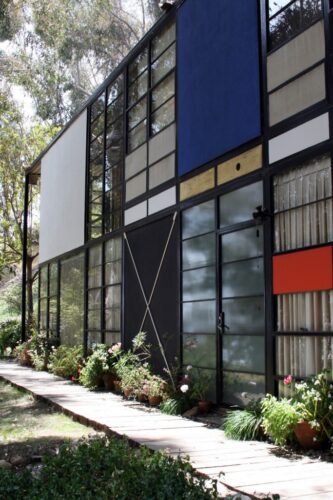
Eames House Detail, by Charles and Ray Eames, 1949, Source: Eames Foundation
As WWII wound down, mid-century modern designers Charles and Ray Eames created a striking contemporary house for their family. Their concept was to create an affordable house for the masses: it was fabricated out of modular panels and off-the-shelf structural components. The design called for prefabricated materials ordered from industrial and commercial catalogs. Built in 1949, the structure was created out of a kit of parts. It was one of roughly two dozen homes commissioned by Arts & Architecture magazine, as part of its Case Study House Program. The Eames House was labeled Case Study House No. 8.
Although a visual design was published in the magazine’s December 1945 issue, a wartime steel shortage delayed construction until late 1948; the house was completed in 1949. The Eameses lived there for the rest of their lives.
Now a National Historic Landmark, the Eames House has drawn visitors from around the world, many of them admirers of its charm and ingenuity. From the outset, the dwelling was conceived to be easily replicated: at the time, this was a somewhat radical idea, suggesting that architecture could be as scalable as furniture. A modular construction kit, based on the Eameses’ iconic home, was introduced this spring at the Triennale Milano. Developed through a collaboration between the Eames Foundation and the Spanish furniture brand Kettal, the revision reimagines the Eames vision as an example of modular, human-scale residential architecture.
The revamped construction setup consolidates the Eameses’ core architectural ideas, including the use of a strategic grid, a compact footprint with maximum volume, and a structure adaptable over time. It arrives as a flat-packed kit of parts, including aluminum beams that form a skeletal frame, along with glass, timber, or composite panels. The system can be configured as a single unit, expanded across multiple bays, or stacked to create two-story structures. It also allows for customization, with options such as flush rooflines or deeper overhangs, as well as a range of façade panel types.
The Kettal/Eames system will go on sale in fall 2026. Depending on material configuration, each kit is expected to cost between $50,000 and $85,000. As concerns about affordable housing continue to rise across the United States, the timing may be apt.
Affordable housing is casting an increasingly long shadow over today’s economic, social, political, and physical landscape. It may seem like a relatively recent concern, but housing has been a persistent American issue for well over a century—and it is now a global challenge. Public discourse has tended to focus on issues of homeownership, rental affordability, and homelessness across urban, suburban, and rural communities. While the debate often centers on high rents and the economic challenges of homeownership and homelessness, part of the solution has long resided—and may still reside—in the evolution of innovative architectural and planning strategies.
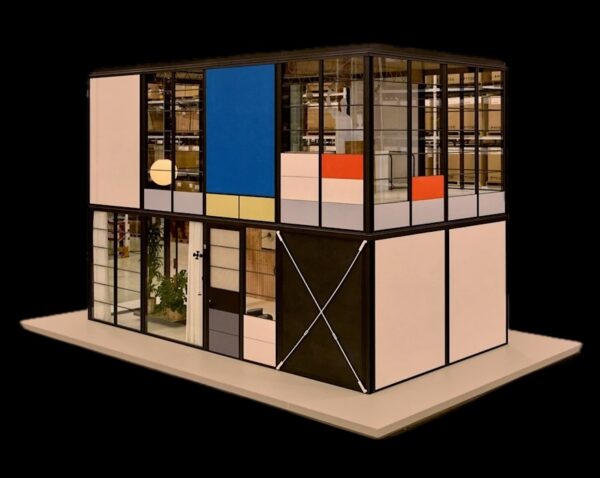
An example of an Eames Modular home, 2026, Source: Kettal Furniture Company, Spain
In recent years, Massachusetts and more than 20 other states have adopted comprehensive statewide policies aimed at increasing the supply of affordable housing. Approaches to increasing residential density and lowering development costs include rezoning to allow more multifamily construction, offering tax incentives to developers, and permitting accessory dwelling units (ADUs) in single-family zones. In Massachusetts, ADUs may be up to 900 square feet.
According to the American Planning Association, “an accessory dwelling unit (ADU) is a smaller, independent residential dwelling located on the same lot as a detached single-family home.” Also known as accessory apartments, secondary suites, or in-law cottages, ADUs enable denser use of existing housing stock in established neighborhoods. However, progress has often lagged behind discussion.
Recent efforts to address homelessness have produced a range of creative design strategies, including the adaptive reuse of motels and hotels, the construction of micro houses, and new multi-unit developments. Driven by the scale of the crisis, Los Angeles has emerged as a leading center for experimentation in this area.
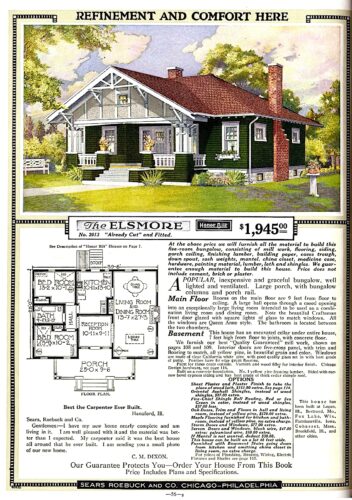
Sears Modern Homes, 1919. Courtesy of Rachel Shoemaker Collection, Internet Archive
Prefabricated housing has deep roots in North America. As early as the 1600s, panelized timber houses were shipped from England to Massachusetts. Commercial sales of modern prefab and mail-order “kit” homes began in the late 19th and early 20th centuries. One pioneer was the E.F. Hodgson Company of Dover, Massachusetts, which began in 1892 by selling two types of chicken coops. It soon expanded to agricultural buildings, children’s playhouses, dog kennels, and “auto stables,” or garages. By 1904, Hodgson was producing summer cottages and larger houses, advertising in widely read magazines such as Good Housekeeping and Better Homes and Gardens.
Recognizing a growing market, Sears, Roebuck and Co. launched its Modern Homes catalog in 1908, ultimately selling more than 70,000 mail-order housing kits between 1908 and 1940. Competitor Montgomery Ward sold its Wardway Homes between 1917 and 1931, offering similar pre-cut kits that included all necessary materials and could be assembled on-site. Montgomery Ward sold more than 32,000 homes before discontinuing the line during the Great Depression. Many of these very conventional designs were produced by largely uncredited and uninspired architects.
During WWI and WWII, prefabrication was used extensively for military construction, including barracks and mess halls. In 1918, eighteen USO buildings located on Boston Common were manufactured by Hodgson. Throughout WWII, prefab structures provided housing for workers and their families who relocated to support wartime industries. After the war, many of these homes were sold to returning veterans, helping to address the acute housing shortage.
Eight decades after the Eameses proposed their modular housing vision, their ideas have attained a new urgency. The need is evident. The question is whether today’s architects and urban designers can translate that legacy into equally inventive and humane solutions—and perhaps, in the process, restore a measure of poetry to the built environment.
Mark Favermann’s firm, Favermann Design, was one of five design consultancies chosen from 481 to design the 1996 Centennial Olympic Games in Atlanta. He is an urban designer specializing in strategic placemaking, civic branding, streetscapes, and retail settings. In 2024, he was awarded the Journalism and Communications Award by the American Planning Association/Massachusetts for his decades of writing on the built environment. In 2025, the Mass Cultural Council awarded him a Creative Individual Award for Sculpture.
Tagged: Charles and Ray Eames, Eames House, affordable housing
During the first world war skilled laborers were needed for the war effort and military barracks were designed for installation by unskilled laborers. Modular components fit very well into this approach. Hundreds of barracks went up as a result of
It should be noted that Peter Lowitt is a Fellow of the American Institute of Certified Planners. From 1999-2023 he led the Devens Enterprise Commission as it redeveloped Devens as a model for the sustainable development of a former army base.
During his tenure, Devens attracted over 4 billion dollars in private sector investments. He has had a lot of experience with prefab structures.
Really good article Mark. Interesting history of production of inexpensive housing and very relevant to today’s affordable housing issues.
I grew up in a Hodgeson house that my father and grandfather built in Manchester, MA. The lot was expensive so my parents had to build a less expensive home so they turned to a modular product. It was a nice 3-bedroom house and most people had no idea it was a modular product.
I hadn’t thought of Hodgeson houses in years!
Thanks again,
That’s amazing! I didn’t know that I knew someone who grew up in a Hodgson House. And it was quite comfortable.
I recently had a conversation with a previous real estate broker in Southern California and recent Harvard BusinessSchool graduate who told me that I left out another microhousing constituency–the working poor. Many are new immigrants and single mothers with children who often lived in their cars or at friends and families’ homes. His view was these folks were more important to house than the homeless.My response was that they were both in need.
Great piece. I especially appreciated the reminder that the Eames House was never intended to be a singular icon; it was conceived as a repeatable system.
What is striking is how often housing conversations focus on style or unit counts, when the deeper challenge is aligning space, culture, and time. The real question is not whether prefab works; we have known for more than a century that it can. The question is whether our policies, financing structures, permitting processes, and cultural expectations allow it to scale.
The Eameses understood that architecture could function more like a platform than a static object: adaptable, expandable, and capable of evolving with changing needs over time.
Perhaps the next breakthrough in affordable housing will not come from a new material or construction method, but from reconnecting design, manufacturing, and regulation into a more coherent system.
And as an architect, I cannot help but appreciate the irony that an idea born from wartime shortages and industrial catalogs may prove highly relevant again in an era defined by housing shortages and supply chain constraints.
Thanks for the thoughtful historical perspective.