
Film Review: The Man Behind the Curtain — A Wishy-Washy “Wizard of the Kremlin”
By Peter Keough
A stylish but troubling portrait that soft-pedals power, propaganda, and Vladimir Putin.
The Wizard of the Kremlin. Directed by Olivier Assayas, and based on the novel by Giuliano da Empoli. At the Boston Common and the suburbs.
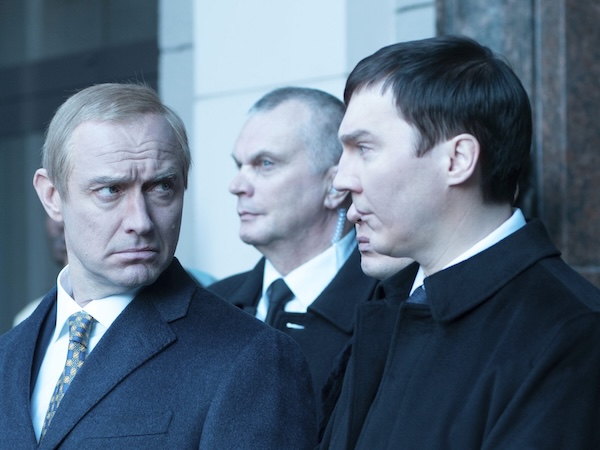
A scene from The Wizard of the Kremlin, featuring Paul Dano and Jude Law.
Even the right leaning British newspaper The Telegraph says that Putin is down and the time is right to start kicking him. But not so for Olivier Assayas in his adaptation of Giuliano da Empoli’s The Wizard of the Kremlin, which, true to the 2022 novel, paints a not unflattering portrait of the despot.
Like Interview with a Vampire, the narrative is framed by a chat. Vadim Baranov (Paul Dano), based on Putin’s former right-hand man Vladislav Surkov, emails Rowland (Jeffrey Wright, adding gravitas to this Russian Fiction follow-up to his American Fiction), a Western journalist in Moscow. Baranov had somehow learned that Rowland was in town researching a book on the early Soviet writer Yevgeny Zamyatin, of whom the poseur Baranov is also a big fan. He invites Rowland to his secluded dacha deep in the woods and there the two discuss this courageous dissident, who had been persecuted and exiled for his ideals.
That sets Baranov off on his own tale of woe, which grows increasingly irritating as related in Dano’s sibilant, insinuating whisper and through Assayas’s erratically edited flashbacks. He tells how he started out idealizing art, taking advantage of the new freedom and ready cash of the early post-USSR years by putting on theatrical spectacles – one of which looks like a cross between Metropolis and the bowling alley production number in The Big Lebowski. But the era of pretentious avant garde artists soon gives way to the reign of vulgar oligarchs in chauffeur-driven armored Bentleys.
One of those is Baranov’s pal Dmitri Sidorov (played by a crassly charismatic Tom Sturridge), based on the real-life Mikhail Khodorkovsky (the name has been changed, perhaps because, unlike most of those properly identified in the film, he is still alive). A fun guy until he steals away Baranov’s mercurial muse Ksenia (Alicia Vikander, vivid and nuanced in a tritely written role). It’s a pivotal point for Sidorov, and the world too as it turns out. He’s no longer satisfied with art that reflects history; now he wants to enter politics and make history. So, there you have it – much of the whole rotten course of the 21st century can be blamed on a cheating girlfriend.
Enter real-life oligarch Boris Berezovsky (Will Keen), who is diabolically charming as he relates to schmoozers at one of his decadent parties how he gained the release of hostages from a Chechen warlord by trading his watch for their lives. Berezovsky has made a fortune despoiling Russian resources that were left up for grabs after the fall of Communism. That includes the state television station, which he has turned into a crass funfest of dumb game shows and reality TV. It’s a potent soft sell for the masses and, recognizing its power to manipulate public opinion, Berezovsky is eager to use it as a political tool. For that purpose, he employs the bitter and ambitious Baranov, who will prove brilliant at his job and shaky in his loyalties.
Then there is the star of the show, Vladimir Vladimirovich Putin, played by Jude Law in a bit of casting which, according to the Guardian, could not have been more agreeable to the actual powers that be in Moscow. True, this Putin can be a bit ruthless but, at least for a while and compared to those who turn against him — depicted here as hypocrites motivated by greed and ambition — for the most part, he’s principled and honest and has the best interests of the Russian state and people at heart.
That’s the image that Baranov crafts for him, at any rate, and the film does little to question it. Baranov grooms Putin, soon to be known as the “Czar,” to succeed the crapulous and moribund Yeltsin. Once installed, he wins the hearts of the masses in every election thereafter. It’s all according to Baranov’s “vertical power” theory of government, which basically says that Russians will trade the possible chaos and nagging responsibilities of freedom and democracy for a tyrant who will tell them what to do and who mirrors their own worst impulses.
But when it arrives at the Ukraine conflict, the film becomes especially hard to take. With Rowland, Baranov haughtily parrots the Kremlin line, arguing that the West and the CIA and George Soros (!) were behind the anti-Russian “Euromaidan” demonstrations in 2013. He gets frustratingly little pushback during these tirades from Rowland, our supposed voice of reason. Baranov’s historical distortions remain pretty well unchallenged. Given that interpretation of events, you kind of admire Baranov’s audacity and wicked cleverness when he gathers together a motley army of “bikers and hooligans, anarchists and skinheads, communists and religious fanatics, from the far left to the far right and beyond” to be deployed in Ukraine to subvert the pro-West movement. It is a basket of deplorables to rival the January 6 mob.
But, as with his master, the “Czar,” Ukraine becomes too much even for Baranov to swallow. He quits his job or is fired – the circumstances are unclear. As is what happened to the real Vladislav Surkov. But what happens to Vadim Baranov lets him – and the filmmakers – off the hook.
Peter Keough writes about film and other topics and has contributed to numerous publications. He was the film editor of the Boston Phoenix from 1989 to its demise in 2013 and has edited three books on film, including Kathryn Bigelow: Interviews (University Press of Mississippi, 2013) and For Kids of All Ages: The National Society of Film Critics on Children’s Movies (Rowman & Littlefield, 2019).
Tagged: Giuliano da Empoli, Jude Law, Olivier Assayas, Paul Dano, The Wizard of the Kremlin