
Stage Commentary: Where’s the Fire? Boston Theater’s Cautious Return to Relevance
By Robert Israel
After a year of safe revivals and recycled material, companies hint at change — but caution, celebrity casting, and déjà vu still dominate the lineup.
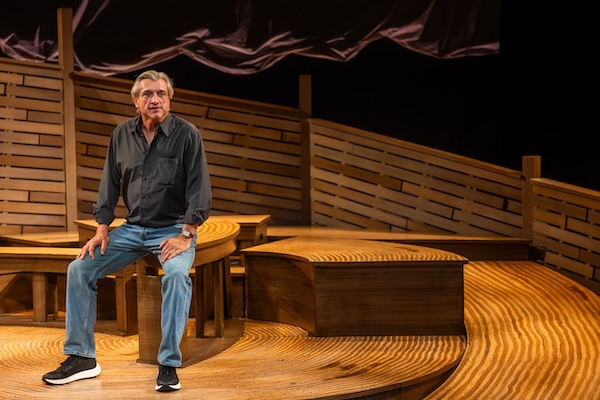
Will McGarrahan in the Lyric Stage production of Our Town. Photo: Nile Hawver
Last season, instead of choosing scripts that mirror the increasingly daunting times we live in, our resident theater companies largely defaulted to recycling. Lyric Stage Company of Boston opened with Thornton Wilder’s Our Town, a venerable (and venerated) 1938 script (which spawned a 1940 Academy Award–nominated film) that has been staged ad infinitum — hardly a risky venture in critically relevant Americana. Huntington Theatre Company again turned to playwright Joshua Harmon with We Had a World after producing Prayer for the French Republic in 2023. (Harmon’s Bad Jews had already been staged at SpeakEasy Stage in 2024). The American Repertory Theater kicked off its season with a return engagement of Passengers from the Montreal-based troupe Seven Fingers, who previously headlined ArtsEmerson’s Paramount Theater.
Will the 2026–27 Boston live stage offerings be any fresher? Are companies actually paying attention to the world beyond their walls? Let’s see.
A.R.T.’s new season announcement arrives with the boilerplate claim that “[we live in] the most turbulent of times.” Their response: a revival in August of Eugene Ionesco’s 1958 anti-authoritarian Rhinoceros, featuring television/movie celebrities Paul Giamatti, Tatiana Maslany, and John Turturro. (Alert: when artistic director Diane Paulus casts celebrity performers, five’ll get you 20 she’s angling for a Broadway run. The Broadway premiere production opened in 1961 with a legendary Zero Mostel.) Yale Rep, incidentally, beat Paulus to the punch with its own revival earlier this year. The Hub Theatre Company of Boston has already staged a double bill of The Bald Soprano and The Lesson, while Arlekin Players Theatre will roll out Delirium, a world premiere adaptation of Ionesco’s Frenzy for Two, in June. The A.R.T. may be late to the Ionesco party, but at least it showed up. For the record, Frenzy for Two follows a middle-aged couple bickering over trivialities as the world collapses into war, chaos, and social breakdown — updated here, no doubt, with a nod to climate catastrophe.
In October, the A.R.T. will produce 1972: A Rock Opera, a venture that looks primed for Broadway. The year wraps (with more announcements to come) with Mexodus in December. There are faint rumblings of change here — if not quite a break from habit. On paper, the lineup gestures toward “turbulent” concerns: collectivism, abortion, citizenship, and the ongoing legal, personal, and political crises at the US southern border.
Boston’s SpeakEasy Stage, announcing its 36th season, seems to be undergoing a similar recalibration, citing “a shifting landscape for the performing arts.” Artistic director Dawn M. Simmons suggests the possibility of “cabaret-style” sessions, collaborations with The Boston Project (new work about Boston by New England playwrights), and an initiative developing new musicals with Somerled Arts. The season includes Covenant by York Walker (a “Southern gothic thriller”) in September, followed by Samuel D. Hunter’s Little Bear Ridge Road in January. By Any Other Name, a new musical by Deborah Zoe Laufer, closes things out next May. SpeakEasy has long championed Hunter — he even popped up at a talk-back last season — but Little Bear will be just the third of his plays staged here. It’s worth noting that it took Hunter a full decade to gain a foothold in Boston, from SpeakEasy’s staging of The Whale — featuring the superb John Kuntz — to the much later arrival of his remarkable A Case for the Existence of God. Ten years is an absurdly long wait for the work of a playwright of his caliber, and he’s hardly alone.
Huntington Theatre Company opens its new season with a few new ideas and several old ones. In the novel category is a production of Purpose by Branden Jacobs-Jenkins. Like fellow playwright Hunter, he, too, has had to wait 10 years for another opportunity to have his work performed in Boston. (SpeakEasy Stage presented his spellbinding drama Appropriate in 2015.)
An old idea then hits the track: a production of To Kill a Mockingbird, an adaptation of Harper Lee’s novel. The show was staged in Concord under Scott Edmiston’s direction (Arts Fuse interview). Mockingbird is followed by Adia and Clora Snatch Joy, a production that will complete the city’s presentation of Mfoniso Udofia’s nine-play Ufot Family Cycle. Meet the Cartozians by Talene Monahon follows in February.
The final HTC production of the new season is an odd pairing: an adaptation of a memoir by Deborah Feldman, previously featured in a four-part Netflix miniseries, now recast as a musical by HTC’s favorite boychick, Joshua Harmon (with collaborators). The play tells of an ultra-Orthodox Jewish woman’s struggle to break from an arranged marriage and describes, in painful detail, her battle with vaginismus, a physical condition that prohibits coitus. The subject matter and playwright seem to make for a bizarre pairing. Even acclaimed feminist playwright Eve Ensler found the subject of vaginal penetration daunting onstage. Describing her experience staging The Vagina Monologues to Time: “The public utterance of the word alone was explosive, as so much of the truth about what happened to vaginas was repressed, denied, kept secret, and coated in shame and self-hatred.” Ensler, who now writes under the name V, urges us to adopt a broader awareness of the issue — not only to agitate for the eradication of sexual violence wherever it occurs in our communities, but also to attend to the plight of trans people, who face physical, psychological, medical, and legal persecution, as well as threats of violence and death. Will HTC’s production engage with this imperative, or remain confined to the narrative of a woman’s struggle within the narrow bounds of the Hasidic Jewish community?
Lyric Stage kicks off its new season with the return of Scott Edmiston, directing Arthur Miller’s All My Sons, which had its pre-Broadway tryout at Boston’s Colonial Theatre on January 27, 1947. The play was later revived in 1987. At the time, Miller told the Boston press, “If I wrote the play now, I’d have to call it ‘All My Grandsons.’” Edmiston delivered a superior production of The Little Foxes, and this staging will be one to watch, as will King James by Rajiv Joseph, under Benny Sato Ambush’s direction, set for March 19–April 11, 2027.
Finally, ArtsEmerson launches its new season in October with new productions, including a presentation, with Huntington Theatre Company, of Taylor Mac and Matt Ray’s Songs from Bark of Millions, which celebrates the art of drag performance in a rock opera format. Patrick Page follows with All the Devils Are Here (October 28–November 1), a solo performance exploring Shakespeare’s most iconic villains, followed by Dream Feed, described as “a genre-defying live concept album from Grammy Award–winning band The HawtPlates that blurs the boundary between dreams and waking life.”
The new season in Boston shows stirrings of life in contrast to the moribund past season. Flickers of healthy sparks sit among the ashes. Yet much necessary work is missing. Where is the political theater? Why all the retreads? Still, here’s hoping that the new blood and visions, like courage, will be contagious — and that theater-going audiences wake from their slumber and demand more work that holds a mirror up to current realities.
Robert Israel, an Arts Fuse contributor since 2013, can be reached at [email protected].