Theater Review: “Salesman” in the Void: Joe Mantello’s Haunting, Existential Revival
By Tom Connolly
The smoke drifting over the set is a metaphor for the mind-fogging rhetoric of Willy Loman’s phony boosterism. He has been adrift in an American dream that was a lie all along.
Death of a Salesman by Arthur Miller. Directed by Joe Mantello. Staged at the Winter Garden Theatre, 1634 Broadway, NY, through August 2
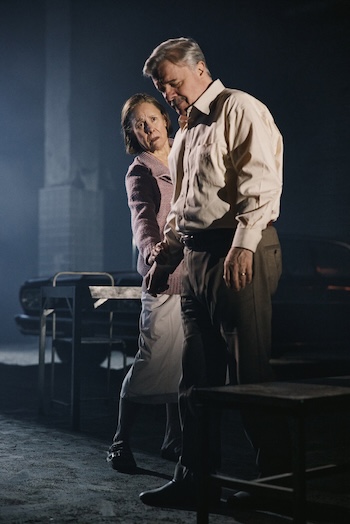
Laurie Metcalf and Nathan Lane in Death of a Salesman. Photo: Emilio Madrid
A massive garage door opens, and a 1964 Chevy glides downstage, its headlights almost blinding the audience. The current Broadway revival of Death of a Salesman is inspired by Arthur Miller’s early, expressionistic drafts for the script. Smoke wafts through the stage, which looks like a desolate warehouse dotted with scattered piles of dirt, one of which will serve as Willy’s grave. A couple of chairs, a table, and two benches are barely visible. Samuel Beckett’s Hamm and Clov would be right at home and that resonance with Endgame is not unintended.
Designer Chloe Lamford’s stripped-down set foreshadows the story’s final collision with the car’s eerie slide downstage. What Miller eventually insisted should be seen as social tragedy here takes on an existential chill. The Lomans didn’t just fail because of “the system” — they eagerly participated in their demise.
The dim lighting ensures that the production is dark, but the heaviness does not weigh down the staging or the play. Instead, it infuses a metaphoric power that a by-the-book staging lacks. Mantello’s choice doesn’t shoehorn in expressionism; his vision restores a depth that Miller’s later, socially conscious interpretation may have diminished. (The dramatist’s essay “Tragedy and the Common Man,” with its argument about “the perfectibility of man,” did not do the script any favors: Salesman is about the fallibility of a man.) Memory doesn’t interrupt what is happening in the present—it inhabits the present.
The staging’s visual field externalizes Willy’s mental implosion. The mist, the dimly lit space, and its shadows are not mere design flukes, but the “inside of Willy’s head” realized. (Miller’s original title for the play was The Inside of His Head.) The approach reveals a mind that can no longer distinguish between what is and what was
Mantello’s brilliant interpretation amplifies what is in the script, not imposing anything extraneous upon it. Few of the cuts seem arbitrary. Among the minor excisions: Ben’s description of Willy’s father as a maker and seller of flutes, traveling across the country in a wagon. Throughout, Miller’s critique of American delusions remains relevant, its pointedness justifying the production’s liberation of the play from its time frame. The production never reaches for contemporary resonance, but cannily reveals the play’s force as a mirror. Willy’s dread of obsolescence, once tied to the waning of charisma in a corporatized world, now resonates with the plight of those in an AI economy that tosses out, like “a piece of fruit,” any individual who asserts human worth. When Ben admonishes Willy that he is “not making anything,” it is no longer a metaphorical dig—this is about a society that is increasingly about image
So, this is not your grandfather’s Death of a Salesman. The costumes and props are a bit eclectic. Linda wears slacks in one scene; Howard, Willy’s boss (played with an encompassing smarminess by John Drea), sports a finance bro’s vest and a to-go cup, whose lid Willy too eagerly picks up after it falls on the floor as he begs to keep his job. Casting also diverges from the norm. Young Biff, Happy, and Bernard are played by adolescent performers, as they were in an early draft. Charley is played by K. Todd Freeman, an African American actor, which puts an interesting spin on Willy’s pride. Willy’s rejection of Charley’s job offer no longer reads as a case of bullheaded arrogance; it takes on an edge of submerged racism. Willy ignores Charley’s competence and generosity; he can only reach out to an African American man through a charade of borrowing money. Willy’s rejection of assistance reveals a sinister side of his pride: he can’t bring himself to work for a Black man. Freeman also delivers Willy’s eulogy, which he reads rather than speaks, with a fitting tone. It is probably the only time the line “Nobody dast blame this man” hasn’t seemed pretentious. Which brings up what may be the show’s only misstep: Linda’s final good-bye to Willy somehow misses a beat. Laurie Metcalf’s Linda places the deed on Willy’s grave, but there’s no finality to the gesture.
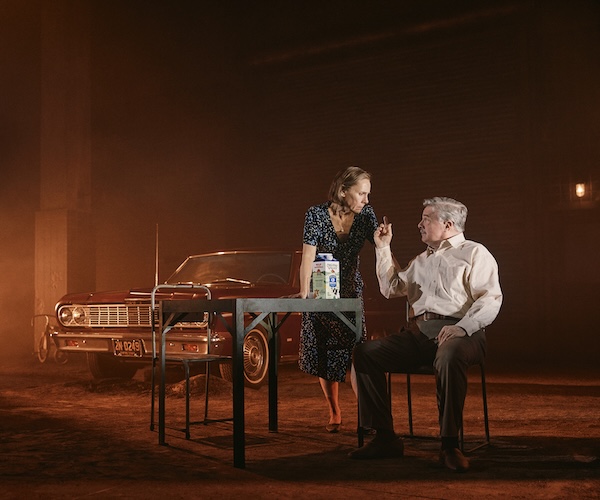
Laurie Metcalf and Nathan Lane in Death of a Salesman. Photo: Emilio Madrid
Mantello’s direction may not be reverent, but it deeply respects the play. It has been widely reported that this production, with these leads, has been in the making for decades. The ensemble spins a disturbing variation on Tolstoy’s credo about families: he declared that each unhappy family is unhappy in its own way. This interpretation of Death of a Salesman suggests something more unsettling—that the Lomans’ unhappiness is all too familiar. Their fleeting periods of contentment are clearly rooted in illusion, which adds poignancy to their downfall. There may be a Brechtian flourish as well: the actors perform the Lomans’ play-acting of the American dream.
Each performer etches a distinct portrait. Laurie Metcalf delivers what must be one of the strongest Lindas on record; her command of the stage renders her blind devotion to Willy all the more moving. The contempt she shows for her sons, once they no longer worship their father, snaps the patriarchal delusion shut. She is unable to see an iota of error in Willy, which feeds his grandiosity. Christopher Abbott’s Biff, racked with emotional turmoil, beautifully conveys his complex feelings for Willy; Ben Ahlers’s Happy is perfectly shallow, yet the character still elicits sympathy. Michael Benjamin Washington’s grounded, charming Bernard provides a contrast to the pseudo-heroics next door. Jonathan Cake’s Ben has an especially otherworldly polish; more than ever, he feels like a figment—not only sinister but, in the end, coldly pragmatic. He urges Willy to follow through on his suicide as if it were a sound business proposition. This matter-of-fact dismissal of Willy’s life makes his decision all the more wrenching.
Nathan Lane deserves every encomium; he fully inhabits the role of Willy Loman. At the performance I attended, some audience members seemed to expect Lane to be his lovable self—there were laughs, for example, when he barks at Linda to stop interrupting him. But there is nothing coy or endearing about this performance, which brings out the darker aspects of Willy’s character. Lane’s Willy isn’t a sympathetic figure—he’s both a pathetic fool and a desperate soul. Nevertheless, you see why Linda, Biff, and Happy idolize his strength. Lane builds the performance as a relentless, controlled collapse from a position of dominance. He never quite whimpers, even at his lowest ebb, resorting instead to his salesman’s patter. What’s particularly striking is how he navigates the play’s temporal shifts: he never signals them, but lets them slide into one another with haunting fluidity.
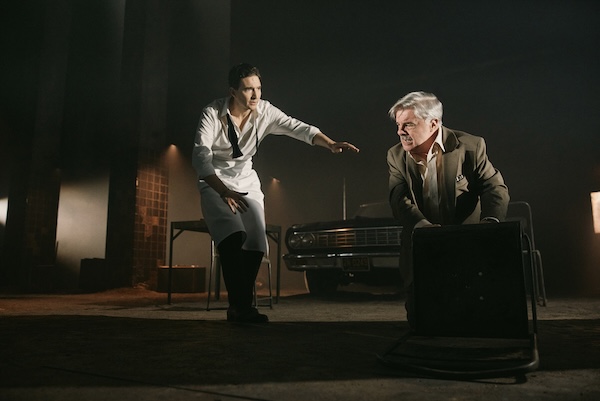
Jake Silbermann and Nathan Lane in Death of a Salesman. Photo: Emilio Madrid
The final confrontation between Willy and Biff is almost gladiatorial. Lane has his moments of bluster throughout, but he avoids any blatant histrionics; his bravado is transparently a false front. Abbott’s Biff seethes with neurotic energy from his first entrance. When he finally explodes in volcanic anger, it is rooted in fear and tormented vulnerability. After father and son wrestle in agony, they embrace. Then comes a theatrical coup: Lane rises and shouts, “I am Willy Loman and you are Biff Loman.” It is a breathtaking blend of rage and anguish. Lane has created such a fully realized character that this cry to heaven feels heartbreakingly human and believable. His Willy is always in two places at once.
The point of this duality—and of the production—is that there is no center left to hold. This is the key to the production’s brilliance: the smoke drifting over the set becomes a metaphor for the mind-fogging rhetoric of Willy’s phony boosterism. He has been adrift in an American dream that was a lie all along.
Tom Connolly is Professor Emeritus of Humanities and Social Sciences at Prince Mohammad Bin Fahd University. He recently edited a historical study (in English) of the 19th- and 20th-century Jewish community of Döbling for the Österreichischen Akademie der Wissenschaften, Institut für Kulturwissenschaften. His book Goodbye, Good Ol’ USA: What America Lost in World War II: The Movies, The Home Front and Postwar Culture is forthcoming from Houghton Mifflin/PMU Press.