
Poetry Review: Mortality’s Muse — Building the Ship of Death
By Michael Londra
D. H. Lawrence’s final poems confront mortality with mysticism, sensuality, and hard-won clarity.
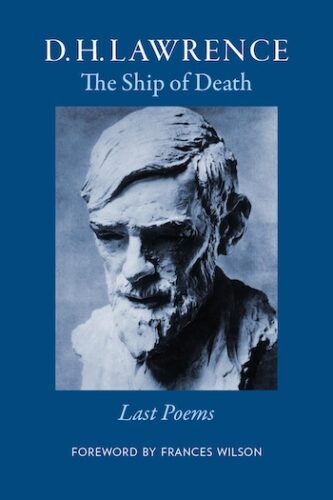
The Ship of Death: Last Poems by D. H. Lawrence. Bergamot Books, 98 pp, $20
 Among ’80s rom-coms, Norman Jewison’s Moonstruck is the GOAT. Despite its lovely cinematography, it’s John Patrick Shanley’s dialogue that elevates the film to icon status. Of all the narrative’s quotable zingers, the most redoubtable belongs to Danny Aiello. Olympia Dukakis asks him the question that’s been plaguing her since learning of her husband’s infidelity: “Why would a man need more than one woman?” Aiello: “Maybe because he fears death.” Indeed, thanatophobia — or “death anxiety” — can trigger toxic behavior. For artists, however, mortality is often inspirational. Mark Rothko’s “Black and Gray” series, for instance, and Francis Bacon’s Painting 1946 testify to the counterintuitive muse of human finality. Literary examples include the novels A Single Man by Christopher Isherwood and Mrs. Dalloway by Virginia Woolf. Poets are no less morbidly fixated on mortality. Rilke’s Duino Elegies, Anne Sexton’s The Death Notebooks, Victoria Chang’s Obit, and Audre Lorde’s Our Dead Behind Us are only a few book-length contributions to the genre.
Add to these examples, The Ship of Death: Last Poems by D. H. Lawrence (1885–1930). Novelist, essayist, and critic Geoff Dyer called it “as near as we can get, in words, to experiencing the extinction of consciousness.” Renowned for such groundbreaking novels as The Rainbow, Women in Love, and Lady Chatterley’s Lover, it is easy to miss that the prolific Lawrence also wrote verse, travelogues, translations, and criticism, as well as fiction. His poetry deserves a wider audience — arguably it is his finest achievement. Only in his stanzas will we find the naked Lawrence.
Composed while dying of tuberculosis in Vence, the volume comprises 67 lyrics that bravely confront the author’s impending demise: “And it is time to go, to bid farewell / to one’s own self, and find an exit.” In her foreword to this edition, Frances Wilson offers an image of the poet “sitting up in bed,” writing in a “notebook resting on his knees, his pencil moving swiftly and neatly.” Weighing only 85 pounds at the time, Lawrence suffered “a slow and dreadful death.” Every day, he stared stoically at the Mediterranean “through his bedroom window.” He did, at one point, allow himself to be admitted to Vence’s local sanatorium, ironically named Ad Astra — a double omen, given that the Latin phrase ad astra means “to the stars,” and “vence” is Spanish for “expiratory due date.”
Perhaps it was Lawrence’s proximity to water that explains the book’s central metaphor: “Have you built your ship of death, O have you? / O build your ship of death, for you will need it.” Wilson, in fact, notes that “Lawrence never felt more connected to the universe than on a ship.” This is apparent in “Mana of the Sea”: “And is my body ocean, ocean / whose power runs to the shores along my arms … I am the sea!” But the reverse is also true; the creatures under those waves can mischievously assume Lawrence’s own desires, as in “Whales Weep Not!,” where two cetaceans have sex like Lady Chatterley and her lover Oliver Mellors: “They say the sea is cold, but the sea contains / the hottest blood of all … And they rock and they rock … they reel with drunk delight.”
Lawrence acknowledges the “urge” behind such wildness: “The mystery of creation is the divine urge of creation … God is a great urge, wonderful, mysterious, magnificent” (“The Work of Creation”). Rejecting Christian ideology, Wilson describes Lawrence as a “religious atheist,” and in “The Body of God,” “The Hands of God,” “Silence,” “Shadows,” and “Lucifer,” God serves as a neutral signifier, an anonymous presence animating the world: “There is no god / apart from poppies and the flying fish, / men singing songs, and women brushing their hair in the sun” (“Pax”); and “For thine is the kingdom/ the power, and the glory. // Hallowed by thy name, then / Thou who are nameless” (“Lord’s Prayer”).
The eponymous centerpiece, “The Ship of Death,” is a 10-part homage to this mystical deity. Reminiscent of Noah, Lawrence counsels, “Oh build your ship of death, your little ark, / and furnish it with food, with little cakes, and wine / for the dark flight down oblivion.” Our journey begins tentatively: “Now launch the small ship, now as the body dies / and life departs, launch out, the fragile soul / in the fragile ship of courage, the ark of faith … we sail / darkly, for we cannot steer, and have no port.” The poet’s vision is pitiless: “there is nowhere to go / only the deepening blackness, darkening still / blacker upon the soundless, ungurgling flood / darkness at one with darkness, up and down/ and sideways utterly dark, so there is no direction any more. / And the little ship is there; yet she is gone. / She is not seen, for there is nothing to see her by … and yet / somewhere she is there. / Nowhere!”
Lawrence is not advising us to build this ship at the eleventh hour. There is no last-minute cheat code, like the sacrament of last rites, which lets you off the hook. Preparing oneself for the “endless ocean of the end” amounts to an act of purified responsibility. The idea appears to be similar to the “death is a part of life” cliché, but Lawrence has something different in mind. Building your ship of death inoculates you from the contagion of mortal fear that dilutes empathy and rationalizes the harm you do to others. Fear of missing out on your bucket list can turn you into the deceitful husband in Moonstruck, for example. On the other hand, if we are building our ships of death properly, we are pursuing ethically fulfilled lives: “All that matters is to be at one with the living God, / to be a creature in the house of the God of Life” (“Pax”).
Ultimately, The Ship of Death: Last Poems is hopeful. Confronting death without compromise earns Lawrence the right to speculate. Perhaps something unexpected awaits us during our “voyage of oblivion”? A peripatetic life of illness, scandal, and dedication to art has convinced the writer that predicting the future is a fool’s errand. Who knows what occurs in the big sleep? These beautiful lines from “The Ship of Death” suggest that Lawrence might believe that death is preparation for a return, for living twice, or maybe more: “And yet out of eternity a thread / separates itself on the blackness, / a horizontal thread / that fumes a little with pallor upon the dark. // Is it illusion? … Ah wait, wait, for there’s the dawn … A flush of rose, and the whole thing starts again.”
Michael Londra — poet, fiction writer, critic — recently introduced the Poets Confront AI and Surveillance Capitalism event at Poets House. He talks New York writers in the YouTube indie doc Only the Dead Know Brooklyn (dir. Barbara Glasser, 2022). His poetry was translated into Chinese by scholar-poet Yongbo Ma. Two of his Asian Review of Books contributions were named Highlights of the Year for 2024 and 2025. “Life in a State of Sparkle—The Writings of David Shapiro” from The Arts Fuse was selected for the Best American Poetry blog. “Time is the Fire,” the prologue to his soon-completed novel of Delmore Schwartz and Lou Reed appears in DarkWinter Literary Magazine. He can also be found or is forthcoming in Lana Turner: A Journal of Poetry & Opinion, Restless Messengers, The Fortnightly Review, spoKe, Cha: An Asian Literary Journal, and The Blue Mountain Review, among others. He added six essays and the introduction to New Studies in Delmore Schwartz, coming next year. Born in New York City, he lives in Manhattan.
Tagged: "The Ship of Death", "The Ship of Death: Last Poems", Bergamot Books
3 Comments
Leave a Comment
A delightful review – thank you.
Yes! Life was such an immense experience for Lawrence that he felt death might be a further adventure, leading ultimately to the renewal of life – to a new dawn.
In his life-affirming essays, Etruscan Places, particularly The Painted Tombs of Tarquinia, Lawrence muses on the vivid frescoes and other contents of those Etruscan tombs.
The Etruscans knew the “natural flowering of life,” he says. They possessed a “religion of life,” drawing life into themselves “out of the wandering huge vitalities of the world.” The cosmos, too, lived – “breathed and stirred,” with “vitality.”
Lawrence writes that the “mystery” of “the death journey, and the sojourn in the after-life,” was in the blood of the Etruscan people, while the Lucumones, their “religious princes,” were “life-bringers” and “death guides,” and so were buried with all they might need for their voyage on the Ship of Death – to oblivion and beyond.
More journeys should be taken with Lawrence on his meanderings in our living death presence…Why can’t we be more poetic and thoughtful with the afterlife, or our present death, beating our pulse to a quiet home….It may be all one landscape ….all together now!!!!
My favorite novelist and poet “o build your ship of death for you will nèed it” describes perfectly the step we all have to take
Thank you for this fine article..I was sad to hear of Lawrence dying of tb alone.in Sicily, yet he had a rich inner world to carry him through this last suffering..I also love the line “Shall we let go or hold on?..His work had such a profound effect on my young mind.I secretly wanted to write but knew I could never…nor could few compare to David Herbert Lawrence