Fest Film Reviews: IFFBoston Round-Up — Docs of Dissent and Art in Focus
By Tim Jackson
Reviews of a pair of documentaries and arts-themed shorts at the IFFBoston.
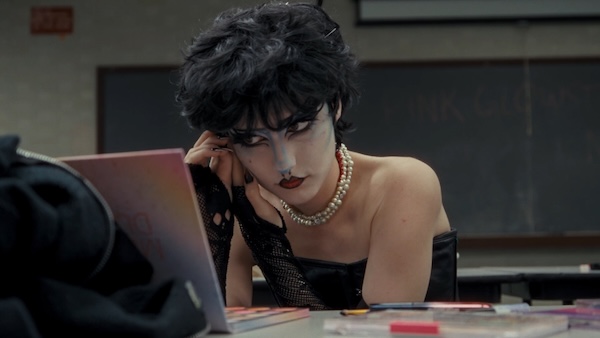
First They Came for My College. Photo: IFFBoson
First They Came for My College chronicles the assault on New College of Florida by Governor Ron DeSantis and his ideological allies. Once a small but thriving enclave of academic independence and student diversity, the college was used as a test case for a broader conservative project: the dismantling of institutions deemed “woke,” a term so elastic here it functions less as a description than as an accusation. It is a word that has been used to define an interest in diversity, and has been made to justify replacing board members and faculty, to deny tenure, and to eliminate socially progressive programs. The suited bureaucrats went so far as to replace LGBTQ students by offering scholarships to more “acceptable” pupils, including baseball players. The college became a bellwether for the conservative takeover of educational institutions of higher learning across the country. An eye-opening, shocking, and important documentary. The post-film discussion included students from the school, the filmmaker, and the former Gender Studies professor.
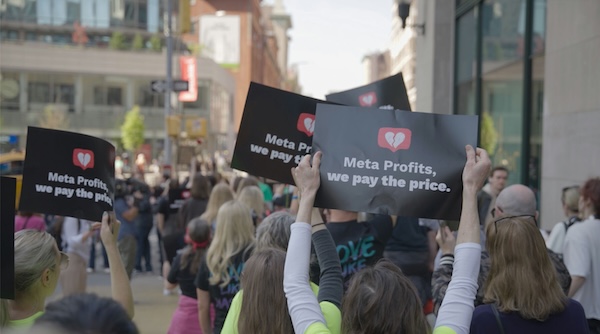
A scene from Your Attention Please. Photo: IFFBoston
Your Attention Please examines the so-called “attention economy” and its effects on teenagers navigating a world mediated by phones and social platforms. At the narrative’s center is Kristin Bride, whose son Carson Bride died by suicide after experiencing bullying and humiliation on apps like Snapchat, YOLO, and LMK. Her grief inspired a sustained campaign to hold social media companies accountable and to press Congress toward meaningful safeguards. The film maps a broader cultural crisis — played out in headlines about what is happening in classrooms and homes — while suggesting policy changes, accountability legislation, and methods for altering daily social media consumption. Rather than a depressing polemic, the film is filled with testimonials and inventive animations. In a post-screening discussion, the filmmakers were joined by students from the film, along with Kevin McCaskill, principal of Brockton High School. In 2024, under his leadership, the school implemented a strict phone policy that required devices to be locked in pouches at the start of the day and to remain inaccessible until dismissal. It’s a modest but concrete step toward restoring a measure of sanity in a school environment increasingly shaped by distraction and digital pressure.
Hereford Shorts was a compilation of films on various arts-related topics.
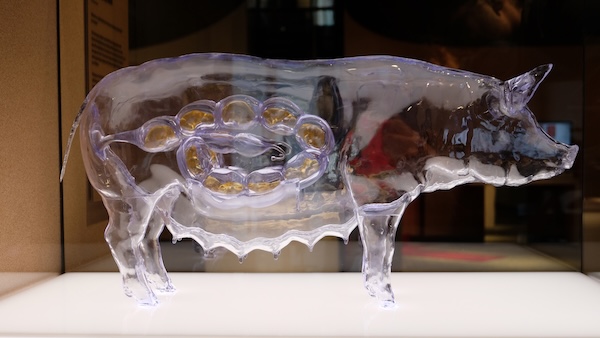
A scene from Ani Liu: Eye Heart Womb. Photo: IFFBoston
Ani Liu: Eye Heart Womb (19 min.) by Maio Wang profiles the titular artist, whose interdisciplinary art intersects with science and technology. “I’ve been obsessed with the body my whole life,” Liu tells us. Much of Wang’s work is informed by her role as a mother. Liu explains early in the film that “the objects in our lives tell stories and encode values.” One of her works is an installation of tubes that shows the remarkable amount of breast milk generated by an average nursing mother. In another, Liu controls sperm cells with her brainwaves (“Men would come up to me and say, ‘that’s totally horrifying’.”) Other sculptures are less visceral, like a collection of mooncakes with mouths. (“My parents never said they loved me but they gave me a lot of food.”) This was a terrific opening film. Link here.
Barbara Prey: Painting to Scale (6:36 min.) by Joe Aidonidis profiles Barbara Prey and how she went about creating the world’s largest known watercolor, an 8-by-15-foot painting for MASS MoCA’s Building 6. The picture is characterized as “a stunning visual meditation on space, stillness, and transformation.” We watch as Prey surveys the space and then creates small studies of details that will be part of the larger work. What we see will encourage a trip to North Adams. Link here.
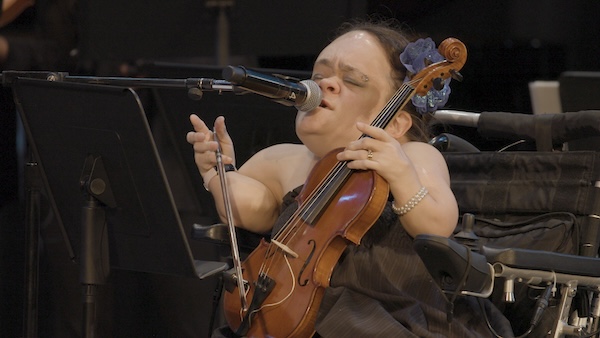
A scene from Make a Joyful Noise. Photo: IFFBoston
Make A Joyful Noise by Alice Stone (Angelo Unwritten, She Lives to Ride), the Winner of the Audience Choice Award for Best Short Documentary, showcases a performance by the Music Inclusion Ensemble, a group of accomplished musicians with physical and neurological disabilities at Berklee College of Music in Boston. It features violinist Adrian Anantawan, co-founder of the project and a string professor at Berklee, who was born with a congenital disability to his right hand. Rhoda Bernard of the Berklee Institute for Accessible Arts Education is also featured in the documentary. One violinist on the autism spectrum perceptively declares: “Perhaps creativity is revealed in a more pure way because of the navigations that someone with a disability has to make in a world that is not necessarily built for us.”
A Matter of Light by Anne Continelli was a companion to Somerville’s Open Studios weekend. The film chronicles the work of a group of Somerville artists who converted abandoned warehouse spaces into artist studios, focusing on the expansive Vernon Street Studios. The film looks at the benefits to Vernon Street and the importance of art to the community, as well as the challenge for artists who are looking for increasingly scarce affordable housing.
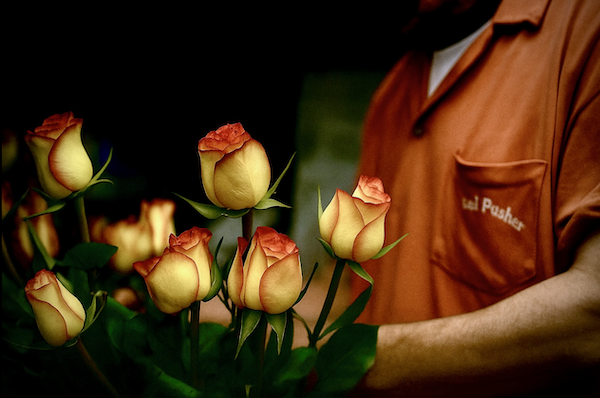
A scene from The Pedal Pusher. Photo: IFFBoston
The Petal Pusher comes from reporter David Abel of Boston University and editor Mark Chesak, a longtime Boston editor and professor at Emerson College. The film presents footage shot over a ten year period: the film follows the closing of one of the longest-running small businesses in New York City’s Penn Station, the busiest hub in North America. The titular flower shop had been open since the ’70s. It was finally priced out of its kiosk space because of renovations. The film features music from various street performers, accentuating its ode to the venerable train station and the price we pay for an ever-changing urban landscape.
Tim Jackson was an assistant professor of Digital Film and Video for 20 years. His music career in Boston began in the 1970s and includes some 20 groups, recordings, national and international tours, and contributions to film soundtracks. He studied theater and English as an undergraduate, and has also worked helter-skelter as an actor and member of SAG and AFTRA since the 1980s. He has directed four feature documentaries: Chaos and Order: Making American Theater, which is about the American Repertory Theater; Radical Jesters, which profiles the practices of 11 interventionist artists and agit-prop performance groups; When Things Go Wrong: The Robin Lane Story, and Marblehead Morning: Daring & Stahl: 50 Years in Harmony. He has made two short films as well: Joan Walsh Anglund: Life in Story and Poem and The American Gurner. He is a member of the Boston Society of Film Critics. You can read more of his work on his substack.
Tagged: "A Matter of Light", "Ani Liu: Eye Heart Womb", "Barbara Prey: Painting to Scale", "Make A Joyful Noise", "The Petal Pusher", "Your Attention Please"