Classical Music Album Review: The Neave Trio’s “In Her Hands”
By Jonathan Blumhofer
The Neave Trio’s new album is as well recorded as it is programmed and played.
There’s music you know because you should—it’s part of your time, your culture, what have you. And then there’s music that, once you hear it, you realize you should know just because it’s good music.
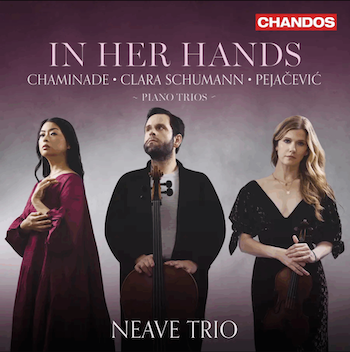
The Neave Trio’s most recent album, In Her Hands, showcases the latter type of repertoire. None of their selections—piano trios by Clara Schumann, Dora Pejačević, and Cécile Chaminade—are canonic. Yet they’re each decidedly personal and inviting installments in the genre.
Though Schumann’s self-doubts about her abilities as a composer are well-documented, she seemed to take modest pride in the strengths of her G-minor Trio. And well she might have: the young Johannes Brahms openly admired the score. In the Neave’s performance, it’s not hard to see why.
This is rich, multifaceted music, oftentimes lyrical but full of stormy turns and moments of coy playfulness. It also abounds in contrasts: the snapping, graceful rhythms of the Scherzo’s outer thirds, for instance, frame an unexpectedly dark-hued, searching Trio. The Andante, too, counters an unaffectedly gorgeous melody with a short, pert animato section.
Throughout, the Neave’s reading is warm, shapely, and well-directed. Textural lucidity rules: the first movement’s development comes out with agreeable clarity of purpose, and the finale’s nifty fugato sparkles.
The group’s account of Pejačević’s Trio in C, her second, is done with similar purpose. The Budapest-born Croatian composer was largely self-taught and much of her output has been neglected since her premature death at thirty-eight (from complications of childbirth). Yet, on the merits of this work, there’s much to admire.
Her writing is often sweeping and tuneful, always idiomatic and conversational. There’s a Brahmsian warmth that marks many of its textures, especially in the middle movements. But those are hardly derivative: the Scherzo’s Trio launches, unexpectedly, into a 5/4 meter, and the finale’s chromatic turns are bracingly fresh.
The last are given thoroughly lively, energetic treatment by the Neaves, who correctly intuit Pejačević’s writing as an offshoot of the best traditions of late-Romantic chamber music. They play up the score’s bold contrasts, too, particularly the Lento’s transitions between dreaminess and turbulence.
Of the three composers, Chaminade was the most widely regarded during her long lifetime (she died at 86 in 1944). Even so, her larger works remain relatively obscure.
This Trio, published in 1887, certainly deserves a better fate. It overflows with personality in the first movement’s opening minutes alone: a sweeping, epic theme crossfades into a subject of striking simplicity. The whole thing is very French in flavor and texture—think Franck—and Chaminade’s larger approach to form and sonority is appealingly free and energetic.
In their reading, the Neaves thoroughly inhabit the essentials of the composer’s style. Their ensemble is agile and light on its collective feet, which means the Trio’s whiplash-inducing transitions are particularly effective. So, too, are the music’s stark plays of character—just listen to the finale’s about-faces from elfin-diabolical to noble chanson to wild, gypsy-like fiddling.
Throughout, Chandos’ engineering is clean and bright. There are a couple of spots (like the end of Chaminade’s first movement) where violinist Anna Williams is placed a bit back in the mix, but, otherwise, this is an album that’s as well recorded as it is programmed and played.
Jonathan Blumhofer is a composer and violist who has been active in the greater Boston area since 2004. His music has received numerous awards and been performed by various ensembles, including the American Composers Orchestra, Kiev Philharmonic, Camerata Chicago, Xanthos Ensemble, and Juventas New Music Group. Since receiving his doctorate from Boston University in 2010, Jon has taught at Clark University, Worcester Polytechnic Institute, and online for the University of Phoenix, in addition to writing music criticism for the Worcester Telegram & Gazette.
Tagged: "In Her Hands", Anna Williams, Chandos, Eri Nakamura, Mikhail Veselov