Classical Album Review: Beyond “East Meets West” — Anne-Sophie Mutter’s Crosscurrents
By Jonathan Blumhofer
Anne-Sophie Mutter’s latest album sidesteps easy binaries, pairing Widmann’s mercurial Beethoven study with works by Chin, Darvishi, and Adès in performances of striking authority.
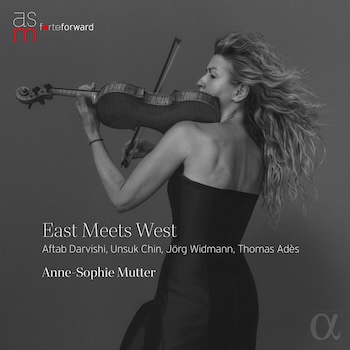
On its surface, the title of Anne-Sophie Mutter’s new album, East Meets West, is a little misleading. Yes, two of its four composers, Aftab Darvishi and Unsuk Chin, were born in, respectively, the Middle East and Asia. But such superficialities don’t do justice to either the disc’s program or the violinist’s artistry.
Rather, the recording takes up the cross-cultural theme of the eponymous 1967 recording from Ravi Shankar and Yehudi Menuhin. In the process, it reminds us that currents of influence don’t flow in one direction—nor is this a particularly recent phenomenon: Beethoven, after all, spent the last years of his life delving into various Eastern philosophies, including Zen.
He makes an appearance here—or, rather, his reflection does—courtesy of Jörg Widmann’s String Quartet No. 6. Subtitled Studie über Beethoven (“Study on Beethoven”), the eleven-movement work marked a point of departure for the German composer, whose first five quartets had been collected under the heading “Attempt at a Fugue.”
This later series (No. 6 dates from 2019; Widmann has since completed four more installments) reckons with Beethoven’s musical influence on the genre. In this instance, that means there is a series of quotations (or allusions) mixed with dizzying virtuosic displays and manic extremes of all the musical elements.
Some of Widmann’s treatment of Beethoven’s influence is clearly whimsical, like running the older composer through a hall of fun-house mirrors. Throughout its 30-minute duration, the writing is dense and busy, suggesting a set of variations but never quite arriving there. At the same time, there’s enough textural and tonal variety to just hold the ear. As with much of Widmann’s output, though, following along with the score is helpful, at least on initial listenings.
Nevertheless, the performance is outstanding and well balanced. Mutter was Widmann’s muse (the Quartet is dedicated to her), and her playing, especially in stratospheric sections, is a marvel of precision and clarity. But the larger ensemble—violinist Ye-Eun Choi, violist Muriel Razavi, and cellist Pablo Ferrández—is terrifically unified, too. Even when the music is at its most rhythmically disjunct and pungently dissonant, there’s never a question of the collective’s command of Widmann’s style or their individual parts.
Chin’s Gran cadenza is delivered with similar confidence by Mutter and violinist Nancy Zhou. Essentially a compendium of contemporary violin techniques, it’s gristly stuff that probably comes off better in concert than on record: the music’s range of character studies sounds like a contest of equals that would benefit from visuals.
Likoo, on the other hand, is a soulful, lyrical effort. The title refers to a genre of mournful songs from Darvishi’s native Iran, and the performance was recorded at the beginning of 2025’s Twelve Days War between that country and Israel. Mutter delivers its bent notes and melismatic turns with a warmth and urgency made more affecting by this year’s renewal of that conflict.
She accomplishes a similar feat with Thomas Adès’ Air, heard here in its premiere recording. Written for the violinist in 2022, the work is, rather surprisingly for this composer, beautifully static in rhythm and tempo, and absorbingly reflective.
Subtitled “Homage to Sibelius,” its solo writing hovers almost exclusively in the violin’s upper register, a range in which Mutter’s playing remains unsurpassed. The larger piece, which, among other things, hypnotically channels Adès’ love of canons, is full of touching details and closes with a magical coda. He leads the performance with Mutter and the London Symphony Orchestra. It’s about as close to definitive as these things get.
Jonathan Blumhofer is a composer and violist who has been active in the greater Boston area since 2004. His music has received numerous awards and been performed by various ensembles, including the American Composers Orchestra, Kiev Philharmonic, Camerata Chicago, Xanthos Ensemble, and Juventas New Music Group. Since receiving his doctorate from Boston University in 2010, Jon has taught at Clark University, Worcester Polytechnic Institute, and online for the University of Phoenix, in addition to writing music criticism for the Worcester Telegram & Gazette.