
Theater Review: “Eureka Day” — Groupthink Gone Viral
By Martin Copenhaver
Jonathan Spector’s successful satire finds biting comedy—and uneasy truth—in the limits of well-meaning consensus.
Eureka Day by Jonathan Spector. Directed by Margot Bordelon. Staged by the Huntington Theatre Company, The Huntington Theatre, 264 Huntington Avenue, Boston, through June 28.

Sasha Diamond, Nancy Lemenager, Ken Cheeseman, and Eunice Woods in the Huntington Theatre Company production of Eureka Day. Photo: Liza Voll
Eureka Day is set in the library of an upscale über-progressive grade-school in Berkeley, California. It is so chock-a-block with books and toys, so lavishly festooned with brightly-colored displays, that room itself communicates an oppressive over-functioning. If Mister Rogers were to wander into the library, I can imagine him immediately calling on Marie Kondo to declutter the place to make room for the imagination of children.
Throughout the play, however, the library is occupied by the four members of the executive board of the school and its principal. In the opening scene, they take up pressing issues facing the school, such as: Should the drop-down menu on the prospective parent application include the option “transracial adoptee?” That question prompts a flurry of virtue signaling as the members try to follow the rules of woke engagement: “I feel heard.” “Everyone should feel seen by this community.” “I think we’re all saying the same thing.” These lines, and others like them, elicit laughter from the audience not because they are witty or clever, but because they are not. It is laughter of recognition. We have been in those meetings. We have heard (and perhaps even said) some of those things. Suzanne, the member with the longest tenure on the board (and don’t you forget it), offers a kind of rest-my-case summation: “There’s no benefit in Feeling Seen if you’re simultaneously Being Othered, right?” Game over. Clearly, she has been at this longer than anyone else in the room.
Nothing is resolved at the meeting. What remains to be said? Ever the hopeful conciliator, the principal, Don, thinks the group could benefit from the words of the poet Rumi, so he reads a few lines with an enraptured expression on his face (“Let the beauty of what you love be what you do.”) The members of the board listen politely, then give a nonverbal, “Whatever,” and head their separate ways.
The board gathers again four days later for an emergency meeting. Suddenly, they have a very real issue to address. There has been an outbreak of mumps at the school. Should they close the school? Require proof of immunity? Do nothing? It quickly becomes clear that this board, using its usual means of communication, is not equipped to deal with a serious issue. Also, they are all the more unprepared to deal with the differences that arise among them. Their assumptions no longer go unchecked. It is increasingly obvious that they are not “all saying the same thing.” Political correctness cannot hold sway when it is not clear what the correct course of action is.

Eunice Woods, Nancy Lemenager, and Ken Cheeseman the Huntington Theatre Company production of Eureka Day. Photo: Liza Voll
Given the themes of the play and how they are developed, we might assume that Eureka Day was written in response to the COVID-19 pandemic. And, indeed, the play had successful runs in London (2022) and Broadway (2024), perhaps in part because it was timely. The Broadway production, however, won a Tony Award for, “Best Revival” of a play. The play premiered in Berkeley in 2018 and had an Off-Broadway run in 2019, well before the pandemic. This timeline makes the playwright, Jonathan Spector, seem downright prescient. It also demonstrates that Eureka Day is about more than today’s headlines. It considers human proclivities that are not nearly so time-bound.
Although the dialogue turns more serious when the issue of the mumps outbreak is raised, it doesn’t stay there. In fact, the next scene is downright hilarious. The board decides to hold a “community-activated conversation” to consider how the school should respond to the mumps outbreak. Don, as principal, leads the meeting, staring into his laptop where parents have joined the meeting via Zoom. The board members are arrayed behind him. Don begins by offering a few of his hippie bromides, but the parents aren’t having it. We cannot hear them, but we can see the chat messages they submit, projected on a wall upstage throughout the meeting. The comments roll through slowly at first, and then increase in velocity. Before long, the comments command our attention more than the dialogue of the actors. The comments devolve from sarcastic, to snarky, to vitriolic (“Were you dropped on your head as a child?”). It resembles a virtual bar fight. One also gets the impression that the comments express the suppressed inner monologue of the characters.
The effect is so uproarious that, eventually, we cannot hear portions of the dialogue because the audience is responding with such loud laughter to the comments on the livestream. The actors are quite literally upstaged by the comments projected on the upstage wall—but in a good way. This is the scene people are certain to talk about after the show. When I recommend this production to others, and I do, this scene is the one I have most in mind.
Spector’s ear for dialogue is almost pitch perfect. I say “almost” because there is one piece that rings hollow and seems out of place in this satire. Late in the play, one of the characters shares a story about a personal tragedy as an explanation for the positions she holds. In this, Spector seems to evince ambitions beyond satire. Perhaps he is attempting to elicit empathy for a character who is not particularly sympathetic. Or, perhaps it is his way of saying what the philosopher Philo said two thousand years ago: “Be kind, for everyone you meet is fighting a great battle.” Whatever his intentions, the scene falls flat. It feels forced and out of place.
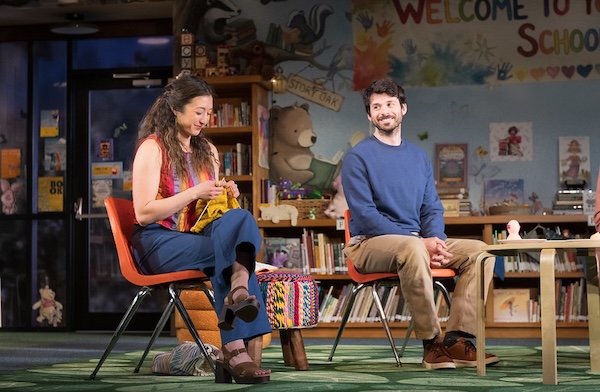
Sasha Diamond and Japhet Balaban in the Huntington Theatre Company production of Eureka Day. Photo: Liza Voll
Put that caveat in the category of “a small quibble.” Spector has done a marvelous job of depicting the various characters, and he has mastered the art of spritely dialogue that fuels a successful satire.
The ensemble of actors is excellent and without a weak link. Ken Cheeseman is able to portray the principal, Don, in all of his goofy new-ageiness without his portrait devolving into a cartoon. Nancy Lemenager is able to inhabit the role of the tightly-wound Suzanne in ways that are entirely believable. We know these people. As the newest member of the board, a Black woman named Carina (Eunice Woods) has not been with the others long enough to be infected with their dysfunction. Hers is the soft voice of common sense, although her facial expressions communicate more loudly. Meiko (Sasha Diamond), the most underwritten of the characters, knits during most meetings, but it is clear, all the while, that she is keenly observing the others. Japhet Balaban (playing Eli) has the most thankless role, the tech-bro who has cashed in, who says all of the right things (or tries to), but nonetheless ends up mansplaining and trying to dominate in ways that make clear that he has not changed a bit. (By the way, the last play Margot Bordelon directed for the Huntington was John Proctor is the Villain, in which Balaban also played a world-class cad. I think she owes him another kind of role the next time around.)
Beyond the individual performances, the actors form a true ensemble, playing as beautifully together as a string quintet.
Eureka Day is the name of the school at which the play takes place. I have wondered about the significance of the name. It sounds new-agey, and that may be the only significance. But “eureka” means, literally, “I found it!” That begs the question, “What have the characters found?” Clearly, they have not found agreement or anything as definitive as that. Perhaps what they have found is how difficult it is to bridge differences and that our earnest efforts are best leavened with laughter.
Martin B. Copenhaver is an author living in Woodstock, Vermont, where he does not raise goats.
Tagged: Eunice Woods, Eureka Day, Huntington-Theatre-Company, Japhet Balaban, Jonathan Spector, Ken Cheeseman, Margot Bordelon, Nancy Lemenager
1 Comment
Leave a Comment

The laughs of recognition Martin Copenhaver mentions are indeed immediate and spontaneous. It would be hard not to laugh out loud at our recognition of ourselves in the various exchanges. However, throughout the play, I kept wondering what deeper insights were sparked in the audience, if any: we so desperately need serious insights as to how we are going to address the deep-seated racism and inability to tolerate difference so clearly evident in today’s world.
While the so-called ‘woke’ vocabulary that has become the target of much of the current discourse has not produced the desired results, the backlash against it has at least surfaced the enduring racism festering under the surface. We can now clearly see more clearly what we are up against, and it is also clear that we need to address the ways in which the “woke” approach has failed to produce the desired results.
However, I strongly disagree with Copenhaver’s assessment that the interchange between 2 of the characters related to a personal tragedy experienced by 1 of the characters rings hollow. The exchange focused on one of the characters revealing the traumatic event that caused her to become an anti-vaxxer. For me, that exchange –– which Copenhaver characterized as an example of what the philosopher Philo said two thousand years ago: “Be kind, for everyone you meet is fighting a great battle.” –– was actually the highpoint of the play. It did not, as Copenhaver suggests, ring false. For me, it was what made the play more than a slick and clever piece of entertainment for the liberal classes.
A recent UTube of a Mamdani day-long listening session with over 100 ordinary New Yorkers (https://www.youtube.com/watch?v=xj89tYvwr6k) is a powerful reminder that liberals and progressives, and especially the Democratic party and its various institutional manifestations, absolutely must reach across the deep divides and polarizations the play purports to address and connect, not to the stereotyped surface rhetoric and behaviors but to the underlying sense of alienation that a significant demographic of this country are feeling. We need to stop locating the ‘source’ of our problems in MAGA, and come to terms with the dysfunctional neoliberal positions Democratic elites have taken that have contributed to ignoring the legitimate needs and aspirations of the working class and rural constituencies.
One of theater’s great strengths is its ability to engender empathy for people unlike ourselves. If we don’t tap this strength, but are satisfied with only it’s ability to entertain, then we are doing a great disservice not only to theater, but to the country as a whole.