
Film Review: “Disclosure Day” — Broadcasting the Truth?
By Steven Erickson
Steven Spielberg revisits extraterrestrial wonder with technical virtuosity, but his media-age fable drifts into sentimentality and soft-focus optimism.
Disclosure Day, directed by Steven Spielberg. Screening at the Coolidge Corner Theatre in Brookline.

Emily Blunt in Disclosure Day. Photo: Universal Pictures and Amblin Entertainment
Disclosure Day wants to believe. It longs for a simple faith in the truth of images, yearning for a time when we all watched the same TV news. Like so many stories about UFOs, it’s full of New Age pseudo-religiosity, but its central questions aren’t about God or even the existence of extraterrestrial life. They’re about the power of the media to change the world for the better. And those means are nostalgic. Disclosure Day was rumored to be a sequel to Steven Spielberg’s first film about aliens, Close Encounters of the Third Kind. Although it proved not to be, the narrative returns to a subject that fascinates him. In Disclosure Day’s press kit, he says “Wouldn’t it be wonderful to actually know that all of this is true?”
Disclosure Day begins in media res, with the camera witnessing a boxing match. It serves as an active participant. Then, Spielberg cuts between several sets of characters who don’t meet up until halfway through. Dr. Daniel Kellner (Josh O’Connor) sits in the audience, along with his partner Jane (Eve Hewson), a nun who has suffered a crisis of faith. A whistleblower who gathered evidence of the aliens’ existence while working for the WARDEX agency, he is looking for a way to access the media in order to broadcast this proof. Margaret (Emily Blunt) is a meteorologist who acquires unusual abilities after a bird flies into her apartment. Suddenly, she’s capable of speaking Russian and Korean and, even more unsettlingly, develops a telepathic insight into the thoughts of everyone she meets. (This helps her get out of a traffic ticket.) We see former WARDEX employee Hugo (Colman Domingo) speaking on the phone with Daniel as workers construct a suburban home set around him. Noah (Colin Firth), who now controls WARDEX, schemes to keep the truth hidden and retain power over “the device.” This piece of alien technology can grant its users the ability to teleport or hypnotize others into committing violence.
After becoming a father, Spielberg came to regret the way Richard Dreyfuss’ character in Close Encounters abandons his family to join a group waiting for the arrival of a UFO. The first half of that film approaches greatness: it retains a bit of New Hollywood prickliness, but it is domesticated by the finale. Dreyfuss’ behavior reads as potential mental illness, a mindset that propels him to unconsciously rebel against a life he finds constraining. It’s a Jack Kerouac fantasy for dads who don’t want to age as quickly as they are. The character isn’t portrayed as especially likable, even if Close Encounters sympathizes with him. The film doesn’t quite stick the landing, tossing aside a character study for a special-effects demonstration reel by the end, but it provides a wealth of material that could be productively updated.
Josh O’Connor and Emily Blunt in Disclosure Day. Photo: Universal Pictures and Amblin Entertainment
Disclosure Day is a safer and more eager-to-please vision of an extraterrestrial meetup. Spielberg’s films tend to blend sentimentality and cruelty; his impulses here incline towards the former. On the one hand, the narrative points back to a lineage of paranoid thrillers. Noah’s visions of domination are not exactly defanged, but they yield toward a more hopeful mood as the story progresses, eventually morphing into a kind of toxic positivity.
Janusz Kaminski’s cinematography grants Disclosure Day a genuinely otherworldly aura. The aliens are associated with the color yellow—their technology is packaged in a sunny glow. The lighting plays a thematic role; long before the film makes this explicit, there is a sense of something larger and more mysterious hovering outside the frame. Lens flares smear the image; even the most mundane shots resonate with enigma.
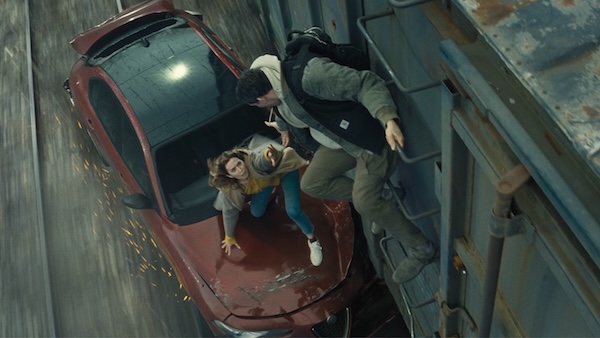
Spielberg’s knack for staging action set pieces remains strong, highlighted by an exhilarating car chase. The direction and editing pulse with nervous excitement. But when Disclosure Day finally has to pull its threads together, that impressive craft falls away. David Koepp’s script resorts to blunt plot exposition delivered through multiple characters. For a film that aims to engage with how the revelation of extraterrestrial life might reshape our understanding of religion, it never moves beyond the most obvious clichés. Jane’s struggle with what God means to her serves as little more than a way to shoehorn faith into the story.
Speaking to podcaster Benny Johnson last March, J. D. Vance insisted that he believes aliens are real—but demonic rather than extraterrestrial. In cinema, alien encounters were once stages for enlightened space hippies to preach peace. By the 1980s, however, the UFO genre had become dominated by nightmarish tales of midnight kidnapping, medical experimentation, and sexual assault. Disclosure Day casts this manhandling of mankind in a more benign light, even when, in this case, children serve as the aliens’ test subjects. The real dehumanization is carried out by humans themselves. The prospect of a corporate-government conspiracy—enforced through attempted murder—to conceal the existence of aliens becomes, improbably, a feel-good device, suggesting that exposure might unite us or even produce positive political change. (This may be the only recent film in which a montage of people staring at their iPhones carries a note of optimism.) The climax of Close Encounters of the Third Kind can be read not as transcendence but as a descent into mindless cult worship. Disclosure Day taps into that vision of docile collectivity.
Steve Erickson writes about film and music for Gay City News, Slant Magazine, the Nashville Scene, Trouser Press, and other outlets. He also produces electronic music under the tag callinamagician. His latest album, Bells and Whistles, was released in January 2024, and is available to stream here. He presents a biweekly freeform radio show, Radio Not Radio, featuring an eclectic selection of music from around the world.
Tagged: "Disclosure Day", David Koepp, Emily Blunt, J.D. Vance, Janusz Kaminski, Josh O'Connor