
Book Review: “Love and Terror” — Charles Manson as Myth, Murder as Media
By Tim Jackson
Claudia Verhoeven’s Love and Terror reframes the Manson murders as a cultural narrative shaped by spectacle, ideology, and America’s enduring fascination with charismatic deception.
Love and Terror: The Helter-Skelter History of the Manson Murders by Claudia Verhoeven. Verso, 384 pages, $29.95
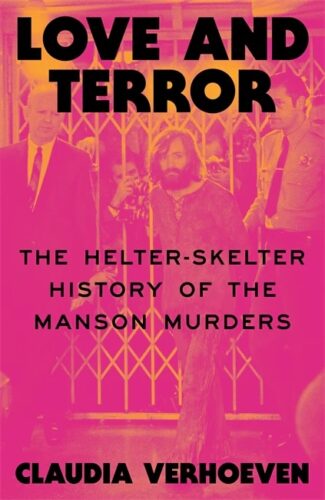
The fascination with the crimes and mystique surrounding Charles Manson has not abated. The approach of Love and Terror: The Helter-Skelter History of the Manson Murders is to take a wide-ranging look at how the murders were covered by the press and absorbed into popular culture. At the time, the crimes of the “Family” became a convenient symbol for the death of 1960s idealism. That interpretation proved particularly attractive to those who viewed the counterculture as a threat to social order, a story of menace that also sold newspapers and books. Manson himself was more complicated: a manipulative blend of street hustler, storyteller, self-styled prophet, and cultural scavenger, he stitched together fragments of philosophy, spiritualism, race paranoia, pop culture, and psychedelia into a seductive mythology. His charisma mesmerized a largely female following, exposing the dangers of cult thinking for a new generation. More than half a century later, the murders remain a cultural touchstone; an atrocity so shocking that it has left a permanent mark on the American imagination. In her book, Claudia Verhoeven is particularly interested in exploring why the case exerts such an unshakable power over our imagination today. Fifty years on, Manson and company continue to reflect the country’s enduring obsession with violence, true crime, and the dark allure of charismatic monsters.
Vincent Bugliosi and Ed Sanders represent the opposing perceptions established by the first accounts of the Manson trial. Prosecuting attorney Bugliosi, author of 1972’s Helter Skelter: The True Story of the Manson Murders, created a dense narrative that would serve as the justification for his case. It also launched his political ambitions; his book became the most popular true crime book in American history, selling around 8 million copies. Robert Kirsch, former book editor and critic at The LA Times, said in his review: “I do not say this is the definitive book on the Manson case. But in its detailed, documented and annotated pages, in its description of the way in which the case was investigated and presented, in the background information it provides on the events and persons involved, in its recapitulation of mood and of the actions behind the scenes, it is arguably an indispensable contribution to the necessary dialogue.”
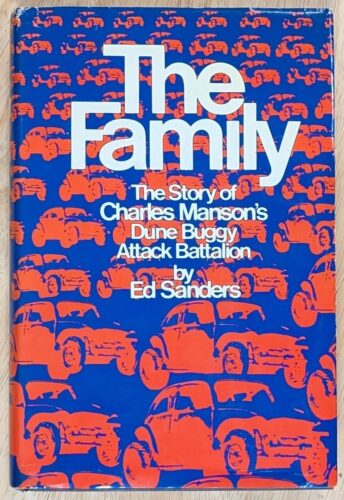
In 1971, poet and musician Ed Sanders took an alternative view in The Family: The Story of Charles Manson’s Dune Buggy Attack Battalion. The NYTimes noted that his “terse notebook style, avoiding comment and ignoring conventional standards of rhetoric, functions as a deliberate artistic choice.” Sanders eschewed what he referred to as “horse-dooky”: he did not psychoanalyze, philosophize, or make excuses regarding his research into the Family. As a journalist for the Los Angeles Free Press, he supplied hip prose passages like this: “the flower movement was like a valley of thousands of plump white rabbits surrounded by wounded coyotes. Sure, the ‘leaders’ were tough, some of them geniuses and great poets. But the aciddropping [sic] middle‐class children from Des Moines were rabbits.” The New York Times noted that Sanders, founding member of the Fugs and an early Yippie (Youth International Movement) participant, was “severely critical of the anti-hippie hysteria among straight journalists.” He was also “horrified by the satanist coyotes who battle the forces of Yippie for the soul of the disaffected young.” Sanders pursued facts about the case during the trial, at some risk to himself. Manson Family members still prowled the landscape. His stated agenda: to debunk the notion that Manson’s demon presence and horrific acts were in any way associated with ’60s counterculture.
Verhoeven, drawing on newly released trial transcripts, offers a cultural critique that draws on but moves beyond Sanders’s psychedelic tabloid style and Bugliosi’s “gargantuan narrative.” She describes the prosecutor’s vision as one populated by “Satan, slaves, robots, a vampire, and Little Red Riding Hood,” all moving through “slaughter, atrocities, and rivers of blood” toward an apocalyptic race war.
 Manson himself was a showman, which helps explain both his appeal to writers and his enduring place in popular culture. He treated the trial as an opportunity for performance: grinning and dancing for the press, issuing outlandish metaphysical pronouncements and insisting on his own motley defense team, including Ronald Hughes, the hippie lawyer valued, according to Verhoeven, for his “experiences with the counterculture and knowledge of obscure metaphysics.” She argues that the violence and the trial became a form of spectacle — what Brian Jenkins called “terrorism as theater” — in which verbal and visual display ruptured everyday reality.
The “Family” was not populated by self-conscious revolutionaries or radicals. Sanders believed that the clan was attracted to obscure philosophies, apocalyptic dreams, and harebrained rationales for murder. Their mindset amounted to “a huge concentration of mule mucus,” “a duplicitous gibberish sandwich.” One of Verhoeven’s chapters goes into detail about Manson’s beliefs and how they strengthened his hypnotic draw on malleable minds. The group avoided clocks and stayed away from the outside world. Members were deep into psychedelics, rituals, and isolation. Manson claimed: “I didn’t see myself as wanting to control anyone, or be a leader. However, being the center of attraction … the hub that turns the wheel can sometimes have an adverse effect on a person.” Manson often referred to circles. “You’ve got a circle, man, that man lives inside of,” he said in an interview with Charlie Rose. “The murders happened in your world, not mine. Not my circle. Because I wouldn’t allow it.”
Love and Terror aims to be a measured narrative, covering the array of misguided beliefs that influenced Manson, ideas that were conditioned by his many periods of incarceration. (By age 32, he had spent roughly half his life in reformatories and prisons.) Verhoeven believes that Manson “tapped into his criminal past and let it flow into everyone’s present.” He was intelligent, his imagination a blank slate on which he inscribed a delusional philosophy that he instilled in his followers. According to Brooks Poston who lived with the Family for a year, Manson believed himself to be Christlike: “He’s looking for a cave that leads down to a city of gold that the Indians talk about.” Manson also believed that hidden messages were to be heard in the Beatles’ tune “Helter Skelter,” which intimated “the coming negro revolt” that he hoped to inspire through murder and fear. He thought “Revolution No 9” had a connection to the Bible. Poston: “He feels the Beatles are the four-headed locusts that are mentioned in the Book of Revelation.”
Love and Terror devotes a chapter to Manson’s agenda as a lifelong environmentalist. His return-to-nature ideals were labeled “Air, Tree, Water, Animals” or ATWA. He would add an “R” in order to morph it into the more emphatic “AT WAR”.
In her chapter “The Out/Law and the Paradoxical Power of the Void,” Verhoeven argues that the Manson Family reflected a psychological state of mind that moved “between the schizophrenic revolutionary and the paranoid fascist.” She goes on to suggest that Manson’s attraction stemmed from a personality that was both hyper-rational and irrational — establishing “the connection between intellect and insanity.” In court, Manson refused to enter an insanity plea because he insisted that his elaborate cosmology and twisted ideals lay beyond the comprehension of his prosecutors. Even the man’s medical records concluded that “his disjointed thoughts seem to be deliberate.”
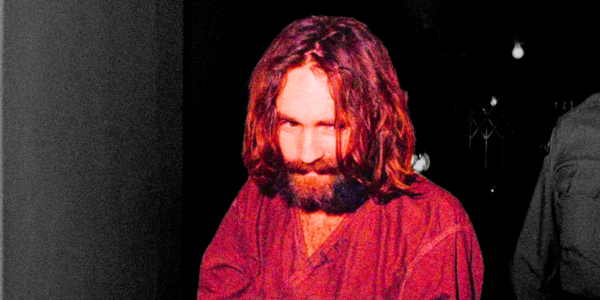
Charles Manson — even “his disjointed thoughts seem to be deliberate.” Photo: Wikimedia
Former associate Gregg Jakobson, who supplied the funds to record Manson’s early songs and introduced him to the Beach Boys’ Dennis Wilson, recalled that Manson possessed “a face or a mask for every level or walk of life of anyone he came across.” Manson himself claimed to have “1000 faces,” a power that allowed him to manipulate everyone from “the ranch hand at the farm to the girl on the Strip.” Manson’s multisidedness encouraged a dissolution of individual identity within the group. As Susan Atkins put it, “Charlie was me and I was Charlie, and all of us were one at the ranch.” For Verhoeven, this fluidity of identity was central to both Manson’s charisma and the cult-like power he exercised over his followers.
The final chapter places the crimes against the backdrop of the bloody, illegal war in Vietnam. Verhoeven begins with a striking fact: “Lieutenant William Calley, Jr. was convicted for his participation in the 1968 massacre on March 29, 1971, the same day that Charles Manson and his three female codefendants were sentenced to death for murder.” From that point, she considers a grim but telling comparison: the brutality that Manson projected into popular culture and the sanctioned slaughter of between 300 and 500 men, women, and children at My Lai. Put under house arrest, Calley served only a few years. The conjunction of the savagery of the My Lai massacre and the slaughter by the Manson Family raises questions about the spectacle of moral decay, especially during a violently disordered historical moment. Verhoeven also cites Jeffrey Melnick’s excellent Creepy Crawling, which situates the murders within the culture of 1960s Los Angeles.
From Herman Melville’s The Confidence-Man to F. Scott Fitzgerald’s The Great Gatsby and Nathanael West’s A Cool Million, American writers have long been captivated by the nation’s embrace of homegrown imposture and self-invention. Their works dramatize the destructive allure of cults, true believers, authoritarian movements, and charismatic fraudsters. Drawing on new information, Love and Terror is an intellectually ambitious attempt to situate Charles Manson and his appeal within that tradition. As a work of nonfiction, it immerses readers in the friendships, lifestyle, methods of seduction, and distorted psychology of the Family and its members. Yet Verhoeven, like Melville and his literary heirs, also delivers a compelling warning about the lethal consequences of placing faith in manipulators and purveyors of deception.
Tim Jackson was an assistant professor of Digital Film and Video for 20 years. His music career in Boston began in the 1970s and includes some 20 groups, recordings, national and international tours, and contributions to film soundtracks. He studied theater and English as an undergraduate, and has also worked helter-skelter as an actor and member of SAG and AFTRA since the 1980s. He has directed four feature documentaries: Chaos and Order: Making American Theater, which is about the American Repertory Theater; Radical Jesters, which profiles the practices of 11 interventionist artists and agit-prop performance groups; When Things Go Wrong: The Robin Lane Story, and Marblehead Morning: Daring & Stahl: 50 Years in Harmony. He has made two short films as well: Joan Walsh Anglund: Life in Story and Poem and The American Gurner. He is a member of the Boston Society of Film Critics. You can read more of his work on his substack.
Tagged: "Love and Terror: The Helter-Skelter History of the Manson Murders"
2 Comments
Leave a Comment

A wonderful review. Your use of that sentence by Susan Atkins was great … it flicked a switch for me and sent me back to the epic Beatles song that begins, I am he / As you are he / As you are me / And we are all together
Beatles song references or not, maybe the fact that Charles Manson was 5’2″ or 5’3″ tall had something to do with his personality. This has never seriously been focused on. Lieutenant William Calley, Jr was listed at 5’3″ to 5’5″ tall. Also, Keith Raniere of the Albany, NY-based NXIVM cult is 5’5″ tall. Extreme, toxic short man issues? Overcompensation? Masculinity issues? Sense of self issues? Perhaps?