
Film Review: “I Love Boosters” — Stealing Style, Seizing Power
By Steve Erickson
Boots Riley fuses anti-capitalist critique with surrealist comedy, imagining revolt as both necessity and joy.
I Love Boosters, directed by Boots Riley. Screening at Coolidge Corner Theatre, AMC Boston Common, Landmark Kendall Square, and Alamo Drafthouse Seaport.
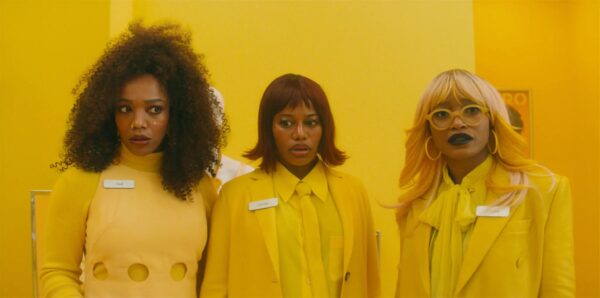
From left, Naomi Ackie, Taylour Paige and Keke Palmer in I Love Boosters. Photo: Neon
Boots Riley’s music, films, and TV series have aimed to push America’s Overton window to the left. You can tell he’s been sincere about that mission since 1991, when his hip-hop group, The Coup, began recording. The band’s music is upbeat and accessible, but it never broke through to a wide audience. With different lyrics, a song like “5 Million Ways To Kill A CEO” might have been a hit. Riley made a much greater impact with his debut film feature, 2018’s Sorry To Bother You. Although his limited Amazon series I’m A Virgo didn’t catch on in the same way, I Love Boosters is a return to form — a radical blockbuster, in Riley’s own words. It’s currently getting a huge push from its distributor, Neon.
A larger-than-life fashion designer with a mile-wide nasty streak, Christie Smith (Demi Moore) does not love boosters. She owns a chain of boutiques, Metro Design, and, after a string of thefts from her stores, she takes to TV news to denounce the culprits, whom she calls “low-class urban bitches.” These bandits are the heroes of Riley’s film. Dreaming of becoming a designer herself, Corvette (Keke Palmer) guiltily admires Christie’s success. She and two friends, Sade (Naomi Ackie) and Mariah (Taylour Paige), get themselves hired at a Metro Design store with a plan to stage a heist. Before they can accomplish this, however, they see a video of Jinahu (Poppy Liu) sucking all of the merchandise into her bag with a magic device. After kidnapping her, they learn she possesses a gizmo with the power to teleport objects. Jinahu has come from China, where she’s organizing a strike in a clothing factory whose exploitative treatment of labor caused her mother’s death. These women start to see nefarious connections between economic circumstances — dehumanization for the sake of profit — in both the U.S. and China.
As in Sorry To Bother You and I’m A Virgo, Riley relies on tropes from fantasy and science fiction to exaggerate present social realities. Mariah has a magical talent to lighten her skin. A giant ball of overdue bills rolls through Oakland’s streets. The satirical use of TV news clips, full of soundbites from ordinary people who just happen to agree with the 1%’s agenda, owes something to the futuristic lampooning of director Paul Verhoeven. I Love Boosters also shoplifts a number of its conceits from John Carpenter’s They Live. Riley pays a direct form of auteur tribute with a short film made by “Jean-Luc Dogard.”
The sight of Mariah and Sade leaving a store cloaked in so many clothes that they may as well have donned fat suits encapsulates the bursting farce of the narrative of I Love Boosters. (My plot description could have gone on for another few paragraphs.) One of the delights of I Love Boosters is how it uses its minor characters, which are scaled up, slightly, from cameos. LaKeith Stanfield is cast as a demon who glitches in and out of reality as he sucks women’s souls out from their bodies during oral sex. Viggo Mortensen, speaking with a German accent, delivers the stilted voice-over to a documentary about Christie. Cast as a boutique manager, Will Poulter makes his character the master of passive-aggressive dominance. The boosters have made the most of a colorful, personal style; ironically, Christie, a supposed fashion visionary, looks rather drab in comparison.
In the final episode of I’m A Virgo, Riley was able to convince Amazon to finance a lecture detailing the state’s monopoly on violence. A similar scene of political explication occurs in I Love Boosters—clashing wigs are used to explain the Marxist concept of dialectical materialism. A strong didactic streak runs throughout, but the narrative is always tempered by a pleasure principle. I Love Boosters attacks the fashion industry’s exploitation rather than fashion itself. It sees clothes and makeup as a productive form of expression in which innovation originates at street level and is then stolen (and monetized) by the wealthy. Riley’s bitter experiences in the music industry bleed through. Several indie labels to which The Coup were signed teamed up with major corporations — only to eventually vanish.
If I Love Boosters seemed excessive at its start, then in its last half hour it transforms into a perpetual motion machine. Odd as it is, Riley’s whirligig explicates its strangest conceits, if only for the sake of underlining its social criticism with a Sharpie. Through it all, the director revels in the lessons implied in his outré images, especially in the film’s orgy of garish colors. He imagines a future where radical change is not only essential to building a more just world, but also, once repression has lifted, a source of eye-popping joy.
Steve Erickson writes about film and music for Gay City News, Slant Magazine, the Nashville Scene, Trouser Press, and other outlets. He also produces electronic music under the tag callinamagician. His latest album, Bells and Whistles, was released in January 2024, and is available to stream here. He presents a biweekly freeform radio show, Radio Not Radio, featuring an eclectic selection of music from around the world.
1 Comment
Leave a Comment

Horrible movie. I walked out