Concert Review: Shadows, Synths, and Sweat — The Black Queen in Full Force
By Scott McLennan
A decade after Fever Daydream, the band’s return transforms moody electronics into a surging, physical spectacle.
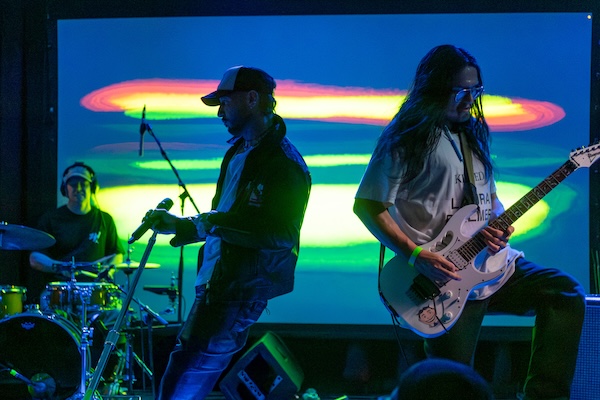
Drummer Chris Pennie, singer Greg Puciato, and guitarist Steven Alexander of The Black Queen. Photo: Sam McLennan
Musicians who land a good thing — artistically pleasing, commercially viable — tend to stick with it for as long as possible. Sometimes, too long.
Singer and songwriter Greg Puciato is an outlier in that regard, jumping from project to project in a long-running and rangy exploration of heavy, dark music.
Earlier this year Puciato made two announcements. Unsurprisingly, Puciato said he was leaving the band Better Lovers, an acclaimed teaming between the singer and former members of Every Time I Die and Fit for an Autopsy that yielded 2024’s alt-heavy gem “Highly Irresponsible.” Another supergroup Puciato sang in, Killer Be Killed, has likewise made great heavy metal in small batches, so these twists and turns are familiar.
What was not entirely expected, however, was Puciato announcing a reunion of The Black Queen for a tour to mark the 10th anniversary of that band’s debut Fever Daydream, which would be played in full each night. This marked a rare look back by Puciato.
Puciato was still active with prog-metal outfit The Dillinger Escape Plan when he formed The Black Queen with Dillinger Escape Plan guitar tech Steven Alexander and go-to multi-instrumentalist Josh Eustis. The Black Queen produced haunting, synth-based music, which demanded that Puciato sing in quieter, softer, more reflective tones — at least compared to the bombast that The Dillinger Escape Plan delivered.
Fever Daydream stands as a landmark album for synth and industrial music, staking out turf somewhere in between Depeche Mode and Nine Inch Nails. The follow-up disc, Infinite Games, came out in 2018. After a 2019 tour, The Black Queen pretty much vanished.
The Black Queen returned this spring without Eustis. His place was taken by Danny Lohner, who has played with Nine Inch Nails, A Perfect Circle, and others — he is handling bass and synth programming.
And when the band arrived at Sonia in Cambridge on May 21, drummer Chris Pennie, Puciato’s bandmate in The Dillinger Escape Plan, made his debut with The Black Queen. It was the band’s first show to incorporate live drums.
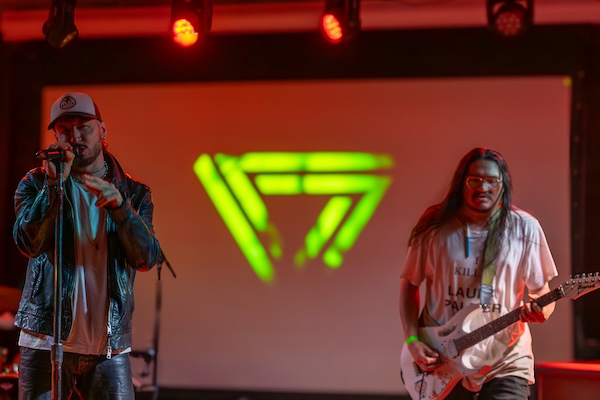
Greg Puciato and Steven Alexander of The Black Queen. Photo: Sam McLennan
And what a show it was.
The band did not play Fever Daydream in order; instead, the tracks were sequenced for an ebb and flow better suited to the rhythms of a concert. And songs not on the album were included in the set. The band did not have any new songs ready, but Puciato said he was working on that.
The set opened with the big thump of “Ice to Never” and “Secret Scream.” From the start, it became clear that, in this live setting, the cool, ethereal air of Fever Daydream was going to be transformed into a wilder and more wiry sound. The stage was kept mostly dark while projections of abstract images and symbols lit up a screen behind the musicians. The visuals complemented Puciato’s similarly shrouded and opaque lyrics — mood matters more than matter in these songs.
But do not confuse the material’s emotional vulnerability with a lack of force. Lohner plays with a fierce physicality, wielding his bass like a weapon, maneuvering at the electronic keyboard as if he were summoning spirits from beyond.
Alexander was likewise prowling the stage throughout the set; Puciato is well known for turning in performances that are aerobic workouts.
Pennie’s live drumming concentrated the frenzied activity, at times serving as a magnet for Lohner and Alexander, who would move closer to the drums so all three musicians could lock in on a groove that blended programming and sweat.
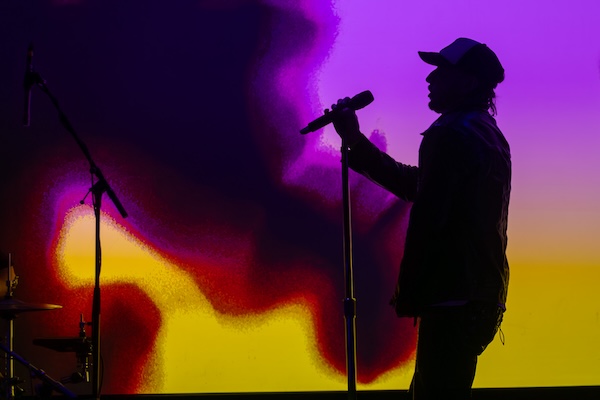
Singer Greg Puciato. Photo: Sam McLennan
When the music didn’t require as much muscle, the expanded range of sound remained effective, especially on more cinematic pieces, such as “The End Where We Start” and “That Death Cannot Touch.”
While Fever Daydream was the night’s focal point, a pairing of “Even Still I Want To” and “Thrown into the Dark” from the band’s second album, Infinite Games, provided a peak moment. The Black Queen coursed through a delicate, spacey web before it served up a big, hook-laden anthem. The band also reconfigured “One Edge of Two” (also from Infinite Games), giving it a pronounced R&B influence.
The Black Queen ended the concert much as it ends Fever Daydream — sort of. While on the album, “Apocalypse Morning” is a slow burn ascent, in concert the band rendered it as a cacophonous jam that dove into the contentment of a full collapse.
Ghost Cop and Trace Amount opened the show. The ’80s-inspired Ghost Cop has sharpened the edge of its New Wave stylings, creating a pleasing dynamic tension between the music’s menace and frothiness. Trace Amount is Brendan Gallagher’s one-man industrial rock wrecking ball that has never fully managed to transfer the catharsis the artist appears to experience on stage to the audience.
Scott McLennan covered music for the Worcester Telegram & Gazette from 1993 to 2008. He then contributed music reviews and features to The Boston Globe, Providence Journal, Portland Press Herald, and WGBH, as well as to The Arts Fuse. He also operated the NE Metal blog to provide in-depth coverage of the region’s heavy metal scene.
Tagged: "Fever Daydream", Chris Pennie, Greg Puciato, Steven Alexander, heavy metal