
Film Festival Reviews: Berlin — A Vampire Returns and a Fascist Invasion Revisited
By David D’Arcy
The Berlin International Film Festival had two major premieres this year — a vampire parade and a war saga in Ethiopia.

Isabelle Huppert in Blood Countess. Photo: Courtesy of Amour Fou Vienna, Amour Fou Luxembourg, Heimatfilm, Ulrike Ottinger Filmproduktion / P. Domenigg
In Ulrike Ottinger’s baroque film Blood Countess, Isabelle Huppert plays a shameless, bejeweled, and bloodthirsty Countess Elizabeth Báthory, a creature who sinks her teeth into more than her share of Central Europe’s aristocracy. And why not? She’s a vampire, as stylish as any that have drunk blood in this extravagant production, with a screenplay by Ottinger and Nobel laureate Elfriede Jelinek that revels in pitchforks of camp.
In this latest twist on a much-told story — check out Andrei Codrescu’s book of the same name from 1995 — Huppert proves that you can’t drink too much (blood, that is) and you can’t be overdressed.
This isn’t just another serial killer who’s also a fashion victim. Huppert plays a vampiress who learns about the existence of a book that instructs would-be vampire-killers on how to exterminate her species. She goes on the offensive. When first we meet her, underground in Vienna, Huppert’s Báthory is on the hunt and dressed to kill — in “jungle” red, of course. If you haven’t already guessed, gender barriers all but disappear in the course of this fanged romp.
The production design of Blood Countess is sumptuous, as is the cinematography. Its costumes are beyond luxuriant. The fact is, like most descriptions of the visuals in this gloriously over-the-top film, adjectives inevitably fall short. Yet Blood Countess’s plot is understated. Vampires have been targeted for slaughter, which triggers the struggle to survive. What’s a poor vampire to do? Dress like a very rich one. And one rewarding way to look at this extravaganza is as a beauty pageant, structured as a vaudeville show, where each performer waltzes into the frame to outdo the previous one. It is Vienna, after all.
The filmmakers may have found a formula that could turn their bloody spectacle of queer decadence into a commercial success. The overlaying of visual overkill is piled so high that it’s more than you can take in a single sitting. The spectacle is such that — once you see it on the big screen — that’s probably where you will want to take it in for a second or third time. Film-viewing habits being what they have become, audiences will watch The Blood Goddess on all sorts of devices, and it will cast its spell wherever viewers want to be dazzled, or enjoy escaping into a world of extreme (but harmless make-believe) predation.
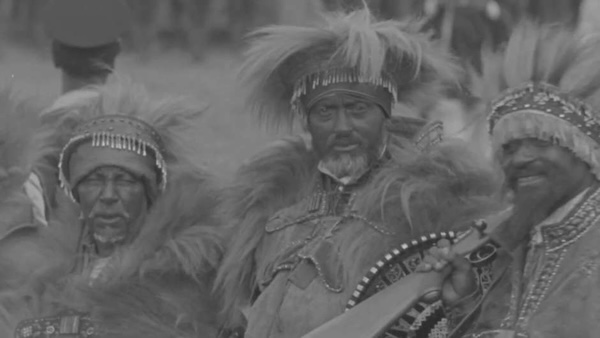
A scene from Haile Gerima’s Black Lions -Roman Wolves. Photo: Berlin International Film Festival
On the subject of predation on a grand scale, another revelation in Berlin was Haile Gerima’s monumental documentary Black Lions — Roman Wolves.
With this epic project, which he began thirty years ago, Gerima has created a monumental saga that chronicles the 1935 Italian invasion of Ethiopia and a bloody occupation that lasted seven years.
Some who watch the nearly nine-hour film that premiered in Berlin will compare Italy’s subjugation of Ethiopia to the Holocaust. A more accurate comparison would be to the Spanish Civil War, a testing ground for Nazi Germany’s ambitions on the ground and in the air. The Italians, allies of Hitler, invaded Ethiopia as an unprovoked act aggression. They bombed the civilian population, using mustard gas to raise the body count. They also massacred noncombatants and crowded them into hellish detention camps where the death toll was so high that comparisons with the German treatment of the Jews and other inferiors were inevitable. No Italian was ever tried for war crimes committed in Ethiopia.
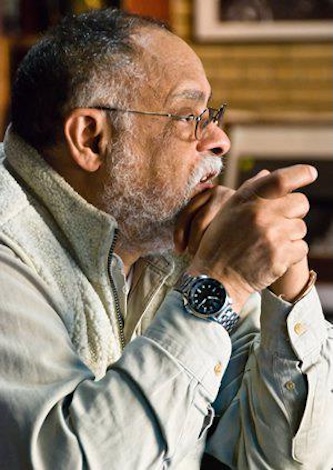
Director Halie Gerima. Photo: courtesy of the artist
Italian officials rarely speak about the army’s war crimes. Images in Black Lions — Roman Wolves provide gruesome witness to the atrocities. Longer than Claude Lanzmann’s Shoah or Marcel Ophuls’ The Sorrow and the Pity, and with landscapes reminiscent of Lawrence of Arabia, the film supplies mountains of evidence of savagery. Getting access to those images and footage was a challenge. Most of that archival material belongs to the Italian state, which predictably resisted providing documentation for a film that proved Italy’s mass murder of innocents. Still, Gerima eventually made a monumental film that draws on documentation from Italy that records its bloody subjugation of another country, including a campaign to murder the elite and target the clergy of Ethiopia’s Christian church. (Pillaging Ethiopia’s cultural sites was part of the bloodbath.)
Gerima, 80, is a veteran director — a professor at Howard University in Washington, D.C., since 1975 and a member of the L.A. Rebellion movement of Black filmmakers, where his colleagues included Julie Dash, Larry Clark, and Charles Burnett, who premiered a digitally restored version of his own second film, My Brother’s Wedding (1983–2007), at the Berlinale.
Speaking to the audience at his film’s Berlin premiere, Gerima, the son of a poet and performer, said, “I set out to do a film right around 1996 because I was fed up with Italians and their fake history of Ethiopia and the Italian invasion. Upon just seeing me, the guilt [about what happened] always made them say stupid things that didn’t correlate with my mother’s experience, my grandmother’s experience, or my father’s experience. So I had to do a film.”
Black Lions — Roman Wolves relies on footage from the unprovoked 1935 invasion by Italy, the bloody seizure of the capital Addis Ababa later that year, a prolonged guerrilla opposition, and the defeat of Italy in 1941, with help from the British army. Among the European powers, Italy had come late to the seizure of territory in Africa; the 1935 offensive was launched more than four decades after Ethiopians had beaten back an earlier Italian effort at colonization. The timeliness of these images is hard to miss. Mussolini’s bullying militarism recalls Putin’s invasion of Ukraine. Propaganda spewed out by Rome’s Instituto Luce (the same institute that still controls the Italian film footage of the Ethiopian war) sings the praises of the fascist forces. Threats from Mussolini to obliterate a regime sound like rhetoric from Washington, D.C., today.
From 1936, when an exiled Haile Selassie pleaded for the League of Nations to fight off Italian forces, the fate of Ethiopia was known to the world. The conflict would soon be overshadowed by the Spanish Civil War and the carnage of World War II and the Holocaust, not to mention the civil wars that ravaged Ethiopia again from the 1970s to the present. Gerima’s extended treatment of Ethiopia’s tortured years under Mussolini is long overdue.
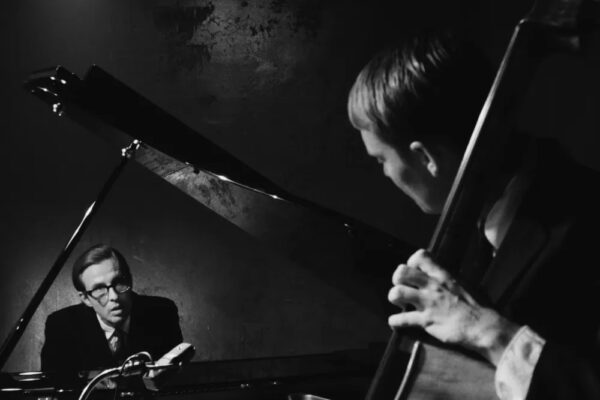
A scene from Everybody Digs Bill Evans. Photo: Berlin International Film Festival
Everybody Digs Bill Evans, another Berlinale premiere, is as subdued as Black Lions — Roman Wolves is epic. Despite the title, the mostly black-and-white period film, filled with lots of cigarette smoke, heroin, and silence, is melancholic rather than celebratory. There’s barely any music from the great pianist.
The feature, directed by Grant Gee and adapted from Owen Martell’s 2014 novel Intermission, begins in 1961, after Evans had completed his legendary live recording at the Village Vanguard. The bassist in his trio, Scott LaFaro, is killed in a car crash, which sends Evans into a dark tailspin. He gives up music and seeks emotional refuge with his retired parents in Florida, an odd fit for a drug addict. The film is a study in grief; as Evans, Anders Danielsen Lie gives us a portrait of a man who feels he has lost everything.
Praise here goes to cinematographer Piers McGrail for his mournful visual textures, particularly his use of jolting chiaroscuro that borrows from expressionism. This is a striking vision of a nocturnal musician in the harsh Florida sun, with Lie as an anguished Evans who is rendered mute.
David D’Arcy lives in New York. For years, he was a programmer for the Haifa International Film Festival in Israel. He writes about art for many publications, including the Art Newspaper. He produced and co-wrote the documentary Portrait of Wally (2012), about the fight over a Nazi-looted painting found at the Museum of Modern Art in Manhattan.
Tagged: "Black Lions — Roman Wolves", "Everybody Digs Bill Evans", "The Blood Countess", Grant Gee
2 Comments
Leave a Comment

In 2008, Juraj Jakubisco made a bizarre epic version, “Bathory” starring Anna Friel and an international cast.
https://www.dailymotion.com/video/x8hsofh
Also Julie Delpy. https://www.imdb.com/title/tt0496634/?ref_=nm_flmg_job_1_accord_2_cdt_t_14