
Arts Commentary: In Memoriam, Michael Tilson Thomas (1944-2026)
By Jonathan Blumhofer
Early promise, enduring vision, and a lifetime of well-timed reinvention.
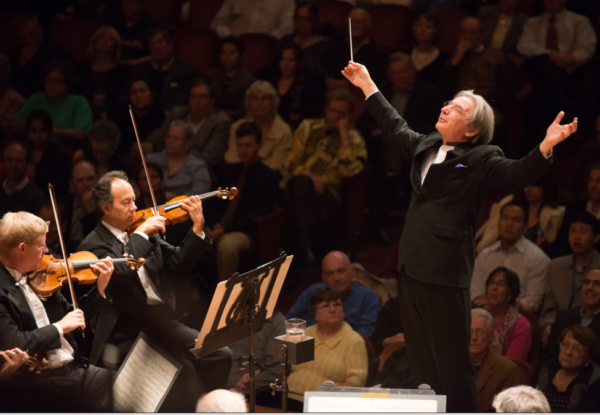
Michael Tilson Thomas conducting the San Francisco Orchestra in 2019 at Symphony Hall. Photo: Robert Torres.
Among his many gifts, Michael Tilson Thomas, who died at 81 on April 22nd, mastered the art of timing.
Some of that may have been genetic: his grandparents were Yiddish theater stars Boris and Bessie Thomashefsky, and his father, Ted, worked on Hollywood sound stages. But, like his one-time mentor Leonard Bernstein, Tilson Thomas was often the right man in the right place at the right time.
That was certainly the case in October 1969, when, as assistant conductor of the Boston Symphony Orchestra, the 24-year-old stepped in, mid-concert, to replace an ailing William Steinberg at New York’s Philharmonic Hall (now David Geffen Hall).
MTT, as he was later styled, “had his golden opportunity and made the most of it,” The New York Times’ Harold Schonberg wrote. “A tall, thin young man, he came on stage with an air of immense confidence and authority and showed that his confidence was not misplaced.”
Schonberg’s revelation was old news, though, to local audiences who had witnessed the conductor’s full-concert debut at Symphony Hall a couple weeks prior. The Boston Globe’s Michael Steinberg, not somebody afraid to poke at musical bears, described that event as “one of the liveliest and finest [BSO] concerts I have heard” and declared the young maestro “one of the ablest and most interesting conductors in the profession.”
That assessment aged well. So, in fact, did many of the observations Steinberg made about Tilson Thomas that are collected in Defending the Music, Oxford University Press’s recent compendium of his Globe reviews. Revisiting them with the benefit of hindsight, it’s notable that the visionary who went on to found one of the world’s great training orchestras and who championed American mavericks during his long stay in San Francisco was very much in-house in Boston from 1969-74.
Not that MTT emerged fully formed; he experienced, as Steinberg noted, a learning curve both as interpreter and programmer. But the core qualities that defined so much of his maturity—the creative juxtapositions of repertoire, the devotion to a wide swath of Americana, the profound connection to the music of Mahler, the naturally communicative way with musicians and audiences—was apparent in those early years.
Who else would have paired Pérotin and Stockhausen with Robert Schumann? Or Walter Piston and William Schuman with Bach and Ravel? Or introduced Lou Harrison’s Canticle No. 3 to Symphony Hall?
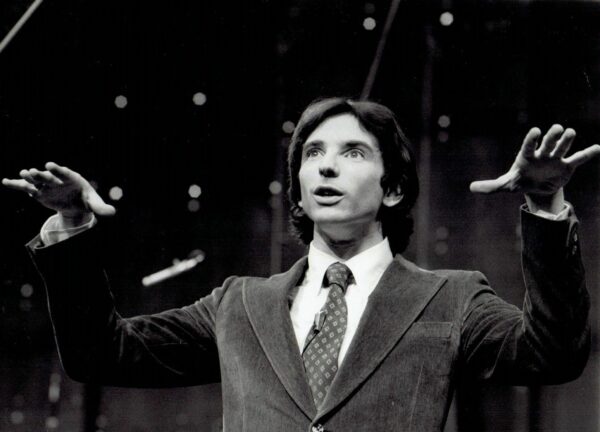
Michael Tilson Thomas conducting the New York Philharmonic Young People’s Concert, 1977. Photo: Wikimedia
If a performance of the Rhenish Symphony involved some “unhappy combination of caution and sloppiness,” the Tilson Thomas-led BSO delivered an accompaniment to Arthur Rubinstein playing Brahms’s B-flat-major Concerto that was “transparent and perfectly scaled…in matters of both continuity and textures, this was…some of the finest working together of a conductor and orchestra with a soloist I have ever heard.”
Above all, there was some tremendous Mahler. A 1970 account of the Ninth Symphony was one that “hardly involved awareness of a performance, an interpretation, at all: there was only contact with the music itself.” Two years later, Tilson Thomas offered a reading of the Fifth that was marked by “a certain emotional restraint, though great inner intensity, […] remarkably sustained with that combination of intelligence, taste, and growing technical resourcefulness which makes him an outstandingly good conductor.”
As fate would have it, MTT would mostly perfect his skills elsewhere: Boston was just an early stop for him. That was probably for the best, since his brash and, by later admission, sometimes arrogant demeanor ruffled more than a few feathers. Passed over for the BSO’s vacant directorship in 1973, he instead went to Buffalo, where he flourished leading that city’s Philharmonic and struck up a friendship with Morton Feldman.
Steinberg’s prediction that Tilson Thomas might be “[the BSO’s] man for the 1980s or ‘90s” didn’t pan out, either. Instead, he spent part of the first decade of is career in his hometown as principal guest conductor of the Los Angeles Philharmonic.
When, in 1988, he did come into his own, it was anywhere but in Boston. Early that year, MTT inaugurated the New World Symphony in Miami Beach and a few months later became music director of the London Symphony Orchestra. The former, a training orchestra designed to “to prepare highly-gifted graduates of distinguished music programs for leadership roles in orchestras and ensembles around the world,” remains one of the premiere institutions of its kind, its thousands of alumni populating leading ensembles and conservatories the world over.
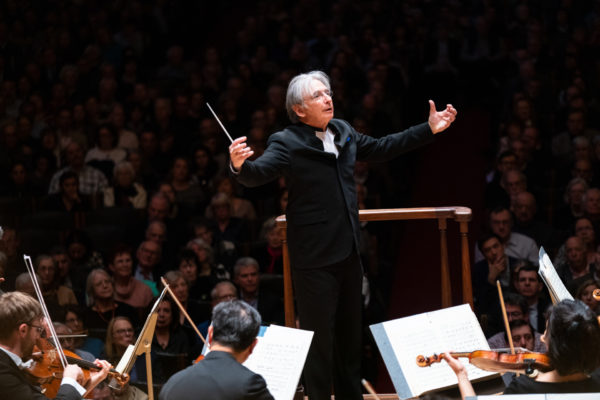
San Francisco Symphony conducted by Michael Tilson Thomas, presented by the Celebrity Series of Boston at Symphony Hall. Photo: Robert Torres.
The London appointment set MTT unequivocably among the top rank of conductors and, seven years later, he followed it up by taking on the directorship of the San Francisco Symphony. Much can be said about what turned into a remarkable, twenty-five-year-long tenure: the celebration of all kinds of repertoire, the superb discography, the insightful music-education series (Keeping the Score), the mentorship of young artists (Yuja Wang, Julia Bullock, and Teddy Abrams, among them).
But the linchpin to all of it may well have been the fact that Tilson Thomas committed to the place. He and his partner (later husband) Joshua Robison settled in San Francisco. They were visible members of the community—a rare phenomenon among top-tier orchestral leaders, especially on these shores. Their investment in the city paid dividends locally and beyond. Already a distinguished ensemble when he arrived, the group took on a fresh sheen between 1995 and 2020.
Eventually, MTT made his way back to Massachusetts, returning to Tanglewood in 2009 after a 21-year hiatus; he was a periodic guest there over the next fourteen years.
I covered his last two Symphony Hall appearances with the San Francisco Symphony in these pages. After one of them, the conductor quieted the audience’s lusty cheers (“Arthur Rubinstein said never to argue with a standing ovation,” he quipped, as he did just that) and proceeded to briefly reminisce about attending BSO rehearsals as an assistant conductor, in the process pointing out his old seat in the first balcony. On that afternoon, those days seemed far removed, the insolent youngster now an energetic elder statesman.
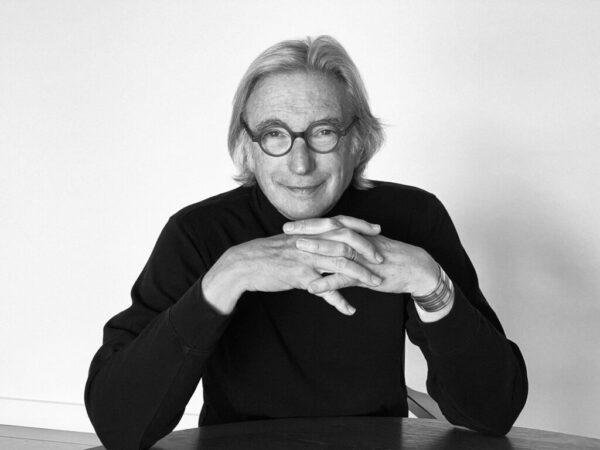
Michael Tilson Thomas Photo: Brigitte Lacombe
True, Tilson Thomas never quite subdued his bad-boy persona: he once had a mother and sleeping child removed from a New World Symphony concert because he found them distracting (the orchestra later apologized) and was known for stopping performances if audiences were unruly, on one occasion throwing handfuls of cough drops into the seats at Chicago’s Orchestra Hall for good measure.
Still, the public image he honed as performer, composer, and teacher was one of generosity, patience, and enthusiasm—no doubt genuine traits, since we’re all creatures of paradox. Those qualities took on a special intensity after Tilson Thomas was diagnosed with glioblastoma multiforme in 2021.
Somehow, he kept on going, outliving an 18-month life expectancy by more than three years and making much music along the way. He and Robison, who was also his manager, stage-managed his exit to perfection: the final appearance was a belated 80th birthday celebration at San Francisco’s Davies Hall last April. (Shockingly and tragically, Robison died in February of complications from a fall he suffered last year.)
Though physically diminished in his last years, Tilson Thomas’s vigorous intellectual engagement with the art form was still evident in those final performances. That aspect continues to come across in his considerable discography and videography. It lives on, as well, in the lives and careers of countless musicians he taught and mentored: singers, instrumentalists, composers, conductors. In that, his legacy recalls Bernstein in its scope and spirit—but it was entirely MTT’s in style, particulars, and form.
Perhaps it says something that, before their first home game after the conductor’s death, the San Francisco Giants held a moment of silence in his honor at Oracle Park. Maybe it says more that, looking back, the clincher of Steinberg’s 56-year-old review of his BSO debut still applies.
We’re lucky, he quotes a patron saying as she left Symphony Hall that afternoon. Given all that Tilson Thomas did and has left us with, the sentiment still holds.
Jonathan Blumhofer is a composer and violist who has been active in the greater Boston area since 2004. His music has received numerous awards and been performed by various ensembles, including the American Composers Orchestra, Kiev Philharmonic, Camerata Chicago, Xanthos Ensemble, and Juventas New Music Group. Since receiving his doctorate from Boston University in 2010, Jon has taught at Clark University, Worcester Polytechnic Institute, and online for the University of Phoenix, in addition to writing music criticism for the Worcester Telegram & Gazette.
Tagged: Boston Symphony Orchestra, Early promise, Michael Tilson Thomas, and a lifetime of well-timed reinvention., enduring vision