
Poetry Review: “Song of Yellow Asters” — The Limits of Pathos
By Jim Kates
Selma Meerbaum-Eisinger’s poetry carries historical weight, but Carlie Hoffman’s translations struggle to convey the formal poise of the originals.
Song of Yellow Asters by Selma Meerbaum-Eisinger. Translated from the German by Carlie Hoffman. World Poetry, Eastern European Poets Series #51, 176 pages $22.
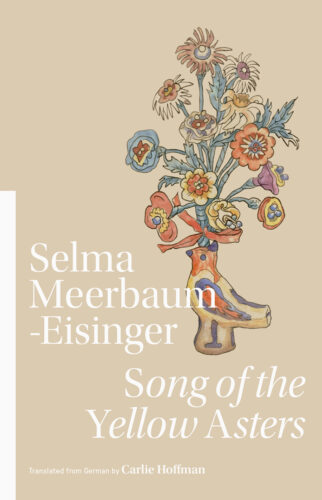 Can we read Selma Meerbaum-Eisinger without invoking genetics and history? The salient facts commanding our attention are her kinship with Paul Celan and her death at the age of eighteen in a Nazi labor camp. Suppose she were stripped of context as completely as, say, Sappho, how would we read her poems in Song of Yellow Asters, a collection originally written in German, passed from one friend to another, preserved in Palestine, and now translated into English by Carlie Hoffman?
A brief afterword informs us that Meerbaum-Eisenberg was born in 1924 in Czernowitz (now Chernitvtsi in Ukraine, but then offically part of Romania). German was the language of her household, Celan her cousin. Hoffman writes, “Meerbaum-Eisinger’s singular gift lies in her ability to recognize in nature moments that call us back to our own humanity, rendered with remarkable emotional precision,” which amounts to a succinct summary of nineteenth-century Romanticism. In 1942, the young poet was deported to Mykhailivka, and died of typhus before the end of the year. Celan promoted her work after the war.
Context is everything. Meerbaum-Eisinger was no Sappho. Her poems express a teen-aged angst anywhere in the twentieth century, unremarkable if not for their historical setting, the gathering clouds that impart a far more sinister shade. The four lines of “Tragedy,”
The hardest thing: to give yourself away
while knowing no one needs you.
To give yourself completely and realize:
I will fade like smoke and vanish.
could be found in almost any high-school literary magazine. If they take on any edge at all, it’s because they were written on December 12, 1941, shortly before the young poet’s deportation and then her death just a year later. Otherwise, Song of the Yellow Asters presents the precocious poems of a young woman sensitive to the life around her and immersed in a German tradition. Her poems reflect the influence slightly more of nineteenth-century established masters than of the poets of her own generation.
This is not always apparent in the English translations. The original “Tragedy” above is a formal rhymed quatrain. What strength it has resides in its restrained form. If we look at most of Hoffman’s English, we read poems with an entirely different flavor.
Here is the first stanza of the 1941 poem “Ja:”
Du bist so weit.
So weit wie ein Stern, den ich zu fassen geglaubt.
Und doch bist du nah —
nur ein wenig verstaubt
wie vergangebe Zeit.
Ja.
You can hear in this the simplicity and quiet rhyming influenced by Goethe. Hoffman’s English gets the words across, but nothing more:
You are so far.
As far as a star I want to hold.
And yet you are near —
just a little dusty
like the past.
Yes.
The internal rhymes of “far” and “star” seem intended to echo the original’s abcbac end-rhyme scheme, but they lack conviction. In a few translations, such as “Lullaby,” Hoffman comes closer to approximating the original form, though not consistently enough to convey a clear sense of it.
Meerbaum-Eisinger herself translated a few poems—from French, Romanian, and Yiddish. Hoffman does not present the originals alongside the poet’s versions, but instead gives Meerbaum-Eisinger’s translations followed by Hoffman’s own retranslations from German. There is something head-spinning about this, especially when we are looking at—or not quite looking at— a source poem as well known as Verlaine’s “Chanson d’automne,” very nicely done into Meerbaum-Eisinger’s German (although without the famous sonority of the French) and then flattened into English prose. It is also placed forty-two pages away from one of Meerbaum-Eisinger’s own poems, “August,” clearly written in imitation of Verlaine’s.
And, while we’re on the subject of context, several of the poems could use notes. “Gilu,” on pp. 98–99, seems to refer to a dance, a place, or something else entirely, but even a quick Internet search turns up nothing.
In the years leading up to the destruction of the Nazi genocide, young women and men all across Europe were writing prose and poetry that open windows onto so many lost lives. We need to hear their voices, but we need not mistake pathos for consummate literature. And we need translations that convey their distinct, individual voices.
J. Kates is a poet, feature journalist, reviewer, literary translator, and the president and co-director of Zephyr Press, a nonprofit press that focuses on contemporary works in translation from Russia, Eastern Europe, and Asia. His latest book of poetry is Places of Permanent Shade (Accents Publishing) and his newest translation is Sixty Years Selected Poems: 1957-2017, the works of the Russian poet Mikhail Yeryomin.
Tagged: "Song of Yellow Asters", Carlie Hoffman, Selma Meerbaum-Eisinger