
Book Review: Kevin Gallagher’s “Diving at the Moon” — Too Drunk to Save the Empire
By Michael Londra
Kevin Gallagher’s volume bridges Tang Dynasty China and contemporary Boston, finding in poetry, friendship, and wine a humane response to a world in turmoil.
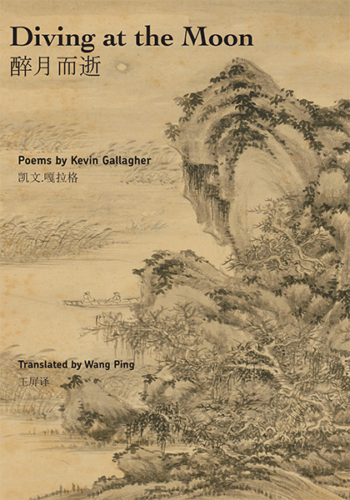
Diving at the Moon by Kevin Gallagher, translated by Wang Ping. Spuyten Duyvil, 140 pp., $20.
In his 1957 essay “Disengagement: The Art of the Beat Generation,” poet, translator, and literary rebel Kenneth Rexroth articulated the countercultural ethos animating the San Francisco Renaissance. Dubbed the “Godfather of the Beats,” Rexroth (1905–1982) rejected consumerism and conformity, insisting that “disaffiliation” was the only rational artistic response to America’s postwar moral decay. “Against the ruin of the world,” he argued, “there is only one defense—the creative act.”
That conviction runs through his One Hundred Poems from the Chinese, published the previous year. The collection includes thirty-five translations of Du Fu (712–770), whose life and work offered a model of the resilience Rexroth championed. Du Fu lived through China’s An Lushan Rebellion (755–763), a civil war estimated to have caused 13–20 million deaths. Although not included by Rexroth in his anthology—likely in order to emphasize the breadth of Du Fu’s repertoire beyond the prominence of this one lyric—the opening of Du Fu’s most famous poem “Spring View” nevertheless underlines this tension between political devastation and enduring life: “The state is destroyed. The country remains.”
Kevin Gallagher, in fact, takes that line as the title of a poem in his new collection, Diving at the Moon, honoring both Du Fu—whom some critics rank alongside Shakespeare and Dante—and the translator who brought his work to generations of English-language readers. Across fifty-four volumes of poetry and prose spanning nearly half a century, Rexroth ranged widely among literary traditions, voices, and forms. His cosmopolitan example helped shape Gallagher’s engagement with China, which began in the 1980s with his discovery of Rexroth’s interpretations of Asian poetry. But Gallagher moves beyond homage. By composing original verse in Du Fu’s Classical Chinese form of lüshi—eight lines arranged in four couplets—he attempts something Rexroth himself never tried.
As an appropriate entry point to Gallagher’s China, Diving at the Moon opens with lyrics ruminating on Chinese history and culture: “Everything around us is so damned new. / I can’t see where this escalator goes…It is hard to imagine the Mongols // stomping through this city in chariots / or the Yellow River flooding this place” (“Song of the Central Plain”). “Guaunyin” is a portrait of the East Asian goddess of compassion: “The head’s roundness resembles the heavens. / The feet’s squareness resembles the earth. // The eyes and ears are the sun and the moon.” The ruler who established the Silk Road in 130 BCE and enshrined the philosophy of Confucius as official state ideology in 136 BCE is pictured from the perspective of a young woman eager to become his bride: “None of us maidens will get married / until the Emperor’s goat and buggy // have come through our village looking for love…I have a lute player in the background. / I let down my hair. I loosen my robe. // I hope Emperor Wu’s goats are hungry. / I lay out bamboo and a pinch of salt” (“Emperor Wu”).
Gallagher’s experiences traveling and teaching in China comprise the volume’s second section. As a professor of global development policy at the Frederick S. Pardee School of Global Studies at Boston University, he has traveled around the world for work, including a visiting professorship at Tsinghua University. “VPN” offers a glimpse into his routine juggling domestic life as a father along with the demands of work, which means navigating governmental censorship: “I read Maisy the Mouse to Estelle. / I kept her in touch with Nana on Skype. // I read the FT and the New York Times. / I would secretly stream Bloomberg TV. // After dropping Theo off at his school / I buy a China Daily for two kuài. // By the East Gate near Tsinghua University, / I learn how to read between the lines.”
“The Way,” on the other hand, depicts a more troubling aspect of voyaging to new shores en famille, though it offers a touching dénouement: “Your bag happened to land in the right basket. / The thief took your money and he threw / your purse into a sea of bicycles. / When the bike’s owner returned to her bike // she found the purse and the hotel’s card inside. / She biked all the way back to Beijing. // She returned your purse back at the hotel. / She rode away without leaving her name.” Likewise, in “Chinese Lessons,” Gallagher riffs on his own lack of fluency in the language, while his son supplies an unexpectedly funny paradox: “I spent one hundred renminbi each week / paying a tutor to teach me Chinese. // I would try to practice every night / at dinner in the cafeteria. // My five-year-old would get so excited / when the waiter would bring out a live fish. // But he would plead with me not to speak Chinese. / ‘They’ll know we are foreigners!’ he’d say.”
The final group of verses synthesizes the themes of the earlier two sections, but now Gallagher’s native Boston is incorporated into the poetic mise-en-scène: “The sky is as gray as an oyster shell. / The Charles echoes looking frozen solid. // The Sycamore trees have lost all their leaves. / They branch out like the long prickly fingers / of all the old Brahmins on Bay State Road” (“Before Another Flight”). But not every entry here embraces a minimalist approach. “Songs for Kelly” is one of Diving at the Moon’s few expansive poems, a four-part letter to his beloved partner in thirty-six lines. Gallagher imagines his wife at home, and even the family dog is name-checked: “I am twelve hours ahead in Beijing. / 6 pm and just back to my room. // Rexroth is standing beside you in bed / about now, then he jumps in to cuddle. // You put your coffee on and give him his pill, / put on his leash, and take him up the hill. // Boston is hard to see through the spring trees.”

Chinese poet Du Fu. Photo: WikiMedia
Diving at the Moon’s best poem is “Wine and Exile.” In this extended lyric sequence, the only real deviation from the lüshi structure (one of its five stanzas clocks in at thirteen lines), Gallagher dramatizes a drinking session between Du Fu and fellow Tang Dynasty poet Li Bai. Legend has it that both men were zealously devoted to a bit o’ the drop (as the Irish would say): “We’re too drunk to save the empire tonight…Words may preserve a man’s thoughts. / but can fill a single empty belly…Grasp this pleasure, who knows if we’ll be / alive tomorrow to share another jar of wine.” Considering the anguish Du Fu and his family suffered—war, poverty, starvation, malaria, the death of an infant son, perpetual displacement as refugees—it may be surprising that he continued to compose around 1,500 poems on 60 juan, or hand-written scrolls. In elegiac terms, Gallagher illuminates Du Fu’s desire to express himself beautifully no matter what: “In broken letters, I record these wandering years. / The people bleed while the ministers feast…The universe is but an inn for all creatures. / Time is merely a passing traveler. / You can turn a gallon of wine into a hundred poems.”
This bilingual edition places Chinese translations by poet, fiction writer, photographer, and scholar Wang Ping—author of the poetry collection My Name Is Immigrant and the novel Foreign Devil—on pages facing Gallagher’s English originals. Diving at the Moon thus becomes a collaboration, extending the cross-cultural empathy of Rexroth’s One Hundred Poems from the Chinese. In that spirit, “Tempest After Kenneth Rexroth” sounds a hopeful note, even as the muse brings as much existential despair as poetic truth, as it does in “Wine and Exile.” Trust the song, then, not the singer. All poets must be drunk, as Baudelaire advised; saving the world is not the measure of their achievement. The wisdom resides in the words, in poetry’s eternal present. Language carries the human revolution forward:
Neither history or nature is moral.
Matter rebels and energy escapes.Our dreams are interrupted by the clowns
who use matter to destroy our village life.We will have to overcome them once again:
with love and the forgiveness of evil,
among the timeless unities of care,
on stage for the unreality of time.
Michael Londra is a poet, fiction writer, and critic whose work has appeared more than thirty times in The Arts Fuse. He recently introduced the Poets Confront AI and Surveillance Capitalism event at Poets House; a recording is available on YouTube. He can also be seen discussing New York writers in the independent documentary Only the Dead Know Brooklyn (dir. Barbara Glasser, 2022), available on YouTube. “Time is the Fire,” the prologue to his nearly completed novel about Delmore Schwartz and Lou Reed, was published in DarkWinter Literary Magazine. His poetry was translated into Chinese by scholar-poet Yongbo Ma. Two of his contributions to the Asian Review of Books were named Highlights of the Year for 2024 and 2025; one of those contributions was translated into Vietnamese. “Life in a State of Sparkle—The Writings of David Shapiro,” published in The Arts Fuse, was selected for the Best American Poetry blog. His work has appeared or is forthcoming in Lana Turner: A Journal of Poetry & Opinion, Restless Messengers, The Fortnightly Review, spoKe, Cha: An Asian Literary Journal, and The Blue Mountain Review, among others. He contributed six essays and the introduction to New Studies in Delmore Schwartz, forthcoming next year. Born in New York City, he lives in Manhattan.
Tagged: American poetry, Chinese poetry, Cross-cultural literature, Diving at the Moon, Du Fu, Kenneth Rexroth, Kevin Gallagher, Li Bai, Michael Londra, Poetry reviews, book-reviews, poetry in translation