
Arts Remembrance: Mario Diacono, 1930-2025 — A Tribute
By Mary Sherman
Mario Diacono’s works were a guide — a guide to see and think deeply about words and images.
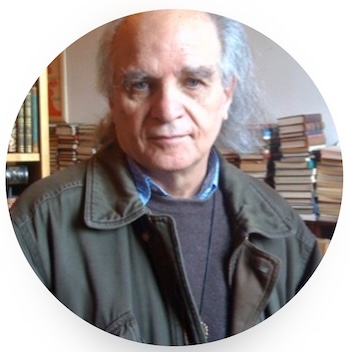
The late gallery owner, curator, and poet Mario Diacono. Photo: John Rutter
The legendary gallery owner, curator, and poet Mario Diacono died in the early hours of October 30. In the local art scene, no one better embodied the saying, “No man can be a prophet in their own country” more than Mario. In his case, “country” meant Boston. For although Mario showed some of the leading figures in the art world — Eric Fischl, Julian Schnabel, the Starn Twins, Ellen Gallagher, Annette Lemieux, and others — he sold little of their work in Boston. “Practically nothing,” he would say. (2020 Arts Fuse feature on Diacono)
I first met Mario when I moved to Boston in the early 1990s and worked briefly as a critic for The Boston Globe and then the Boston Herald. I often covered Mario’s shows. It seemed irresponsible not to. Although “show” might be a misnomer. Exhibitions at Mario’s galleries typically consisted of a single work of art. One painting hung on a wall. Accompanying them was a small leaflet in which he wrote about the work — a text almost as dense as any writing by James Joyce. One had to read his essays the way one reads a poem: Once to get the general idea, and then many times over until its meaning finally took hold, although the import could never be succinctly distilled. Perhaps not surprisingly: Mario, besides being a gallerist, was a well-known Italian avant-garde poet or, more precisely, a verbo-visual poet.
Mario’s books of poetry informed his gallery texts, full of meaning and beauty but, slightly elusive — not unlike the present moment, not unlike all great art. Mario published dozens of works in his lifetime. In April 2017, the rare book dealer Ars Libri held an exhibition devoted to these bookworks. In 2015, Eros/Libri d/Artista republished his beautiful book Theoria del Viaggio, Libri dei Morti (translation: Travel Theory, Book of the Dead). Each of its pages is devoted to a letter and includes an image and a brief text, circling around the subject of transmutation, in which shifts in letters create shifts in meaning. “Written in 1976,” as Ars Libri’s catalog notes, “the book presents a form of alchemical alphabet adapted from elements of a papyrus Egyptian Book of the Dead, copied by the artist on a visit to the Louvre.” All of this makes even more sense, knowing that a great love of Mario’s was alchemy. He owned a remarkable collection of ancient books devoted to the subject.
Mario was a lovely and generous man. When the MFA’s contemporary curator Trevor Fairbrother asked him to donate a work to the MFA, Mario donated himself. Well, more precisely, he donated an artwork by Piero Manzoni that consists of a piece of text, certifying that Mario Diacono is a living work of art.
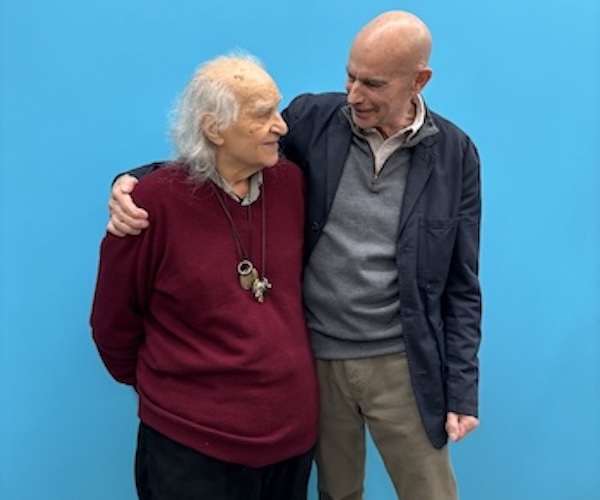
Mario Diacono and NYC gallery owner and publisher Peter Blum. Photo: Amanda Burke
In the early 2000s, Mario closed his second Boston gallery on South Street (his first was on Petersborough Street) and moved to New York. When he returned, he opened a space in Allston and later began showing art works at Ars Libri in SoWa. But after a water main on Harrison Avenue broke and flooded the basement of the building, followed by a dramatic raise in rent, the venture closed. Ars Libri moved to Charlestown and Mario stopped showing art work — that is, until he turned 94. In 2024, he opened a new gallery on Beacon Hill. True to form, for the first show, one work was shown, along with one of his brilliant texts. People came far and wide to pay their respects. And then, as happened with his shows on South Street, the gallery grew quiet again.
By this time, I had known Mario for years. As a local critic, I was careful to avoid conflicts of interest. I did not send slides to galleries or tell them I was an artist. Once though — some years after I moved to Boston — when I had a show at a university, I had the show’s catalog sent around. The only person to mention it was Mario. As I was leaving his gallery one day, he called out, “Mary, you are an artist?” he asked.
After years of being known here only as a critic, having Mario recognize the rest of me was a relief. And, anyway, with Mario, my secret was safe. I was hardly in the league of his stable of artists. Moreover, I did not make the kind of works he showed, but from that day forward, the slow start of a friendship began as we discussed various teachers I had in Venice — all of whom, I came to learn, he knew.
Once, in the late ’90s, coming back from New York on Amtrak, I had just taken my seat, when I heard my name. I turned around to find Mario. “Mary, why don’t you join me?” he asked.
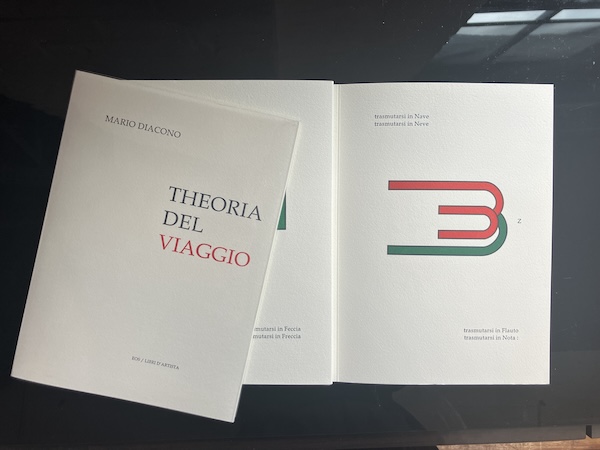
Mario Diacono’s Theoria del Viaggio. Photo: Mary Sherman
We talked about what we saw in New York, and then Mario asked me something I would have never dared to ask on my own: “Do you know how I am able to do these shows in Boston?” Of course, I was curious. How can anyone show a Schnabel, for instance, without much of an opening and likely no sale? That’s when I learned Mario was exhibiting works predestined to be sent to his friend Archille Maramotti, the founder of Max Mara and an early buyer of works from Mario, starting with his first gallery in Bologna. When Maramotti died, the collection became the core of the Collezione Maramotti in Emilia-Romagna, with Mario as its curator.
On that same train ride, I learned about Mario’s interest in writing, in the slippage between words and images, and how the shows he curated were prompted as much by his desire to write about the work as the work itself. Around then, two books, compiling his exhibition texts, were already being readied for publication. At the time of his death, Ars Libri was in the process of creating a third, devoted to the texts of the shows he curated in Boston.
When I last saw Mario, we spoke about an artist he knew in Montenegro. He was tired. And then this morning I awoke to a text message saying he had passed in the night. A beautiful icon has left us, I thought. Later, as I looked through Theoria del Viaggio and at the image of him in the gallery announcement, I finally understood: Mario’s works were a guide — a guide to see and think deeply about words and images. In his last gallery on Beacon Street, each wall was painted a color corresponding to one of the elements — fire, earth, air, and water. The reference to the alchemical was clear but not explained. Simply offered, a wondrous possibility to be considered. Like the man himself.
For two decades Mary Sherman wrote about the arts, beginning as a freelancer for the Chicago Reader, followed by being the art critic for the Chicago Sun-Times and, later, as a regular contributor to The Boston Globe, Boston Herald, and ARTnews, among many other national and international publications. In addition to writing, she is a widely exhibited artist and founding director of TransCultural Exchange. Currently, Mary is at work on her first book, A Legacy of Deceit. It is part memoir, part Cold War investigative journalism, prompted by the many unexplained encounters she had with her late father, not the least of which was his once showing up at an airport, a briefcase handcuffed to his wrist.
11 Comments
Leave a Comment
Thanks so much for this personal take on Mario Diancano’s career and presence especially in Boston. He was always in the background of the Boston art zeitgeist, as a mind well beyond the ken of most collectors. A special presence.
Beautifully integrated some of the personal and public personas both of Mario Diacono and you. Such a presence he had. Kind. Down to earth and spectral. Would love to read Theoria del Viaggio -his last (?) text.
Erica and Jane, Thank you for your kind words — not an easy piece to write on such a sad day. … Ars Libri may have a copy of Theoria Del Viaggio.My copy is one of th reprints. My best wishes.
Thank you so much for this piece, Mary. As with so many obits, it makes me wish I had known him. You were lucky ( and so was he). Please let me know when your own book is available to read. It sounds fascinating. Put me on your notify list. Regards, Debby Reisman
PARADISE
Ti ho legato le mani
sopra la testa
(me l’hai chiesto)
con un nastro blu
ti ho appesa
con occhi bendati
(me l’hai chiesto)
all’albero della vita
hai consumato
il futto della conoscenza
del pene e del male.
Mario Diacono / Anarch&types 2023
What a beautiful piece of writing and story. I wish I had met him. I am eager to know his work and yours more deeply. Thank you for taking the time to know him, and to write this story down.
Mary thank you for writing this beautiful and very thoughtful tribute, the world has lost an extraordinary human being.
Thank you very much, Mary, for letting me know Mario Diacono’s work and also yours as a writer. What a beautiful tribute!
Thank you Mary for writing this tribute, and for writing about Ars Libri’s involvement with Mario over the years. I will never forget going to see Mario with you this past summer right before you were going to Montrenegro, and of course Mario remembered an artist there he had worked with decades earlier. That was Mario.
I knew him since his days on Peterborough Street in the Fenway. Richmond Burton, Doug and Mike Starn, Meyer Vaisman are some of the shows I remember from that space. I never missed an opening on South Street.
One time I asked him to autograph the essay that he published with every show. He seemed taken aback and he asked me why I wanted it? I felt awkward and I don’t recall how I responded, but he did sign it and I kept it and I kept every essay that he produced before and after. I learned of his passing last night. So sad.
Does it mean, at the moment we die
we only recall the event of our birth,
that the cycle and the circle are full
with the Text finally explained?
Mario Diacono / MEDICINA CATHOLICA , 1988-9