Arts Remembrance: Sonny Rollins, Jazz’s ‘Saxophone Colossus,’ Dies at 95
Compiled by Arts Fuse Editor
To appreciate Sonny Rollins is to marvel at the casual ordinariness of his blazing genius.
Composer and tenor saxophonist Sonny Rollins died on Memorial Day at 95, leaving behind a body of work that, for many, redefined what a jazz soloist could be. Below, Arts Fuse critics Paul Robicheau, Steve Elman, Allen Michie, and Jon Garelick offer tributes to a legacy shaped not only by innovation but by synthesis — a tenor voice that absorbed Coleman Hawkins and Charlie Parker, Miles Davis, and Ornette Coleman, as well as funk and rock fusion, and transformed it all into something unmistakably his own.
— Bill Marx
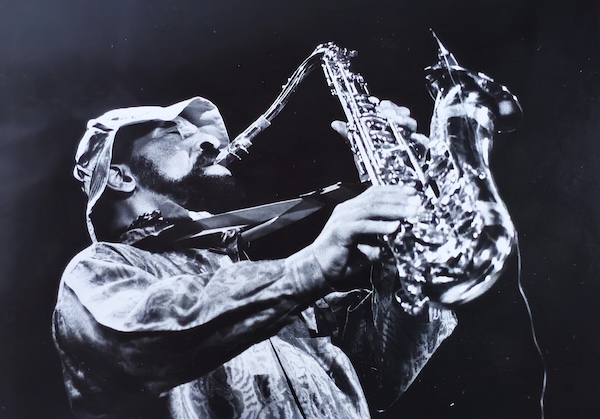
Sonny Rollins at the Berklee Performance Center in 1987. Photo: Paul Robicheau
Sonny Rollins maintained a soft-spoken modesty for someone widely considered the greatest living improvisor, with his bold-toned flights, a tenor saxophonist described in a 1995 Village Voice cover story as “The Last Jazz Immortal.”
“I have to face my maker one of these days too,” Rollins, then 72, told me during a 2003 interview from his home in upstate New York. “I’ve tried my best. That’s all we can do.”
For Rollins, who retired from playing a decade later with pulmonary fibrosis and died at age 95 on Memorial Day, his “best” particularly thrilled those who were able to witness his spiraling, thematic solos onstage. As critic Gary Giddins once noted, “Rollins has been seriously challenged by only two saxophonists, John Coltrane briefly, and himself eternally.”
Indeed, Rollins set his own standards. “I consider myself a work in progress, whereas people might look at me and say, ‘Oh, this guy is a jazz legend,’” he said during that 2003 call ahead of a Boston show at Berklee (where he also performed days after evacuating his Manhattan apartment on 9/11, a concert later turned into a live album). “I’m just a guy who’s still trying to get to the music that I hear, that I haven’t gotten out.”
For him, that improvising was borne through his daily practice of rudiments. “It’s like learning the alphabet,” Rollins said. “I’ll have all of these letters in place, and I put them together when I’m improvising to form words.”
The process happens ahead of the mind, he explained. “You’ve got to think about what you’re doing to a point, then the music takes over. The greatest aspect of playing is when the music plays itself. When I’m really playing, my mind is gone. The music is just coming into me rather than me trying to get proactive.”
One thing that Rollins was proactive about through the years was setting the conditions for his art, regardless of the music industry. Following a string of 1950s classics including Tenor Madness (with Coltrane), Saxophone Colossus, and the topical Freedom Suite, Rollins took two years off — famously practicing on the Williamsburg Bridge so as not to bother his neighbors — before returning to recording in 1962. Several years later, he took another sabbatical, a spiritual quest where he explored yoga and Buddhism ahead of his next record in 1972.
“I think when the creative person ends, he continues in the next existence,” Rollins said a few years before his final concert in 2012, a quote released by his publicist with the news of his death. “I’m a person who believes this life isn’t the be-all and end-all of everything. A spiritual person doesn’t feel like that.”
— Paul Robicheau
Why was Sonny Rollins great? Not an easy question to answer in a few words.
I think of Rollins as the greatest synthesizer in jazz history. The pantheon always includes the great innovators — Armstrong, Ellington, Billie Holiday, Parker, Gillespie, Monk, Mingus, Miles Davis, Bill Evans, Betty Carter, just to name masters who come immediately to mind — but they are trailblazers, iconoclasts, the ones who said, “I’m going this way … follow me if you dare.”
Rollins was different. He looked back, and forward, and around, and made his music a combination of all he admired and respected. He left a legacy of synthesis that is an alternate kind of lesson to all who come after.
He could listen with critical and appreciative ears to Coleman Hawkins, Charlie Parker, Miles Davis, Ornette Coleman, John Coltrane, the funk players, the rock fusionists — in short, anyone who had talent and ideas he could incorporate into his personal music. He was relentlessly self-critical and tirelessly committed to self-improvement. As such, no one recording does him justice, although many are classics.
I cherish the sessions with Miles that produced “Doxy” and “Airegin.” I love the recordings with Max Roach and Clifford Brown. The sessions with Jim Hall were models of thinking person’s music. The trio recordings at the Village Vanguard, despite their odd acoustic and the weird way in which Elvin Jones’s drums were recorded, redefined linear improvisation. The cover of Way Out West, with Rollins posed as a gunslinger armed with saxophone, was the quintessential visual expression of his puckish sense of humor. The “Alfie” session confounded my expectations of what interpreting a film score could mean. The session with Coleman Hawkins, when Rollins was flirting with the avant-garde, made for a fascinating exchange across decades. The Milestone dates, when Rollins began incorporating electric instruments into his groups, proved that he could be contemporary and yet remain his own man.
If I was less happy with the coarser tone of his later work, his fondness for Al Foster’s drumming (which was less like Max’s or Elvin’s than I would have liked), and his tendency to play too long on any one tune, that didn’t mean that I couldn’t marvel at his ability to write elemental but fascinating tunes — a legacy that still needs much more exploring. Rollins is survived by great musical ideas that others need to embrace and rethink — not just “St. Thomas,” “Blue 7,” “Pent-Up House,” and “Airegin,” but “The Stopper,” “Valse Hot,” “East Broadway Run Down,” and “Best Wishes.”
Death draws a line — this far, and no farther. For Sonny Rollins, no more was needed. He had done enough to achieve immortality.
— Steve Elman
Editor’s Note: Steve posted two long Arts Fuse pieces, conversations with critic Bob Blumenthal — one of Sonny’s greatest admirers — and they are well worth reading:
https://artsfuse.org/11829/music-interview-jazz-colossus-at-80-bob-blumenthal-on-sonny-rollins/
https://artsfuse.org/12088/music-interview-blumenthal-on-the-making-of-a-saxophone-colossus-part-two/
To appreciate Sonny Rollins is to marvel at the casual ordinariness of his blazing genius.
 To pull just one of the many examples you may have overlooked, outside of his classic recording sessions, take the concert from Saturday, October 25, 1980. Rollins was on yet another European tour. The band pulled into Umea, Sweden, a university town of about 53,000. Three days earlier, it was Warsaw. One week later, it was Zurich.
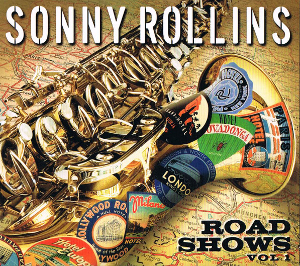
At one point during the show, Rollins calls one of his new compositions, “Blossom” (which you can find in two parts on YouTube, here and here). As Gary Giddins describes it in the liner notes to Road Shows Vol. 1, it has “eight-bar sections with stop-time beats in the seventh and eighth measures of each section, and is played with an eight-beat Latin rhythm that varies in intensity.” It has a simple melody with repeating notes that suits Rollins well, as his mind has always seemed to work in an ongoing dialectic between all things fundamentally simple and constantly complex. There are unmemorable opening solos from keyboardist Mark Soskin and bassist Jerome Harris, and then Rollins completely uncorks it. Like Coltrane before him and Keith Jarrett after him, he becomes a channel for pure music that seems to come from within him and outside him at once.
He starts with intensity and urgency from the first note at 4:42. The staccato shots contrast with the long-held notes. He crawls up and down scales with bop intervals. (He echoes the pattern later, on a different scale, with the pianist perfectly aligned.) There are high squealing overtones contrasted with gruff growls in the middle register.
In part two of the video, jazz history parades through the solos. He starts exploring a more free approach of pure sound and energy untethered from the composition. He moves on to show us how to dig in with a modal approach. He falls into a jagged interlude where the hyperattentive rhythm section follows him so closely, it’s like they rehearsed it in advance. You can hear John Coltrane. You can hear Gato Barbieri. You can hear Pharoah Sanders. You can hear Wayne Shorter. You can hear the samba and calypso, which no tenor player ever did better than Sonny Rollins.
He never repeats himself. As the solo develops, the rhythm section, driven by Al Foster on drums, gets elevated and elevates Rollins back in turn.
At the end of this eight-minute solo, you can hear the audience gasp.
Yes, perhaps his classic recording days for Prestige, Blue Note, Riverside, and Impulse! in the 1950s and 60s were behind him. Yes, his tone had changed into something more rough-edged and untamed. He was still a major draw in 1980, but jazz was moving in smoother and more mannered directions. But here was Rollins at a different peak at 50 years old, reminding us, as Miles Davis and Coltrane did, that you’re allowed to have more than one. He kills it that night in Umea with presence, swagger, stamina, lung power, personality, imagination, momentum, muscle, and soul that are simply hard to imagine.
If Sonny Rollins is being reincarnated this week as a more perfect spirit, as he believed he would be, then 50 years from today there will be a musician somewhere, perhaps in some small European college town, who will play a solo even better than this one. Rex quondam rexque futurus.
— Allen Michie
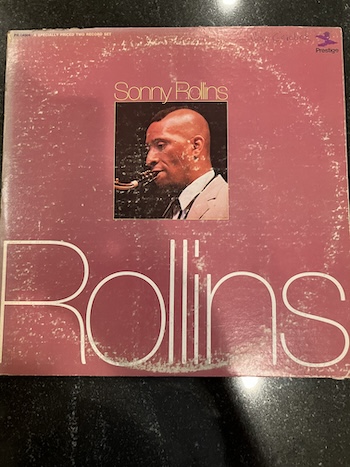 For many of us, Sonny Rollins was one of the cornerstones of our jazz education, and our love of the music. When people find out I’m a jazz fan and ask, “Who do you like?,” my answer is automatic: Miles, Mingus, Monk, Coltrane, Rollins. Not necessarily in that order.
I’m not sure what led me to buy the “two-fer” Prestige re-release sometime in the early ’70s — I don’t think I knew what was on it, except that there was Sonny on the cover, in a Mohawk haircut, saxophone in mouth, staring straight ahead. When did that haircut happen? And why? Inside, a choice selection from Tenor Madness (including the title track) and Saxophone Colossus (including “St. Thomas,” the first iteration of his many calypsos).
So what was it about Sonny? I think it was the big, soulful sound and the explosive inventiveness that was somehow immediately legible. The syncopated start-stops of “Strode Rode” open to a smooth uninterrupted flow of ideas; the indelible “St. Thomas,” where Sonny works a two-note interval over Doug Watkins’s bass and Max Roach’s drums until he finds the key to what he’s looking for and unlocks a torrent.
That’s what kept me going back to Rollins shows year after year. That and a live show at the American Music Hall in San Francisco circa 1975. I no longer remember who was in the band or what the tune was. At some point, Sonny cut the band for one of his a cappella soliloquies. It gained in fury until Sonny was speaking in tongues, ideas coming from everywhere, snippets of old pop songs, double-time excursions, and honking exclamations. In later years, when he worked over a melody ad infinitum, I was OK waiting. He was looking for something. And I wanted to be there when he found it.
— Jon Garelick