
Film Review: A Marriage Under Suspicion in “Gentle Monster”
By Tim Jackson
Léa Seydoux gives a powerful performance in Marie Kreutzer’s unsettling exploration of trust, betrayal, and the limits of knowing the person closest to you.
Gentle Monster, directed by Marie Kreutzer. Screening at Landmark Kendall Square Cinema in Cambridge.
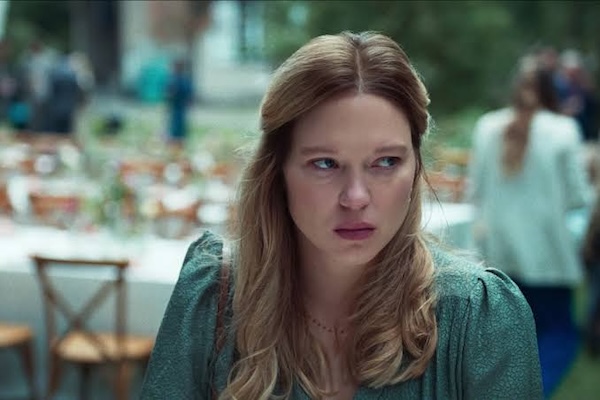
Léa Seydoux in Gentle Monster. Photograph: Frédéric Batier/Film A-G/Komplizen Film
The sexual abuse of children is difficult to confront on film without turning suffering into entertainment. Robert Greene’s Procession and Todd Solondz’s Happiness come to mind as successful efforts. Greene combines documentary and dramatic reenactment in a collaborative exploration of the trauma of clergy abuse; Solondz stages a father’s confession, delivered by Dylan Baker, with queasy directness. Neither offers the reassurance of making trauma manageable for an audience. Marie Kreutzer’s Gentle Monster approaches the subject through another devastating possibility: that someone loved and trusted could be involved in the trafficking of images of child sexual abuse. The discovery inflicts its own emotional shock: a spouse is forced to reconsider not only the person beside her but the life they have built together. Kreutzer probes that rupture with restraint, examining a grievous betrayal of trust that threatens a family’s foundations.
Léa Seydoux plays Lucy Weiss, a successful pianist who performs avant-garde music on multiple instruments before enthusiastic audiences. At home, however, we first see her haltingly practicing “Would I Lie to You?”—a pointed introduction to what will be the film’s central concern. Her husband, Philip (Laurence Rupp), interrupts her playing when he collapses in what appears to be a panic attack. Soon afterward, police arrive, arrest him, and seize his computers and cell phones. At the station, Lucy learns that images of child sexual abuse have been traced to his devices. The couple’s young son (Mallo Blanchette) will also have to be questioned. Initially speechless, Philip eventually claims that the images were research for a documentary. Lucy’s initial disbelief gives way to doubt, depression, and anger. Seemingly trivial experiences acquire disturbing implications, inviting her—and us—to search their shared life for signs she might have missed.
Lucy is the family’s main breadwinner. Philip makes short television pieces he considers beneath him. It is suggested that his resentment of her success fuels a frustrated need for control. He also regularly films his wife and son with a small portable camera, ostensibly for a personal documentary. Its presence makes ordinary domestic intimacy newly ambiguous. One early scene is particularly uncomfortable, though Kreutzer gives it little emphasis: hearing his son cry, Philip emerges naked from the shower and takes the boy onto his lap. In isolation, the moment might register as unremarkable familial closeness. Here, even before the investigation begins, it feels disquieting. Lucy shows no concern. As the allegations emerge, the scene serves as a test of our judgment: does suspicion distort what we see, or make us recognize something we would otherwise overlook?
The possibility that a tender spouse might harbor a monstrous secret makes the betrayal especially devastating. Munich detective Elsa Kühn (Jella Haase), who investigates Philip’s case, maintains a professional distance from Lucy, though she offers sympathy. She explains that such abuse can be as much the exercise of male power as it is an expression of sexual desire. The officer’s own family life offers a troubling parallel: her aging father, Hermann, who has dementia, sexually harasses his live-in caregiver, Natalia. Elsa minimizes his behavior and tries to persuade Natalia to stay, exposing her own difficulty in confronting abuse committed by someone she loves.
Cameras and the internet extend the reach of the man’s exploitation, but Kreutzer, who also wrote the screenplay, keeps her attention firmly on the women left to confront its consequences. The director releases information gradually so the audience shares Lucy’s uncertainty. Questions about Philip’s motives—financial gain, sexual compulsion, something else—sustain the narrative’s tension without resolving a more intimate question: just how well did Lucy know her husband? The pianist struggles to give Philip the benefit of the doubt as she confronts the possibility that doing so requires her to deny the facts before her. At first, Lucy cannot bring herself to tell her mother (Catherine Deneuve). A visit to Philip’s wealthy parents becomes another fraught negotiation between suspicion and family loyalty.
The film’s emotional force comes from performances rooted in ordinary life. Seydoux gives one of her finest turns, allowing disbelief, desire, grief, and rage to coexist rather than resolve into discrete stages. Her slightly hooded, careworn eyes register the strain of watching, doubting, and reassessing. Even the uninhibited lovemaking takes on an unsettling charge: physical intimacy is no guarantee of knowing the person beside you. Haase offers a restrained counterpoint, her pulled-back hair and crisp uniform suggesting a composure that stops short of indifference. Moving among three languages, this Austrian-German-French co-production locates its deepest unease in a painfully familiar possibility: the person closest to you may also be a stranger.
Tim Jackson was an assistant professor of Digital Film and Video for 20 years. His music career in Boston began in the 1970s and includes some 20 groups, recordings, national and international tours, and contributions to film soundtracks. He studied theater and English as an undergraduate, and has also worked helter-skelter as an actor and member of SAG and AFTRA since the 1980s. He has directed four feature documentaries: Chaos and Order: Making American Theater, which is about the American Repertory Theater; Radical Jesters, which profiles the practices of 11 interventionist artists and agit-prop performance groups; When Things Go Wrong: The Robin Lane Story, and Marblehead Morning: Daring & Stahl: 50 Years in Harmony. He has made two short films as well: Joan Walsh Anglund: Life in Story and Poem and The American Gurner. He is a member of the Boston Society of Film Critics. You can read more of his work on his substack.
Tagged: Betrayal, Catherine Deneuve, Child Sexual Abuse, European Cinema, Gela Haase, Gentle Monster, Laurence Rupp, Léa Seydoux, Marie Kreutzer, Psychological Drama, family drama, film review