
Arts Commentary: What Historical Fiction Can Teach Us About America
By Joseph Horowitz
From Peter Quinn’s Civil War New York to Dvorak’s New World, imagined lives can deepen our understanding of the past — and restore the arts to the teaching of history.
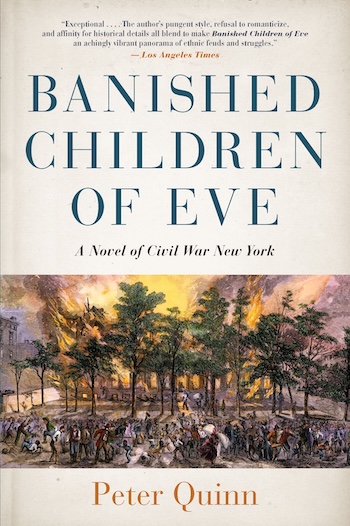 Quite suddenly, the writing and teaching of American History are exigent topics, both on the left and the right. What might be the timeliest strategies for studying and imparting the history of the United States? How best to teach history in high schools and colleges?
I newly ponder these questions having just read a majestic “novel of Civil War New York”: Peter Quinn’s Banished Children of Eve (1994). Quinn’s topic is New York’s draft riots of 1863. My knowledge of this event had been scant: I knew that Irish-Americans hostile to African-Americans had violently opposed Civil War conscription. Quinn’s treatment is capacious but indirect. There is no “story.” Rather, he tracks the activities of a dozen residents of roiling Manhattan, mostly Irish, and also delves into their origins in impoverished Ireland. The riots are understood as an inescapable wartime consequence transcending individual agency. I have never read a more instructive American history book.
Only two of Quinn’s main characters — the composer Stephen Foster and Archbishop John Hughes — are historical. The others, including a star blackface minstrel and a mixed-race actress in Uncle Tom’s Cabin, are invented yet representative. By comparison, E. L. Doctorow’s admirable sequence of novels exploring episodes of the American narrative, while equally vivid in its re-creation of time and place, superimposes plots that risk blurring the grand lines of cultural memory.
I come to Quinn having in recent years written a couple of historical novels of my own: The Disciple: A Wagnerian Tale of the Gilded Age and The Marriage: The Mahlers in New York. These are kindred exercises returning to stories I have told as “fact.” The necessity of putting words into the mouths of the Wagnerian conductor Anton Seidl and of Gustav and Alma Mahler proved revelatory. Via impersonation, I learned things about my real-life actors I had not previously gleaned.
In fact, I have come to regard historical fiction as a vital tool for the cultural historian. Unlike Quinn’s novel or those of Doctorow, mine are exclusively populated by characters who actually lived and died. And the incidents I recreate actually transpired. Perhaps the genre I attempt could be called “creative nonfiction.” In any event, I have become keenly aware that “historical fiction” and “history” span an unbroken continuum. The incidents and people at hand must be embellished and interpreted — and this contextualization can take many forms.
It can also broach different genres. Martin Scorsese’s meticulously detailed Gangs of New York (2002) features the same draft rioters who inhabit Peter Quinn’s novel — and devolves into a bloody melodrama. Ken Burns’s TV documentaries artfully animate historical events. But these acclaimed films — and films in general (unless silent) — do not, in my experience, invite as personalized a response as books. Books require more of an exercise of imagination. When Quinn describes the lynching of a young African-American he’s tracked for 300 pages, I have to stop reading. There is no stopping a film.
That is: Quinn’s dogged account of the hunting, taunting, and mutilation of an innocent victim of prejudice is ultimately envisioned by the reader, not the author. It engenders a cumulative visceral experience not to be acquired from a movie, or scattershot via AI and the internet. For that matter, any number of readers and reviewers of my novel about the Mahlers in New York testify that they’ve acquired a newly compassionate understanding of Gustav’s controversial spouse. Certainly that was my own experience imagining Alma’s response to new challenges posed by a new environment.
 Might historical fiction also prove a vital resource for the educator? Might it speak to today’s high school and college students, riddled with ever-shorter attention spans? Might it instill an interest in the creative word?
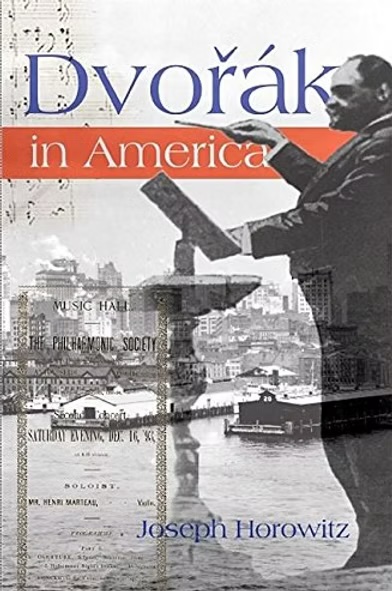
My first attempt at historical fiction, back in 2003, was a short book for young adults: Dvorak in America. My goal was to inspire social studies teachers to sneak the arts into the classroom by a back door.
During his three-year sojourn in the United States (1892–1895), Antonin Dvorak proved a musical de Tocqueville. Challenged to distinguish what most defined the New World versus the Old, he came up with three seminal attributes: Native Americans in danger of extinction, African Americans once enslaved, and a vast American West he found both melancholic and majestic. He inscribed these impressions in the most famous, most beloved symphony ever composed on American soil: “From the New World,” premiered by Anton Seidl’s New York Philharmonic in 1893.
Dvorak also issued a landmark prophecy: that “Negro melodies” would foster a “great and noble school” of American classical music. (Instead, they would foster popular musical genres known the world over.) He grasped that the sorrow songs of the South were (as W. E. B. Du Bois would put it a decade later) “the spiritual heritage of the nation and the greatest gift of the Negro people.” For an assistant, Dvorak hired a young African-American from Erie, Pennsylvania. This was Harry Burleigh, who would become the key player in turning spirituals into concert songs. Dvorak was fascinated by the most popular nineteenth-century American literary text: Henry Wadsworth Longfellow’s The Song of Hiawatha — which inspired many a passage in his New World Symphony. He apparently attended Buffalo Bill’s Wild West Show. He spent three weeks observing the itinerant Kickapoo Medicine Show in Spillville, Iowa. He attended the 1893 World’s Columbian Exposition in Chicago. His employer at New York City’s National Conservatory of Music, Jeannette Thurber, successfully enticed Black students with free tuition. In 1894, at the Madison Square Garden Concert Hall, Dvorak conducted the school’s interracial orchestra and an all-Black chorus in a program including his own transcription of Stephen Foster’s “Old Folks at Home”; the soloists were Burleigh and the premier Black concert soprano of her time: Sissieretta Jones. The concert was ingeniously publicized by the supreme exponent of yellow journalism: James Creelman, whose subsequent on-site reportage would influence the Spanish-American War and the Mexican Revolution. Dvorak’s advocates also included Henry Krehbiel, the dean of New York’s music critics, who wrote a pivotal book-length study of “African-American Folk Songs.” Upon visiting Boston, however, Dvorak was denounced as a “negrophile”: a tale of two cities. He returned to Prague when Mrs. Thurber’s husband was knocked out by the Panic of 1893.
Inhabiting these formidable people and events for young readers, my little Dvorak in America book produced a personal epiphany. I had already written extensively about Dvorak’s and Seidl’s New York, had already spent years digging into archives to fathom Seidl’s New World fate. Hypothetically situating Seidl and Dvorak at the round table of Fleischmann’s Café (their daily Union Square hangout), I discovered I could hear Seidl speak.
“Incidentally, I have been looking at your new symphony. The second movement.”
Dvorak bristled.
“It is a slow movement, nein?” said Seidl.
Dvorak exhaled a gust of cigar smoke.
“Andante, you call it,” Seidl continued in his low, steady voice. “But I am sure that it is slower. A Largo. That is to get underneath, to the inner meaning. The Innigkeit.” . . .
Dvorak confronted Seidl’s gaze. “No one can sing so slowly,” he said. “Burleigh . . .”
“Ja! Ja! Burleigh!” Seidl snorted and glanced away. “This is not Burleigh. This is Heimweh — homesickness. Your ‘New World’ Symphony is an ‘Old World’ Symphony. Negro music, Indian music, it is all very fine. It is what the Americans call window dressing. It is not the heart of this music. Your heart — is it in New York? Or in Bohemia?”
Seidl pointed at his chest. Dvorak ordered another Pilsner. Minutes passed.
“Do as you please,” said Dvorak.
Seidl lifted his watch from his pocket. “I must rehearse,” he said, and left the table.
I subsequently enjoyed opportunities to deploy the Dvorak/America story in various settings, most memorably at the Boston Latin School during a brief stint on the faculty of the New England Conservatory of Music. I also had occasion, in 2010, to lead a “Dvorak and America” NEH Teacher-Training Institute — a three-week exercise hosting 30 high school teachers from around the nation. The participants included a teacher from a Dallas private school who happened to be part of the team overseeing the Advanced Placement American History curriculum. He informed me that the AP curriculum included no music. He subsequently proposed that a day be set aside for the Dvorak/New World story. His proposal failed.
That was sixteen years ago — when a crisis in humanities education was not yet widely decried.
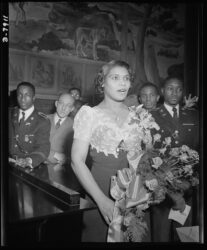
Marian Anderson sings “The Star Spangled Banner” at the dedication of a mural commemorating her free public concert on the steps of the Lincoln Memorial on Easter Sunday, 1939. Photo: Wikimedia
My confidence in historical fiction as a tool for the scholar is by now a boundless conviction. But I’m not sure what pertinence it may have to present-day pedagogy. What I do know is that transcending the STEM curriculum has never been more imperative — and that linking history to music, literature, and the visual arts is a necessary opportunity. It’s a truism that the arts — and participation in the arts, and learning about the arts — do not require “practical” justification. And yet I have no doubt that the arts are empowering. They power individual self-knowledge and communal self-knowledge. Not least, they are morally empowering.
This last claim fell into disfavor over the course of the twentieth century. It needs to be revisited. Dvorak, Seidl, and their New World adherents took it for granted. For them, it supported a posture of empathic understanding.
The most iconic vignette of Franklin Delano Roosevelt’s funeral train shows a weeping Navy accordionist named Graham Jackson. He is playing the spiritual “Goin’ Home” — for FDR’s sad return to Hyde Park. One of the things the story of Dvorak in America teaches is that this familiar tune is not quoted in the Largo of the New World Symphony. Rather, it’s a melody Dvorak himself composed in the style of the spirituals Harry Burleigh sang for him. His pupil Harry Rowe Shelley, for whom he first played it, testified that Dvorak shared “the immortal theme with great passion and fervor, his eyes bulging out, his blood purple red in the neck veins, his whole body vibrating.” Another Dvorak pupil, William Arms Fisher, added the words eighteen years following Dvorak’s death. After that, “Goin’ Home” was famously sung by Marian Anderson and Paul Robeson — names, I have discovered, no longer known even to African-American undergraduates.
However imparted, this tale is one today’s students of American history deserve to know. It opens a back door that some may choose to enter.
Joseph Horowitz’s blog is The Unanswered Question. His website is www.josephhorowitz.com
Tagged: African American spirituals, American history, Anton Seidl, Antonín-Dvořák, Banished Children of Eve, Classical Music, Harry Burleigh, Joseph Horowitz:, New World Symphony, New York City, New York Draft Riots, arts education, civil-war, historical fiction, humanities education
I agree completely with the need to re-balance the weight given to STEM over the Arts. I think we can agree that the way history is taught tends to extract the humanity and vitality from the process. The question of whether or not historical fiction can help address this problem is not simple.
I too write about music, usually jazz, and the lives of the people I write about are often not well documented-especially black musicians. In short-form journalism, I can address these lacunae by sharpening the focus of the piece or briefly noting discrepancies. Long form work-histories, biographies, historical novels can’t finesse the issue as easily.
I have to admit this comment has a selfish impetus. I’m grappling with the question of how to approach writing about a particular musician whose life I find very compelling, but about whom the record is spotty and contradictory. Is an historical novel the right solution to dealing with this dearth of documentation?
The very ambiguity of the name “historical fiction” presupposes the reader will approach the work in a flexible way. However, after many years as a journalist, I believe people will always ask: “Did this really happen?”
In novels and films about artists, I’m alert to and recoil at the manipulation and debasement of history. In your essay you refer to “embellishment,” “interpretation” and “contextualization,” but the line is fine. What is the priority-conveying the Who, What, Where and Why’s with veracity or trying to recreate the flesh, bone, blood and mind of historical characters?
The historian and the novelist both face the challenge of trying to create an immersive reading experience while preserving the integrity of the known facts. The question of whether this thorny problem can be worked out in a classroom is, again, not simple.
Thanks for this. I have told the story of Anton Seidl and Wagnerism in NYC in the late Gilded Age as “fact” (Wagner Nights: An American History) and now as “fiction” (The Disciple: A Wagnerian Tale of the Gilded Age). But even in Wagner Nights the process of bringing this story to light involved creativity of various kinds — as when I imagined what a “Wagner Night” on Coney Island ca 1890 would look and feel like to Laura Langford, who presented it. As I happens, I yesterday gave a talk in Chicago on Seidl in which I read from the Chicago chapter of The Disciple. It recounts the 1889 visit of the Metropolitan Opera to Chicago. My account relied heavily on newspaper reports. I also had Seidl visit the Auditorium Theatre, then nearing completion. Louis Sullivan (a Wagnerite) demonstrated the acoustics, etc.
As I told my audience: having written this novel long ago (tho it was only published rather recently), I can no longer recall if there actually exists a documented visit by Seidl to the Auditorium Theatre (which would become an ambitious home for concerts and opera). Maybe there was. Certainly it would have made sense for him to visit. My audience didn’t seem to care — and neither do I. The curiosity over what “really happened,” as I attempted to argue in my piece, is to some extent naive. Every written account describing past events requires all kinds of imagination. JH
I don’t think the question “did it really happen” should be called naive and dismissed as beng un-creative. At the very least, it deserves to be addressed as honestly as possible. Admittedly, the question of an author’s purported motivation has been taken to undue and absurd lengths in the last so many years. But, an author who understands and is willing to admit he or she has an agenda-and perhaps describes it in a forward or introduction-shows respect for the question and is making a good faith effort to address it.
“What is the priority-conveying the Who, What, Where and Why’s with veracity or trying to recreate the flesh, bone, blood and mind of historical characters?”– You cannot re-create it. The provenance of how accurate you are in you depiction is difficult because verification is (as yet) impossible. And then there is the forensic approach sleuthing through evidence. And most complex of all, the everywhereallatonce concept of the reality of the Many-Worlds Interpretation. But more simply, Kurosawa’s RASHAMON shows the story from four people’s four different accounts of a man’s murder and the rape of his wife. I am currently writing the script for an animation about my great great grandparents. He was what is known now as a “German Jew “. And although Germany was not Germany then he spoke only Yiddish and wrote only Hebrew. In 1836 at 27 he left Darmstadt for Le Havre De Grace in France and bought passage to New Orleans. His future wife was a devout Cajun Catholic who converted to marry him in the rural deep South. My cousins have written books about the family. One of those recently by Nicholas Lemann, RETURNING, discusses his take on our shared New Orleans family. There is a special collection of the late Bernard Lemann, which was the archive of all of the information about the family living at Tulane University. I learned more details about the forbear’s journey from the Rhine River to Donalsdonville. And , surprisingly even some more details about my great great grandmother. But despite those windows into character in the first half of the 19th Century, getting it right is intimidating as Hell. As an artist, I am drawing–books and books of images of scenes I am think about, which will likely serve as storyboard. It is ultimately a love story about emigrants figuring out belonging in a different time. I can say even after substantial research I understand a kind of backbone of time, people and events, but the story details rely on me, the raconteur, so things are slow. I can say I am resolutely engaged in autofiction. The middle way. The worst and the best part of it is a curious family.