Theater Review: A Less Idealized Atticus, a More Challenging “Mockingbird”
By Martin B. Copenhaver
The Huntington Theatre Company’s staging of Aaron Sorkin’s adaptation finds fresh complexity in Harper Lee’s moral hero, even as uneven performances and distracting choices diminish its power.
Harper Lee’s To Kill a Mockingbird, an adaptation of the eponymous novel, by Aaron Sorkin. Directed by Loretta Greco. Staged by the Huntington Theatre Company production at the Huntington Theatre, 264 Huntington Ave., Boston, through November 8.
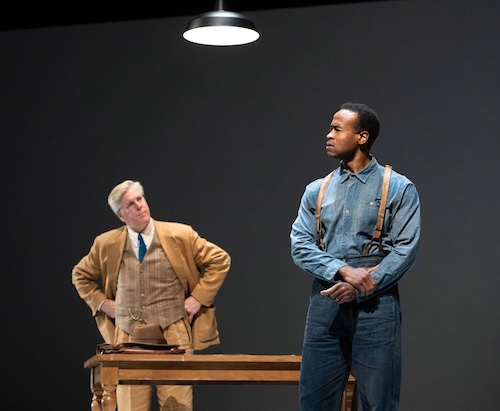
Rafael Jordan and Karl Kenzler in the Huntington Theatre Company production of Harper Lee’s To Kill a Mockingbird. Photo: Liza Vol
The Huntington Theater’s production of To Kill a Mockingbird is the first regional staging of Aaron Sorkin’s adaptation, which debuted on Broadway in 2018. The play’s official title, Harper Lee’s To Kill a Mockingbird, grabs us by the collar and insists that we remember whose story this is: Lee’s, not Sorkin’s.
Despite that insistence, this is very much Sorkin’s To Kill a Mockingbird. Lee’s estate apparently thought so, too: it sued over the adaptation, eventually settling after the playwright made minor revisions. Sorkin has said that his first draft essentially reproduced Lee’s novel, with stage directions added. It didn’t work.
For one thing, the novel’s treatment of race exposed the distance between 1960, when it was published, and the present. Its two principal Black figures—Tom Robinson, the defendant, and Calpurnia, attorney Atticus Finch’s maid—barely register as fully realized characters. Apart from Tom’s courtroom testimony, they have few lines and little voice. In Sorkin’s words, they are there for “atmosphere.”
In Sorkin’s version, Calpurnia (who is still the only character not dignified with a last name) is not only allowed to speak but also uses her voice to challenge the perceptions and assumptions of Atticus. She is the embodiment of hard-won wisdom and, as such, is even more of a moral arbiter than is Atticus.
Those who cherish the novel’s principled Atticus or Gregory Peck’s granite-jawed incarnation will find their memories challenged here. Atticus’s idealism—“There is goodness in everyone, you just have to be fair enough to see it”—becomes not his great strength but his fatal flaw. He embodies the limits of empathy in a world where evil cannot simply be stared down. Challenging endemic racism demands more than some version of “there are good people on both sides.” Atticus repeatedly urges his daughter, Scout, to spend time “crawling around under someone else’s skin,” seemingly oblivious to the possibility that doing so might make her own skin crawl.
Any actor playing Atticus Finch faces the unenviable task of following Gregory Peck on film and Jeff Daniels on Broadway. But the challenge goes beyond those predecessors: Atticus can too easily become virtue personified—empathy or courage on legs—rather than a fully realized character. Sorkin’s script pulls him down from his pedestal, but the actor must still give him flesh and blood.
The challenge is particularly acute in a staged version of Mockingbird. In the novel and the film, we see Atticus through Scout’s adoring eyes. Her admiration shapes our own, even as it limits her understanding of him. In Sorkin’s adaptation, the audience must confront Atticus more directly, beyond his loving daughter’s gaze. Thankfully, Karl Kenzler gives us a more complex, less polished Atticus than we are used to seeing. Like his rumpled linen suit, he shows some creases. He is less an ideal than a recognizable human being.
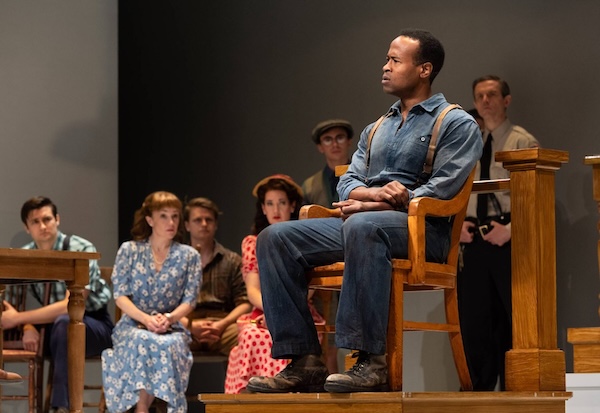
Rafael Jordan and the cast of the Huntington Theatre Company production of Harper Lee’s To Kill a Mockingbird. Photo: Liza Voll
Sorkin has the three children—Scout, Jem, and Dill—played by adults, a choice that creates its own challenge: making us believe in them as children. Of the three, only Karen Killeen, as Scout, fully succeeds. Her speech captures a young girl’s rhythms, mixing confident assertion with self-conscious hesitation. She moves with the ungainliness of someone just beginning to grow into her body.
The other two actors portraying children fare less well. As Scout’s brother Jem, Benjamin Izaak is simply too big to pass for a child. In one scene, the mismatch becomes unintentionally comical. When a gang threatens Atticus, Jem wants to take them on—a sweet but misguided impulse in a young boy. But this Jem looks big and buff enough to handle the whole gang. It is harder to believe that Atticus could hold him back.
Andrew Stevens Purdy has little to work with as Dill, Scout and Jem’s friend. It doesn’t help that he resembles a young Rick Moranis sporting a goofy Jerry Lewis grin. The character seems superfluous, perhaps intended as comic relief but mostly just annoying.
In fact, none of the scenes centered on the children measures up to the rest of the play. Nor does the odd directorial choice to place them prominently in the courtroom, where they sometimes wander, sometimes follow the proceedings, and always distract.
The cast’s standout is Jackie Scholl as Mayella Ewell, who has accused Tom Robinson of rape. On the stand, she squirms and twitches, giving way to anxious fury. To call her performance hard to watch is a compliment.
For the most part, the set does the play few favors. The featureless flats are just that—flat. They also leave the wings exposed to no discernible purpose, as though someone ran out of building material. One element, however, is wonderfully evocative: an enormous tree, draped in Spanish moss, stretches across half the stage from high above. It remains throughout the play, a silent witness to all that transpires—and a threat. No one needs to say that this tree could become an accomplice to a lynching.
To Kill a Mockingbird—as novel, film, or play—remains worth telling and interpreting anew. Calling it a classic does it no favors if the designation means preserving it in amber. This production does more than summon a cherished story. It invites us to engage with it afresh.
Martin B. Copenhaver is a retired pastor and seminary president who lives in Woodstock, Vermont, and Cambridge. Once upon a time, he studied theater criticism with Stanley Kauffmann.
Tagged: Aaron Sorkin, Atticus Finch, Boston-theater, Harper Lee, Huntington Theatre, Jackie Scholl, Karen Killeen, Karl Kenzler, literary adaptations, racial injustice, theater-reviews