
Concert and Album Review: Threadgill, Iyer, and Prieto — Fifteen Years, One Distinctive Voice
By Jon Garelick
At Harvard, the 82-year-old composer-saxophonist joined Vijay Iyer and Dafnis Prieto for a taut, wide-ranging evening of angular melody, open space, and rhythmic surprise.
“Fifteen”: Henry Threadgill, Vijay Iyer, Dafnis Prieto At John Knowles Paine Hall, Harvard University, October 8.
Fifteen (Nonesuch Records)
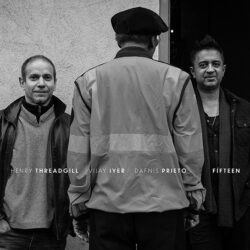 Henry Threadgill, now 82, has been a singular force in jazz since his first recordings with the trio Air in the ’70s. Nurtured in Chicago’s fertile avant-garde jazz scene and an early member of the Association for the Advancement of Creative Musicians, he has made music that, pretty much since its inception, has been as likely to draw from John Cage and Anton Webern as from Charlie Parker or Miles Davis.
At Harvard’s John Knowles Paine Concert Hall on October 8, in a free concert presented by the Harvard Music Department and the school’s ArtsThursdays series, Threadgill performed with pianist Vijay Iyer and percussionist Dafnis Prieto in “Fifteen,” a program named for the number of years over which the trio has made its sporadic appearances and the title of their debut album from Nonesuch. This is an illustrious ensemble. Among its many laurels, Iyer, 54, a Harvard professor, and Prieto, 52, are both MacArthur “genius” Fellows. Aside from being a generation older, Threadgill is the recipient of a Pulitzer Prize (2016, for In for a Penny, In for a Pound). He’s clearly the Big Dog in this cooperative venture, which features compositions from all three.
In recent years, Threadgill’s own recordings have been as likely to feature him as composer/conductor as instrumentalist, so it was a treat to hear him playing alto saxophone, flute, and upright bass flute at this show. His sound — to these ears and to a fellow saxophonist I talked to after the show — was undiminished.
This was the second local appearance by this trio, after one at the ICA back in 2025 (reviewed for The Arts Fuse by Paul Robicheau). It followed the August release of the Nonesuch record as well as another from Threadgill’s long-running Zooid ensemble, Cut You Where You Was, on Pi. At the Harvard show, the trio performed all eight songs from Fifteen.
Except for the opener, Threadgill’s “Sail,” which I could find documented only as having been performed at Ornette Coleman’s funeral service in 2015. Here Threadgill played the rarely seen (by me) upright bass flute, eliciting a gently haunting sound over Iyer’s spare bass notes and Prieto’s soft mallet cymbal splashes.
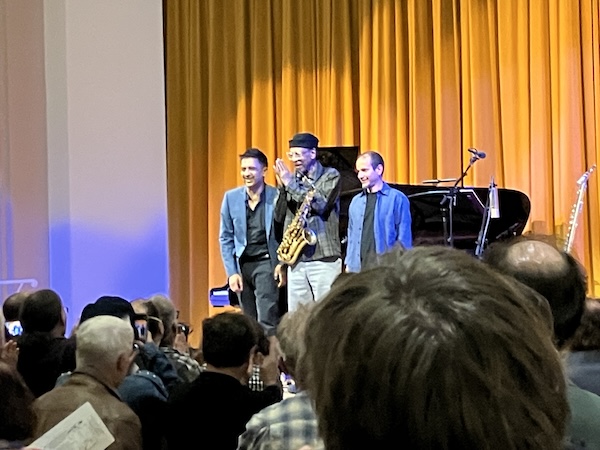
(r to l) Vijay Iyer, Henry Threadgill, and Dafnis Prieto at Harvard’s John Knowles Paine Concert Hall. Photo: Jon Garelick
Iyer’s “Fire City” sported Threadgill-like fragmentary angular phrases for alto and piano, with plenty of open space, building in velocity and texture before ending with a satisfying unison melody of piano and horn and a decrescendo and chiming cymbal from Prieto.
The next tune began with a soft martial roll from Prieto and a vamping bass progression from Iyer before becoming more declamatory and taking on a kind of gospel roll as Threadgill’s alto joined in. It turned out to be another Iyer original, “I Wanted a Map.” (None of the tunes was announced from the stage.)
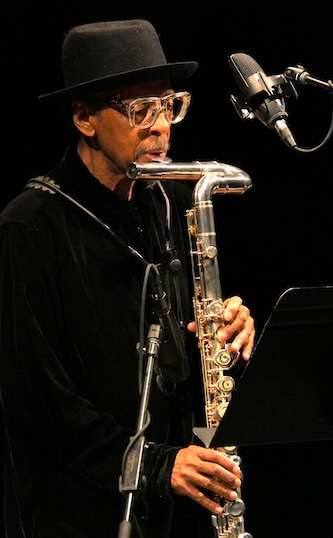
Henry Threadgill at the ICA in 2025. Photo Paul Robicheau
With “Trio Piece” we were back in serious Threadgill-land: short interlocking cells of rhythmic melody for flute and piano with Prieto — reading, for the first time that I saw — somehow nailing every displaced accent with just the right playful donk! of percussion block or ping of cymbal, maintaining its appealing herky-jerky groove and taking a compact solo. Everyone somehow ended together on a hard stop.
All these pieces were relatively short, and tightly arranged, but after “Trio Piece” a few people left. They missed what might have been a palate cleanser, Prieto’s “Gently Trapped,” which played like a ballad standard, fully chordal, with brushes and Threadgill’s flute giving gentle lyricism to the melody line.
Threadgill’s “Last Night” likewise almost had the medium groove of a pop tune by comparison with “Fire City” or “Trio Piece.” Here Iyer’s left hand, which had been active all night and was maybe freed up by the absence of a bass player, took on orchestral breadth and color, with Prieto’s phrasing and accents again girding the shape of it all.
How to describe Threadgill’s alto? Tart and sinewy, with quicksilver shifts in attack and dynamics, ringing top notes, and a vibrato that’s somehow, um, thready? He can sound at once technically commanding and emotionally raw. Whatever, it’s like no one else’s playing of the instrument these days that I know of.
By the last few tunes, Threadgill was freely exchanging broad smiles with the other players. Iyer’s “Prefect Victims” segued to Prieto’s “On the Way” without pause. The first was quiet and ominous, with Threadgill’s alto venturing ruminative phrases over tolling repeated arpeggiated figures from Iyer and Prieto’s bell-like cymbal hits. It built to a massive crescendo with Iyer smashing chords at either end of the keyboard. “On the Way” began with a tinkling opening treble piano pattern dancing along with Prieto’s clacking rims. Threadgill let the vamp build before joining in, and soon he was dancing too, literally so. The tune built in rhythmic waves, breaking for a flying solo from Iyer, a calibrated kitchen-sink solo from Prieto, and then Threadgill cueing the tune and a hard stop. Big cheers.
An encore of Threadgill’s “Where Coconuts Fall” (heard previously on his Make a Move ensemble’s 2001 Everybodys Mouth’s a Book) was a quiet benediction, Threadgill’s deepest long tones casting a final spell.
Jon Garelick is a former arts editor at The Boston Phoenix and Opinion page editor at The Boston Globe. He can be reached at [email protected].
Tagged: AACM, ArtsThursdays, Association for the Advancement of Creative Musicians, Boston Jazz, Cambridge MA, Dafnis Prieto, Fifteen, Harvard Music Department, Henry Threadgill, Jazz, John Knowles Paine Hall, MacArthur Fellows, Nonesuch Records, Pulitzer Prize, avant-garde jazz, concert review, contemporary jazz, creative jazz, harvard-university, jazz review
